
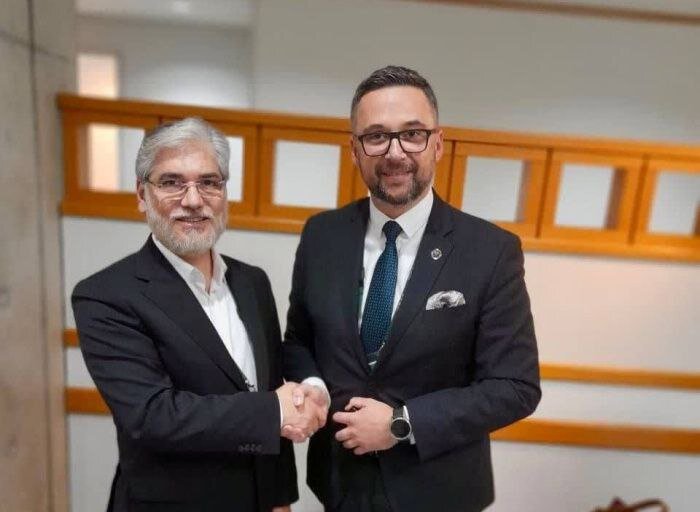
TEHRAN – Officials from Iran and Poland emphasized the importance of promoting scientific, research and technological cooperation between the two countries.
At a meeting held on Tuesday, Science Minister Hossein Simaj-Salaf and Polish Minister of Science and Higher Education Marcin Klasek agreed to revive the science and technology agreement.
Officials met on the sidelines of the Science and Technology Society (STS) Forum’s 22nd Annual Meeting, held in Kyoto, Japan, from October 5 to 7.
Both officials also exchanged invitations to visit each other’s countries and learn more about the university and its scientific achievements, msrt.ir reported.
Established in 2004, the Science and Technology in Society (STS) Forum is an annual international conference held in Kyoto every October. The 2025 edition will be held October 5-7 and will be the 22nd annual general meeting.
The forum provides a global platform for policymakers, business leaders, scientists, researchers and the press to discuss how science and technology can best serve humanity.
The event was attended by nearly 1,400 global leaders from more than 80 countries, regions and international organizations.
Iranian officials also met with Japanese officials. They emphasized leveraging the capabilities of the elites of both countries to improve scientific exchanges between the two countries, and maintaining and promoting scientific ties.
During the meeting, Simai-Sarraf called on Japan to increase the number of scholarships for Iranian students.
Successful model of science and technology development
In September, Mohammad Iqbal Chaudhry, Coordinator of the Standing Committee on Scientific and Technical Cooperation of the Organization of Islamic Cooperation (COMSTECH), highlighted Iran’s innovation and technological capabilities as one of the world’s most successful countries.
The official made this comment while referring to the inauguration of the Comstech Center in Tehran’s Pardis Technology Park.
Pardis Technology Park is the best model for the innovative ecosystem in West Asia, which has seen remarkable growth over the past two decades, IRNA quoted Chowdhury as saying.
The park’s infrastructure and extensive network play a vital role in promoting scientific cooperation in the Islamic world, and the establishment of a joint academy in the region will be a milestone in fostering joint advances in science and technology, officials said.
Iran ranks 72nd in technology and innovation
According to the United Nations Conference on Trade and Development (UNCTAD) 2025 Innovation Report, Iran is ranked as an upper middle income country, ranking 72nd out of 166 countries.
The country’s ranking improved by one place compared to 2022.
UNCTAD classifies 17 types of technologies as frontier technologies, including artificial intelligence, Internet of Things, big data, 5G, 3D printing, robotics, drone technology, solar power, concentrated solar power, biofuels, biogas and biomass, wind energy, green hydrogen, electric vehicles, nanotechnology, and gene editing.
The Technology and Innovation Report 2025: Inclusive Artificial Intelligence for Development explores the complex artificial intelligence landscape and aims to help decision makers design science, technology, and innovation policies that foster inclusive technological progress.
Report 2025 calls for an AI that puts humans first and is shaped through global cooperation where all countries have a voice. This report provides a broad socio-economic perspective on AI, identifying three key leveraging points: infrastructure, data, and skills, and analyzing requirements and policies to foster sustainable industrialization and innovation.
According to the Frontier Technology Readiness sub-index in 2025, Iran’s highest ranking is in the Research and Development sub-index (35th in the world).
In the financial sub-index, the country’s ranking improved from 62nd in 2022 to 56th in 2025. In other sub-indices, such as skills and information and communication technology establishment, the ranking fell from 74th and 78th in 2022 to 82nd and 94th, respectively, in 2025.
MT/MG