
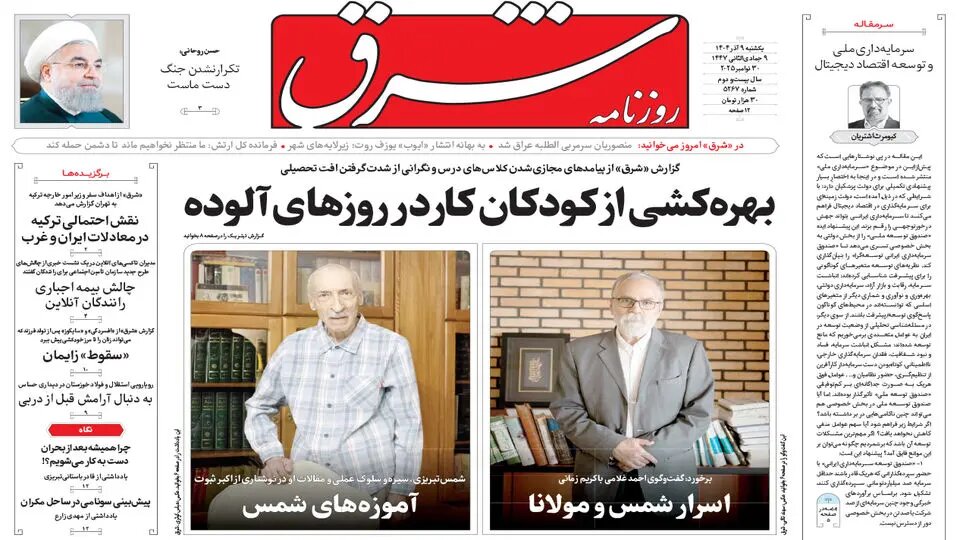
TEHRAN – Mr. Shah analyzed the escalating conflict between Pakistan and Afghanistan and Iran’s potential role as a mediator.
The paper claimed that at the same time as Ali Larijani’s visit to Pakistan last Monday, Islamabad resumed airstrikes against Afghanistan after the second round of talks broke down. This event indicates that the crisis between Pakistan and the Taliban is escalating into a full-scale war. If formal conflict erupts between Pakistan and the Taliban, the crisis could quickly spread to Iran’s eastern borders. In such a situation, it is not enough for the Ministry of Foreign Affairs to have telephone contact with regional officials, especially since Turkey and Qatar have also failed in their mediation efforts and are now turning their attention to Tehran. There is growing evidence of indirect US government involvement, strengthening analysis that the US green light may be causing a shift in the balance in Afghanistan. In that case, Iran’s lack of active involvement could result in its exclusion from the Eastern security equation. If Iran continues to take a passive stance, it may not only weaken Iran’s influence in the Afghan issue, but also increase the possibility of extra-regional intervention, strengthen the roles of Pakistan and Doha, and worsen border security.
Donya Ektesad: Carefully reflecting on her trip to Paris
Donya Ektesad reflected on the significance of Foreign Minister Aragushi’s recent visit to France. The paper quoted Rahman Ghalemanpour, a senior international affairs researcher, as saying that what makes Aragushi’s visit so important is the role France has played in Iran’s nuclear documentation over the past two decades. France has often sought to play the role of “good cop” in its relations with Iran. However, this trip should be carefully considered. The reason is that so far no significant progress has emerged from Washington. Moreover, Iran has no intention of withdrawing unless the United States asserts its position and meets Iran’s minimum demands of approval from the wealthy. Iran is waiting for the United States to take the first steps and create conditions for more constructive talks. Until that happens, the Iranian government perceives Washington’s approach not as a negotiation but as a demand for surrender that Iran cannot accept. The question now is whether France’s diplomatic initiatives will be pursued by Europe in the coming weeks, or whether they will be limited to bilateral issues such as the release of prisoners.
Arman M.M.Ruz: Is Europe an important link between Iran and Washington?
Arman Emrouz argues that Europe is ready to immediately assume the role of active mediator between Tehran and Washington if Iran takes confidence-building measures regarding its nuclear program. According to the newspaper, Germany’s permanent representative to the United Nations stressed in important remarks that Berlin continues to welcome negotiations with Iran over its nuclear program and sees the triggering of the snapback mechanism not as the end of diplomacy but as a serious warning for Iran to return to its commitments. Europeans now realize that without their active involvement, Tehran will either turn to other countries or bring the region to the brink of full-scale military conflict. The German envoy’s statement should be seen as a calculated message to Iran. On the one hand, it shows Europe’s firm determination to use all legal means if Iran persists on its current course. On the other hand, it continues to open the door to a return to diplomacy. If Iran is willing to pay the political costs of changing its position and take confidence-building steps, Europe is not only prepared to halt the snapback process but could also quickly assume the role of an active mediator between Iran and the United States. Thus, in contrast to the gloom of recent months, Europe is now a player wielding both the stick of the snapback mechanism and the carrot of negotiation, and is determined to use this combination to prevent nuclear disaster in the Middle East.
Iran: Tehran-Ankara cooperation model in regional transition
In an article about Turkish Foreign Minister Hakan Fidan’s visit to Tehran, Iranian newspapers wrote: Hakan Fidan’s visit within the framework of consultations on bilateral cooperation and regional documents once again emphasizes the importance of relations between the two neighbors in the regional structure. West Asia’s development, increased activity, and changing equations in the post-October 7 environment are accelerating the transformation of the regional order and forcing key actors to adopt long-term strategic roadmaps to secure their place in the emerging order. Among these actors, Iran and Turkey stand out as important players, the dynamics of their competition and cooperation shaped by their geopolitical capabilities and central geography, gaining importance under the management of conflicting interests and strengthening of commonalities. The Zionist regime’s separatist plans not only threaten Syria, but also cast a shadow of territorial division in Iraq, Iran, and Turkey. Israeli pressure on Türkiye in Syria may paradoxically create opportunities. If Tehran shows the will and initiative to seize it, the foundation could be laid for an effective Iranian presence in Syria’s development, even in the absence of formal ties with Damascus.