
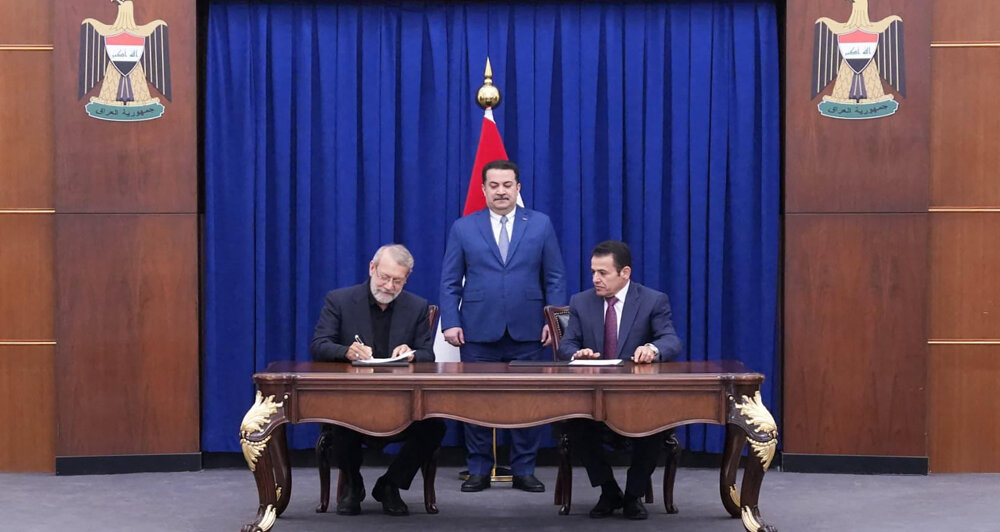
TEHRAN – Iran’s Chief National Security Council, Ali Larijani, stresses that Tehran and Baghdad should not allow third parties to undermine shared security and stability, and that the recently signed Iran-Iraq security agreement should not be pointed out as a model of regional cooperation.
In an interview with the TV show on Irib Channel 2, Larijani discussed his first official trip to Iraq and Lebanon in his new role, outlining Iran’s broader security outlook. He said local issues remain at the heart of Iran’s national interests and security strategies.
“Undoubtedly, regional issues have always been central to our national security. The Islamic Republic’s strategy is built with attention to the dynamics of these regions,” he said.
Larijani explained that two opposing approaches dominate the security environment. “One theory openly expressed by the United States and Israel argues that peace only comes through power. This essentially means either submission or war, and the consequences of such thoughts, as can be seen clearly in Syria, are chaos in the region.”
The “second theory” is to “achieving lasting security through the participation of local states where all countries are empowered. This is an approach Iran pursues: instead of promoting instability, it seeks to build stability.
Larijani said the central point of the Iran-Iraq agreement is that both sides pledge to prevent groups, actors, or foreign states from hampering mutual security or using one country’s territory against the other. “We must not allow third parties to infiltrate or disrupt the security of our two countries,” he emphasized. He added that his trip also includes discussions about strengthening cultural and economic cooperation.
Regarding the development of the wider region, Larijani said the US and Israel are consistently seped up the confusion. He recalls former US Secretary of State Hillary Clinton, who admitted Washington created the Dursh. “They did this to cause problems in Iran and Iraq and inflamed the Shia Sunni division despite the fact that these communities lived together for years. They exaggerated these differences and created discords.
However, he emphasized that recent conflicts have been different. “This time it was face-to-face. Americans were always hiding behind local events, but now they’ve taken the stage themselves. Their Defense Secretary explicitly ordered the bombing, and the Pentagon admitted that they had spent 10 years preparing for this attack.”
Larijani said the Israeli attacks prompted a strong national response within Iran. “People cultivated a unified understanding that they must face Israel. Even individuals who previously opposed the government aspects were taking part in the demonstrations saying that they came out because of Israel attacks.”
He added that a local leader told him. “The world is now seeing Iran’s national solidarity.” Larijani described this as an important cultural, political and social asset.
The chief security official said Washington and the Tel Aviv regimes assume Islamic countries will distance themselves from Iran, but the events have proven to be the opposite. “The Islamic government and people stood behind Iran, while the Europeans coincided with the US and Israel,” he said.
Larijani also detailed Iran’s military response. “The enemy believed the defense was unparalleled, but midway through the conflict, the Iranian missile strike completely baffled them. Officials from the senior region called him saying that Iran was over on the first day of the war.
He described the military operations against Israel against Iran as a major achievement, acknowledging its shortcomings. “The invasion of enemies within Iran is a serious problem. We had painful weaknesses, but we also had important strengths that we had to recognize,” he said.
Citing President Donald Trump, Larijani said: “Trump said that on his last day it was a hellish situation for both us and Netanyahu and saved Netanyahu.”
Still, Larijani warned of self-satisfaction. “We should not be rog arrogant. The enemy will study these developments and devise new methods. We must do the same and not rely on a single military approach,” he concluded.
Iran and Iraq signed a memorandum on August 11 to increase security along the shared border.
Previously in March 2023, Iran and Iraq had signed a security agreement that included coordination to protect the borders between the two countries. The agreement was primarily due to an increase in terrorist activity in the Kurdistan region of Iraqi. In response to the activities, Iranian Islamic Revolutionary Guard Corps (IRGC) has launched several rounds of airstrikes against their position since September 24, 2022, vowed to continue the attack until the group becomes unarmed.
The newly signed agreement sparked backlash from US officials. State Department spokesman Tammy Bruce said on August 12 that Washington supports “real Iraq, authentic Iraq’s sovereignty, not laws that turn Iraq into an Iranian satellite state.”
In response, Iraqi officials stressed that the agreement was not entirely new. National Security Advisor Al Aridi said the provisions had already been in place for some time.
The Iraqi Embassy in Washington also reaffirmed the country’s independence, saying “Iraq is not subordinate to the policies of other states, and its decisions are guided solely by an independent state will.”