
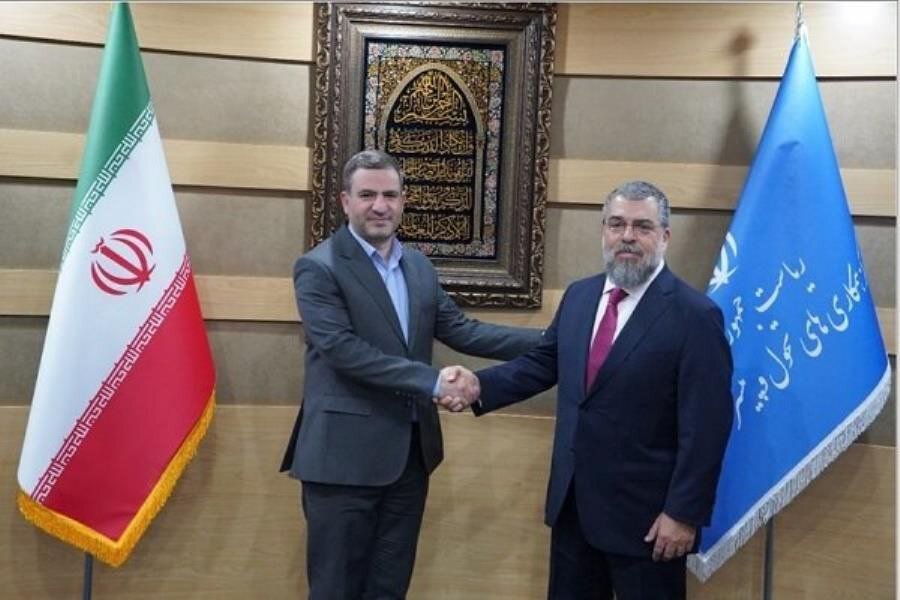
Tehran – Iran (CPDI) Progress and Development Centre Sajad Ahadzadeh, and Tehran’s Brazilian ambassador, Andre Bellas Guimares, discussed ways to promote cooperation between the two countries in the science and technology sector.
At a conference held in Tehran on Wednesday, Guimarès highlighted the membership of two countries of BRICS, the BLOC, a key platform for expanding regional cooperation and strengthening multilateralism. “BRICS, which accounts for more than half the world’s population and 40% of global GDP, has important potential to improve economic, political and scientific technological structures at the global level,” Mehr’s news agency quotes Guimarães as saying.
Officials also sought a deeper mutual understanding of the countries’ cultural and geopolitical positions to promote broadening trade relations and joint efforts between Iran and Brazil.
On his part, Ahdzadeh benefited from his potential, highlighting the importance of increasing bilateral and multilateral cooperation and referring to the 120-year relationship between the two countries and the partnerships in the fields of science, technology and innovation since 2009.
Authorities agreed to strengthen cooperation across a wide range of sectors, including agriculture and food security, artificial intelligence (AI), quantum technology and digital economy, minimal water consumption, AI in cognitive neuroscience, AI in oil and gas, and renewable energy.
It has reached the production of ethanol as Brazil’s main biofuel, manufacture joint electric vehicles, develop mineral exploration and exploration tools, extract crude oil in the deep seas of the Caspian Sea, and promote cooperation in the aerospace industry. Brazil will chair the BRICS Group in 2025.
Development of scientific relationships with BRICS
In April 2024, representatives from Iranian universities and institutions of higher education and the BRICS Specialist Council held a meeting in Tehran to discuss ways to expand scientific cooperation.
This was the first meeting on the topic of scientific research and technology initiatives.
During the meeting, Victoria Panova, the council director who is also vice-president of the HSE University in Russia, and Omid Rezaei-Far, an employee of the Ministry of Science, Research and Technology, explored ways to enhance scientific and technical connections.
“Despite the brutal sanctions, Iran has achieved many achievements in the fields of agriculture, biotechnology, technology and engineering science,” Irib cited Panova as saying.
She also said unlike what is imagined, the BRICS group is not just an economic group. From a science and technology perspective, it is here to introduce a large capacity of BRICS.
Panova emphasized Iran’s ability and preparation to expand scientific cooperation with member states of this international organization.
Rezaei-Far said the working group was soon established and is in line with BRICS’s educational activities. Academic members of each working group will work with BRICS to achieve their goals.
Emphasizing the high scientific capabilities of Iranian universities and science and technology parks, Lezaeifer announced that he is ready to participate in Iran’s BRICS scientific efforts, particularly skill training courses focused on innovation and technology.
The BRICS Group, consisting of Brazil, Russia, India, China and South Africa, was founded in 2009. It emerges as an important force shaping global economic debate.
mt/mg