
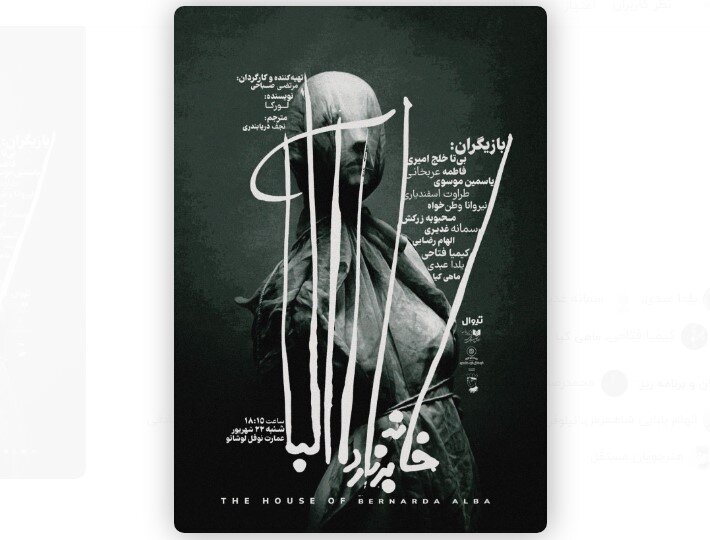
Tehran’s Neaful Le Chateau Theatre will host a reading performance in the famous play “House of Bernada Alba,” Federico Garcia Lorca’s famous play “Bernarda Alba,” on Saturday evening.
The performance will be directed by Morteza Sabahi, based on a translation of Persian by famous Iranian translator Najaf Daryabandari.
The play is read by a cast consisting of Elham Rezai, Mahbu Zarkesh, Yarda Abdi, Samane Gadiri, Nirvana Vatanha and Vita Karaj.
The three-act tragedy was published in 1936 as “La Casa de Bernarda Alba: Drama De Majeres Enros Pueblos Despana” (“The Drama of a Woman in a Village of Spain”). It constituted the third play in Lorca’s dramatic trilogy, which also includes “The Blood Wedding” and “Yerma,” and was first produced in Buenos Aires in 1945.
“The House of Bernarda Alba” centers around the oppressive family of Bernarda Alba, the protagonist who enforces strict rules after the death of her second husband. In observance of family traditions, she imposes an eight-year period of mourning, sequestering her five daughters, Angstia, Magdalena, Amelia, Martilio and Adela, from the outside world and romantic prospects, raising tensions within the home.
Bernarda’s eldest son, Angustia, inherits great fortune from her late father, and thus becomes the purpose of her desire for her young suitor, Pepe El Romano. This inheritance is brewed among her sisters, especially considering that little remains in her father. The wealth of Angustias gives her an agency feel. Her sisters are symbolized by her decision to wear a vibrant green gown and ignore her mother’s mourning dress code, especially when Adela, the youngest man who longs for freedom and happiness.
As the story unfolds, the dynamics of the home become more and more difficult. Adela’s initial spirit and desire for liberation are restrained when he discovers Angstias’s impending marriage to Pepe. Advising Adela, a family maid, Poncia, suggests that Angustia may not survive the birth, suggesting the harsh possibility that Adela will act on her desires. When the sisters get a glimpse of Pepe from time to time, Adela is torn between her burgeoning love for him and her loyalty to her family, and expectations and tensions intensify.
Emotional volatility reaches a breaking point when Bernarda discovers that Angustia, who wears makeup, discovers a violation of her strict mourning rules. In her rage, she forces her make-up, showing her tyrannical control and the oppression of her daughter. The situation intensifies as Maria Josepha, Bernarda’s older mother, as Maria Josepha, who is usually trapped in her room, expresses her longing for freedom and warns Bernarda about the destructive nature of oppression.
The secret events of Adela and Pepe are contrasts with the strict moral norms of the family, further amplifying tensions. Adela’s rebellion manifests in a destructive way, especially in her conflict with Martilio, who has her own feelings for her brother, especially Pepe. The family atmosphere is charged with jealousy, res, despair as gossip about local women who have been treated harshly for social violations deepens their collective fear.
As the play surges towards its tragic conclusion, Bernarda refuses to admit that her daughter’s emotional confusion will peak in violent conflict. When the shot is heard outside, it is initially assumed that Pepe was killed at Bernarda’s request. In a heartbreaking turn, Adela, who believes Pepe is dead, hangs in despair, unaware that he has survived, and takes her life.
In the aftermath of Adela’s tragic death, Bernada reveals herself obsessed with the family’s reputation, claiming that Adela is a virgin, a manifestation of her strict moral belief. She orders the rest of her daughters to grieve in private, and refuses to acknowledge the true nature of their struggles and the deep consequences of her oppressive domination. The play concludes with reminders of the devastating effects of tyranny and social expectations that have fallen into individual freedom and emotional connection.
sab/