
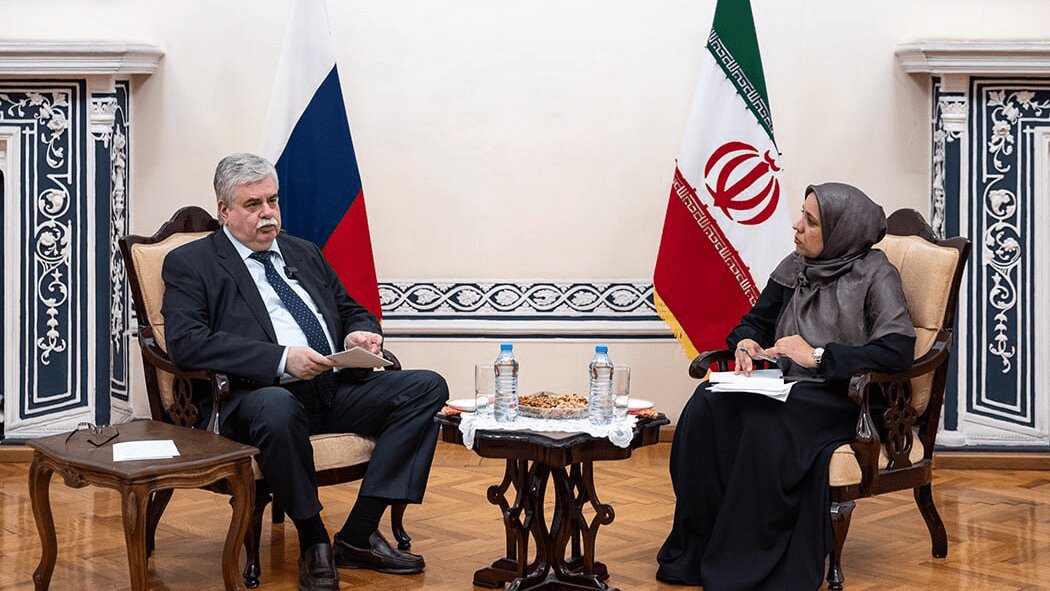
TEHRAN – Russia reiterated that its relations with Iran will continue to be guided by the Treaty of Comprehensive Strategic Partnership, stressing that Russia will not bow to external pressure or seek alternatives to close ties with Tehran.
“We once again emphasize that the strategic nature of our bilateral relations is guaranteed,” Russian Ambassador Alexei Yuryevich Dedov said in an exclusive interview published on Saturday.
Beyond cooperation in the field of peaceful nuclear energy, Ambassador Dedov highlighted several key areas of bilateral cooperation, including transport, logistics, construction of the Rasht-Astara railway, the North-South International Transport Corridor, and energy. “Under no circumstances will we negotiate under the pressure or coercion of a third party, and there are many prospects for advancing these efforts,” he said.
“Snapback sanctions are unacceptable and illegal.”
The ambassador strongly criticized Western attempts to trigger a snapback mechanism to reinstate previously lifted UN sanctions against Iran.
“We consider the activation of the snapback mechanism unacceptable and illegal,” Dedov said. “Any restrictions arising from the snapback mechanism are unacceptable to us. We insist that all provisions of UN Security Council Resolution 2231, including the envisaged restrictions, have been terminated.”
The snapback mechanism was formally activated in late August by the European signatories to the 2015 Joint Comprehensive Plan of Action (JCPOA) – the UK, Germany and France. On September 19, the UN Security Council voted against permanently lifting pre-JCPOA sanctions against Iran. On September 27, the Security Council also rejected a resolution proposed by Russia and China, which remain signatories to the JCPOA along with Iran after the US withdrew in 2018, to delay the reimposition of sanctions. The next day, E3 announced that UN sanctions against Iran had been officially reimposed.
“Russia will continue to cooperate with Iran based on the Comprehensive Strategic Treaty.”
Foreign Minister Dedov reiterated that Russia is fully prepared to continue cooperation with Iran under the provisions of the Treaty on Comprehensive Strategic Partnership. The treaty, signed in Russia on January 17, 2025 by Presidents Vladimir Putin and Massoud Pezeshkian, aims to deepen bilateral cooperation across multiple fields.
Under the agreement, Iran and Russia aim to strengthen cooperation in defense, energy, finance, transportation, industry, agriculture, culture, science and technology. The treaty marks a major step forward in bilateral relations and was described by Mr. Dedov as opening “a new chapter in the mutual relations between our two countries.”
Dedov added: “Oman’s mediation with Iran and the US is very active and positive.” “Iran has expressed satisfaction with Oman’s efforts, and Oman’s special representative recently visited Tehran and received the highest level of welcome.”
“Iran is one of the most important priorities of Russian foreign policy.”
Ambassador Dedov said that Iran is one of the most important priorities in Russia’s foreign policy. “Iran is an independent actor on the international stage, plays an important role in regional development, and is actively engaged in promoting a multipolar world,” he said.
He noted that Russia has consistently supported Iran’s efforts to secure full membership in the Shanghai Cooperation Organization (SCO), join BRICS, obtain observer status in the Eurasian Economic Union, and sign a free trade agreement with the Eurasian Economic Union.
“The relationship between Iran and Russia is strategic, not tactical,” Dedov stressed. “Despite changes in the international situation, both countries remain committed to the implementation of the treaty and its strategic nature remains unchanged.”
Cultural exchanges have also played an important role in strengthening bilateral relations. This year, Russian Culture Week was successfully held in Iran, and next year Iranian Culture Day is planned in Russia. A high-level delegation led by Iran’s Minister of Culture and Islamic Guidance Seyyed Abbas Salehi recently participated in the Unification Culture Conference in St. Petersburg. On November 24th, the first Eurasian Film Freedom Awards ceremony entitled “Diamond Butterfly” will be held in Moscow, with the participation of Iranian films.
“Joint project continues despite sanctions”
Construction of Units 2 and 3 of the Bushehr nuclear power plant, a joint effort between Iran and Russia, continues despite sanctions on both countries.
Dedov stressed that military cooperation between Tehran and Moscow is carried out in full accordance with international law and does not go against the interests of any third country.
Alexei Yuryevich Dedov is serving in his second diplomatic post in Iran. Previously, he served as deputy ambassador in Tehran from 2004 to 2009, and then as ambassador in Islamabad for six years from 2013.