
TEHRAN – Iran has slammed Canada for portraying itself as a global champion of human rights, saying the country should instead be grilled for its record of systemic racism and abuse against indigenous peoples.
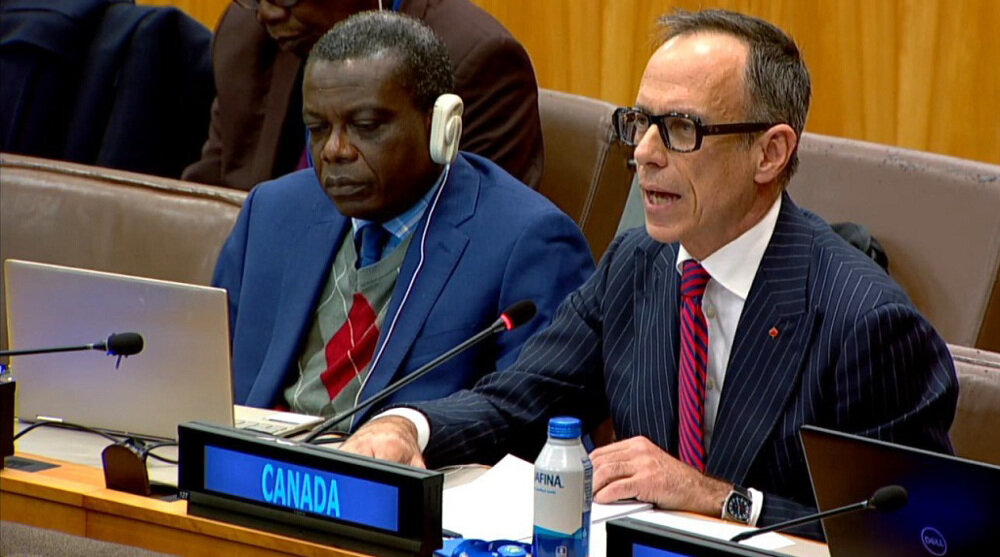
Iran’s mission to the United Nations criticized Ottawa in a statement Thursday after Canada welcomed the passage of an anti-Iranian human rights resolution drafted for the United Nations General Assembly’s Third Committee on Social, Humanitarian and Cultural Affairs.
“Please excuse Canada’s self-righteous remarks,” the envoy said. “This country, which has a well-documented history of thousands of indigenous children being buried in unmarked graves and which still grapples with deep-seated structural racism, now takes the position of global human rights advocates when it comes to Iran.”
The mission added that if human rights were not routinely used for political influence, Canada would be held accountable internationally.
“If ‘human rights’ were not weaponized by the usual suspects, Canada would be on trial – sitting in the dock under a resolution, not strutted on the world stage.”
On Wednesday, the UN’s Third Committee adopted a draft resolution titled “The Situation of Human Rights in the Islamic Republic of Iran” with 79 votes in favor, 28 against, and 63 abstentions.
The document reflects a politically motivated and selective assessment and “condemns what it describes as the alarming increase and continued use of the death penalty” in Iran, which the Iranian government rejects as inaccurate and biased representations.
Before the vote, Iran’s acting permanent representative to the UN, Gholamhossein Darji, rejected the resolution as “politically driven, selective and completely counterproductive.”
He said the accusations against Iran were based on “unverified claims and selectively interpreted information.”
Darji stressed that the resolution ignores Iran’s progress on human rights as well as its efforts to promote socio-economic development and strengthen legal protections in line with its constitution and international commitments.
He also criticized the lack of documentation condemning the blatant violations of international law committed by the Israeli regime and the United States during the 12-day military offensive against Iran in June.
Darji said the drafters deliberately omitted any mention of the negative impact that unilateral coercive measures would have on the human rights and welfare of Iranian people.
“We strongly believe that if human rights were not being misused as a political tool by certain countries, Canada, the main proponent of this draft, would itself be subject to this body’s resolution for its atrocities against indigenous communities, its disregard for the livelihood and economic conditions of its own people, and its military support for the Israeli regime, which is committing genocide and war crimes in the Occupied Palestinian Territories,” he said.
He concluded that these types of resolutions, divorced from reality on the ground, are “designed not to advance human rights but to apply political pressure.”
Despite frequent human rights defenses by Western governments, observers and several UN member states have noted instances of inconsistent approaches, particularly regarding developments in Palestine and Lebanon. While Western countries regularly issue resolutions and statements criticizing the human rights record of their rivals, they have been less vocal about Israeli military actions that have caused significant civilian casualties in Gaza and Lebanon. Analysts also point to continued Western arms sales to Israel, a veto in the United Nations Security Council of a resolution calling for an investigation, and a limited response to attacks on civilian infrastructure. These trends demonstrate continued concern over the selective application of human rights standards in international forums.