
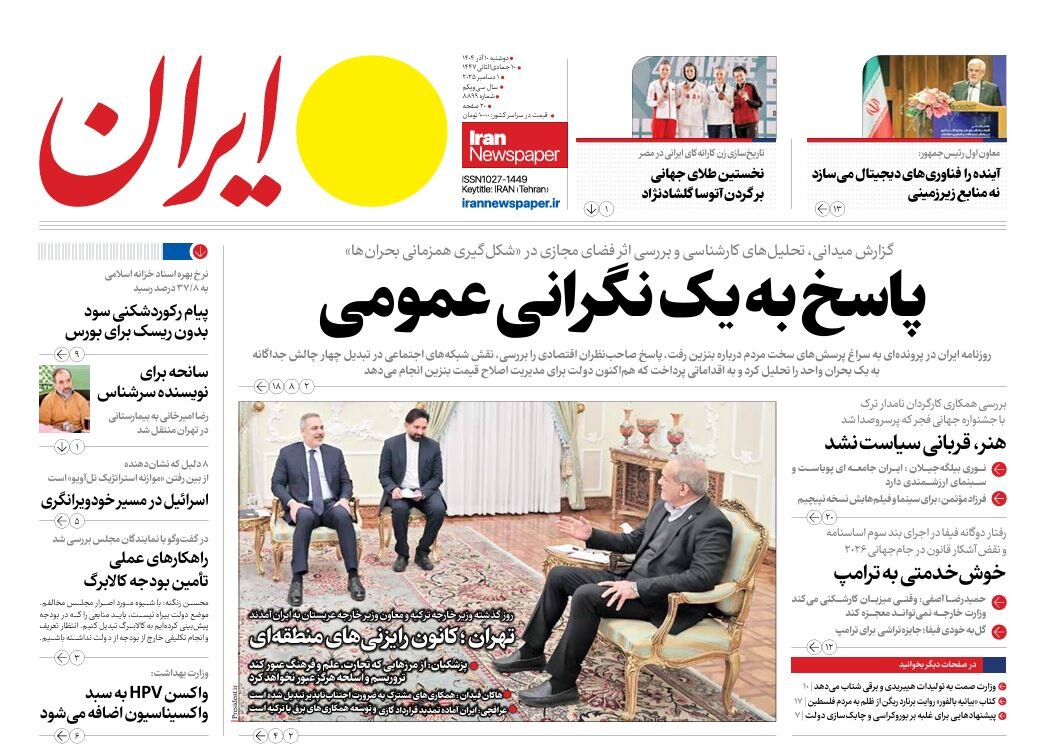
TEHRAN – Iranian newspapers analyzed the stay in Tehran of the Turkish Foreign Minister and the Saudi Deputy Foreign Minister.
“Turkish Foreign Minister Hakan Fidan and Saudi Arabia’s Parliamentary Vice-Minister Saud bin Mohammed Al-Sati visited Tehran to meet with Seyyed Abbas Araghchi,” the newspaper wrote. The simultaneous presence of Turkey’s foreign minister and a Saudi diplomat in Tehran symbolizes Iran’s importance in the regional equation and its role as a focal point for important dialogue in West Asia. The combination of these two visits reflects the reality that in today’s complex regional situation, Iran seeks to play an active role in crisis management, foster coordination among key actors, and pave the way for multilateral engagement. The significance of Hakan Fidan’s visit coincides with the gradual strengthening of regional relations between Tehran and Riyadh, and is seen as an expression of the two countries’ determination to expand cooperation in regional security and economic relations. Observers believe that enhanced economic and security cooperation could become a key pillar of regional stability and strengthen both countries’ roles in managing the crisis in West Asia.
Etemad: Opportunities ahead for Iran
Mr. Etemad provided an analysis of the opportunities arising from improved relations with Arab countries. The report argued that with improved relations with Arab countries, Iran faces an unprecedented opportunity to leverage its regional capabilities and strengthen its negotiating power vis-à-vis the West. One practical strategy is to institutionalize economic diplomacy with Arab partners. Cooperation within multilateral organizations and initiatives can also be very effective. The simultaneous presence of Iran and Arab states in the emerging political and economic institutions could form a coalition of developing countries against Western domination. Now that it is able to diversify, Iran must balance its foreign policy positions more effectively. Arab neighbors could become multiple pillars of Iran’s foreign policy, along with China and Russia. Improving Iran’s international image through regional diplomacy is equally important. Leveraging the media and propaganda capabilities of its Arab neighbors provides a powerful soft lever. Ultimately, if Iran’s influence in the Persian Gulf region becomes more pronounced, it will be difficult for Washington and Brussels (the European Union) to ignore or isolate Tehran, as Iran’s influential friends are in the capital.
Jam-e Jam: A strong bond between two neighbors
Mohammad Hassan Habibolazadeh, former Iranian ambassador to Ankara, analyzes Turkish Foreign Minister Hakan Fidan’s visit to Tehran. He tells Jam-e-Jam: Iran-Turkey relations in the past decades have developed under the simultaneous influence of geopolitical factors, changes in the regional security environment and the emergence of new patterns of economic cooperation. This development reflects the multi-layered interaction between the two countries. Contrary to some interpretations, these relationships are neither based solely on political rivalry nor limited to temporary and tactical cooperation. Rather, both countries follow a deeper logic that integrates political and security imperatives, geopolitical considerations, historical continuity, and economic capabilities within a pragmatic framework between the two neighbors. In recent years, regional developments, particularly changes in the balance of power in the Middle East, changes in the South Caucasus, and changes resulting from the Gaza crisis and the Eastern Mediterranean, have forced countries to recalibrate their perceptions of threats and opportunities. What distinguishes Iran-Turkey relations from many other bilateral relationships in the region is the ability of both sides to adopt a convergent approach while maintaining their respective perspectives. This ability stems from a series of factors, including geographic proximity, shared history and culture, long borders, interdependence on transportation routes, complementary economies, and mutual understanding. Together, these factors created an interdependence that significantly shaped the strategic behavior of both countries.
Mr. Armand et Meri: Efforts to build a deterrence coalition
Mr. Armand-e-Meri argued that the resurgence of unrest in Syria, Lebanon and Iraq shows that the Middle East is facing a new wave of instability. Great powers no longer play the decisive role they once played. The United States has reduced its focus, Russia is embroiled in a war in Europe, and China is more concerned with economic stability than involvement in security conflicts. As a result, regional countries are under pressure to take the initiative themselves and form new security structures. The simultaneous presence of Turkish and Saudi diplomatic officials in Tehran could signal an effort to form a deterrent coalition against the unpredictable actions of Israel and non-regional actors, especially as attacks on the territory of regional countries increase. At the same time, Turkey and Saudi Arabia may seek to de-escalate tensions between Iran and the United States to prevent the crisis from spreading throughout the region. Taken together, these factors clearly indicate that the Middle East is out of balance and its actors are recalibrating their relationships, security arrangements, and alliances. These moves could portend a new map of regional power. Although its contours are not yet fully defined, early signs of it are evident in these unexpected diplomatic efforts.