
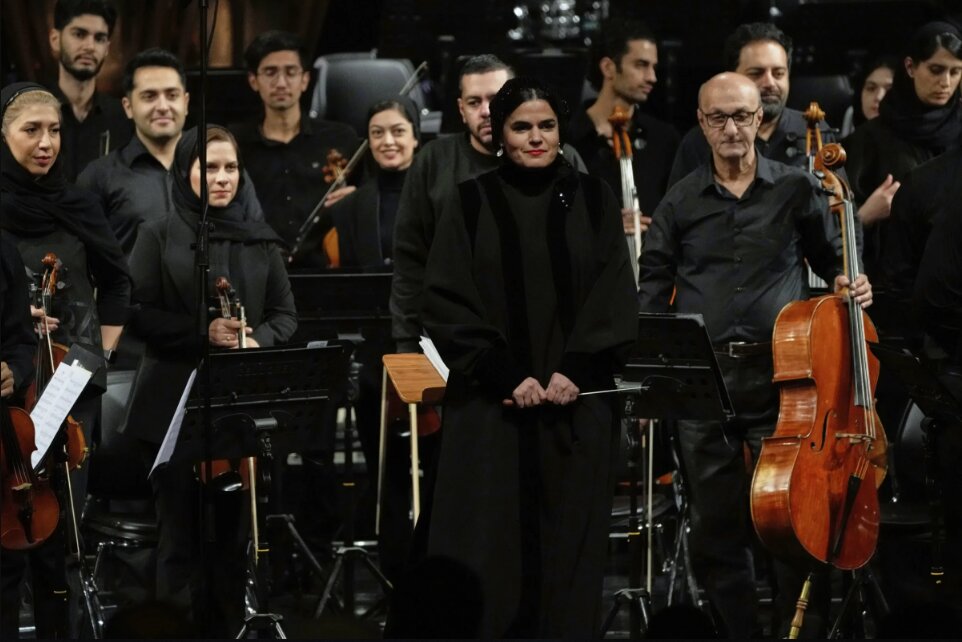
TEHRAN – The Tehran Symphony Orchestra performed the “Residences of Simurg” concert on Wednesday and Thursday at Vahdat Hall in Tehran under the baton of guest conductor Paniz Faryosefi.
Iranian musician, violinist and conductor Paniz Farosefi has become the first female conductor in the history of the Tehran Symphony Orchestra, IRNA reported.
The concert showcased a fusion of Iranian and international artistry, including works by Iranian female composers Aftab Darvisi and Golfam Hayyam, as well as world-renowned works by Franz Schubert, Jean Sibelius, and Aram Khachaturian.
Speaking at the end of the performance, Faryo Sefi acknowledged the Rudaki Foundation and the Orchestra’s Artistic Council for choosing her, and said the appointment was a sign of confidence and support for women in Iran’s classical music scene.
Mr. Faryosefi expressed his gratitude to Nasir Heydarian, the permanent conductor of the Tehran Symphony Orchestra, saying, “He has been caring and caring for me and the orchestra during this period, so that this concert can be held in the best possible manner.”
“I would like to dedicate tonight’s concert to all Iranian women and mothers, especially my mother, who has always wanted to see me as a leader,” Farosefi added.
At the end of the concert, the Rudaki Foundation honored Panis Farosefi, Golfam Khayyam and Aftab Darvisi by presenting them with plaques of appreciation and gifts.
Panis Faryosefi, 42, a graduate of the Tehran Conservatory and the Komitas State Conservatory in Yerevan, is the concertmaster of the Tehran Philharmonic Orchestra.
She is also the founder and leader of the Novak String Quartet and has appeared as an invited guest violinist with the New York Philharmonic.
Tehran-born Golfam Khayyam (43) is a composer and improviser. Her career reflects her unique musical language by integrating her native musical elements within the framework of contemporary experimental music.
She holds a Master of Music degree from the University of Cincinnati College of Music in the United States. I continued my studies at HEMGE (Switzerland) as an Interpreting Soloist and obtained a Master’s Degree in Composition. She is a visiting assistant professor at Tehran University of Arts.
Kayam has performed extensively as a performer and composer, and her music has been performed around the world, featured on the Elbphilharmonie, NPR’s songs we love, Danish Kulture Radio, BBC3, Deutschwelle, Royal Festival Hall, Ojai Festival, and more, spreading her musical message in a variety of projects.
The recipient of numerous competitions, scholarships, and awards, she was selected as a composer of choice at the Paris-based International Music Council’s Composer Rostrum in the “Windows on the World” category in 2016.
She received the HES-SO Full Fellowship Award for her research project on “New Vocabulary” which highlighted the concepts of synthesis and cross-cultural fusion in contemporary music.
He actively conducts workshops on the themes of improvisation and synthesis as a guest lecturer at the Aarhus Royal Conservatory, the Copenhagen Royal Conservatory, the University of Geneva, and the Lucerne College of Music.
Aftab Darbishi, 39, was born in Tehran. Started playing the violin at the age of 5, then switched to classical piano. She also learned several traditional Persian instruments, such as the kamancheh and setar, under the influence of her father, the renowned composer and musicologist Mohammad Reza Darvisi.
After studying piano at the University of Tehran, he moved to the Netherlands and studied film composition in Amsterdam and contemporary composition in The Hague. She is currently studying for a PhD in Composition at the University of Birmingham and is a regular guest lecturer at the University of Tehran.
Darvisi’s music reflects a rich diversity, combining aspects of his Western training with the deep influences of Persian music, sometimes using traditional instruments, structures, modes, and harmonies.
She writes music for film, theater, and concerts, and particularly enjoys interdisciplinary projects. Her work is heard all over the world. She has performed with ensembles such as the BBC Singers, Kronos Quartet, Orkest de Elepris, Helsinki Chamber Choir, Latvian Radio Choir, Riccioti Ensemble, and Orcnal. Darvisi became the first non-European woman to win the Tenso Young Composers Award in 2016.
The Tehran Symphony Orchestra was founded in 1933 and is Iran’s oldest and largest symphony orchestra. Founded as the City Symphony Orchestra by Gholamhossein Minbasyan, it took on its modern form in 1946 under Parviz Mahmoud.
Over the next few years, conductors such as Rubik (Ruben) Gregorian, Morteza Hanane, Heimo Tauber, Heshmat Sanjali, Farhad Meshkat, and Fereydun Naseri took over the reins of the orchestra.
The orchestra, which performs works by prominent Iranian and international composers, held more than 20 concerts at Vahdat Hall last year.
SS/SAB