
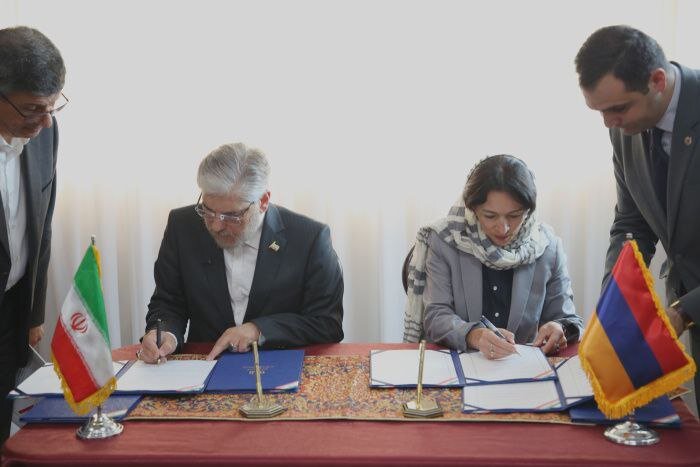
TEHRAN – Science Minister Hossain Shimaei Saraf and his Armenian counterpart Zhanna Andreasyan signed a Memorandum of Understanding (MOU) here on Monday to expand scientific cooperation between the two countries.
Emphasizing the historical commonality between Iran and Armenia, Armenian officials proposed to boost scientific cooperation by implementing joint research projects. Andreasyan also announced Armenian preparations to strengthen cooperation in teaching Persian language, focusing on iranology, MSRT.IR reported.
Referring to the establishment of Armenia in Academic City, officials said they are developing new scientific laws to promote the link between science and research. The main objective is to increase efficiency and scientific competition. Armenia plans to attract international students to the centre. She invited Iran to attend a meeting held on the issues mentioned.
Simaei-Sarraf has announced its willingness to share its expertise in technology parks and knowledge-based companies with Armenia.
The formula welcomed the idea of collaborating with collaborative scientific research and exchanging professors and students.
Both sides agreed to form a workgroup to follow up on the contract, address challenges and facilitate implementation of signed MOUs.
During the meeting, Ara Shaverdian, head of the Iranian-Aramenian friendship group, expressed his readiness to build a basis for the expansion of interaction between the two countries, and Said Habiba, head of student affairs, said 217 Iranian students were studying in Armenia.
Iran emphasizes fostering relations with its neighbours
In May, Farhad Yazdandoorst, an official from the Ministry of Science and Research and Technology, said the current administration is prioritizing promoting scientific cooperation with neighboring countries.
On the one hand, the high capacity of neighboring countries and the need to import Iranian science and technology bases on expanding relations, the IRNA quoted Yazdandoost as saying.
Authorities further say that since the Islamic Revolution in 1979, the country has made great strides in promoting science, technology and higher education. Additionally, they demonstrate these achievements through interactions with universities around the world. Typical examples are Iranian science elite, its achievements and overseas status.
President Masoud Pezeshkian’s administration is seeking to resume and promote collaboration with countries where science is on the agenda.
Therefore, scientific communication is not limited to neighbouring countries, he said. “We are strengthening our scientific and international partnerships with Independent States (CIS) countries.
It also plans to develop relationships with several non-neighboring countries that rely on external scientific support, importing scientific knowledge and sharing expertise.
Working with major Asian countries in science, such as China and South Korea, will help you become familiar with Iran’s potential.
mt/mg