
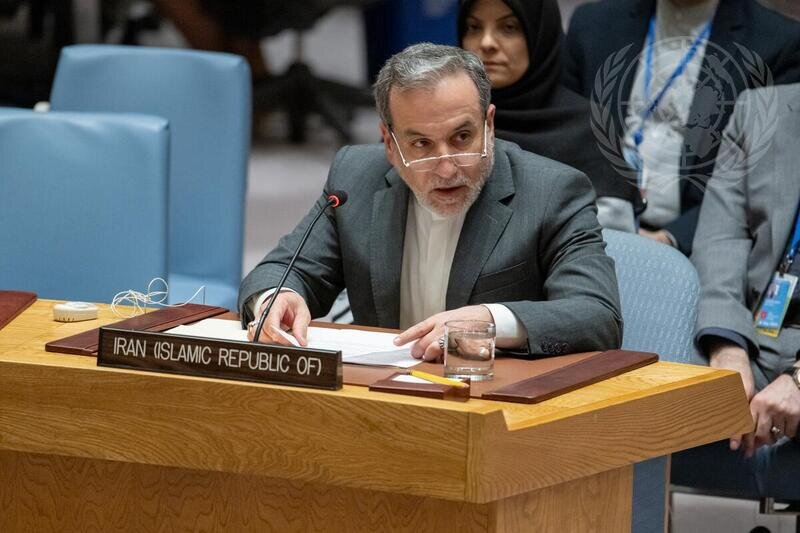
In a letter to the UN Secretary-General and the President of the Security Council, Iran’s Foreign Minister Seyed Abbas Araghchi stressed that with the termination of UN Security Council Resolution 2231, any claim to “revive” the expired resolution is essentially invalid.
The full text of Mr. Araguchi’s letter is below.
In the name of God, the Most Merciful, the Most Merciful
October 18, 2025
Your Excellency, in addition to my previous communications, including the latest of 27 September 2025 (A/80/406 to S/2025/602), I am honored to address you on the occasion of the final expiry and termination of Security Council resolution 2231 (2015) of 18 October 2025, in full compliance with its provisions. In this regard, I would like to reaffirm the position of the Islamic Republic of Iran as follows: Ten years ago, the Joint Comprehensive Plan of Action (JCPOA) entered into force with the approval of resolution 2231 (2015), reflecting a collective conviction that diplomacy and multilateral engagement remain the most effective means of addressing conflict. Remaining unwavering in its commitment to a peaceful resolution of the conflict, the Islamic Republic of Iran has accepted and fully implemented the JCPOA in good faith and strictly in accordance with its commitments.
Despite Iran’s full and verified compliance, the United States acted in clear violation of its obligations, first failing to fulfill its commitments and then unilaterally withdrawing from the agreement on May 8, 2018, and reimposing and expanding unlawful unilateral and extraterritorial sanctions. These coercive measures were in serious violation of international law and the United Nations Charter, and seriously impeded implementation of the JCPOA. Although the European participants, namely France, Germany, and the United Kingdom, initially promised to uphold the agreement and offset the US withdrawal, they not only failed to keep their commitments, but also imposed additional illegal sanctions on Iranian people and entities, thereby committing further serious violations of the JCPOA.
All of these serious incidents of gross non-compliance and egregious violations have been thoroughly documented over the past several years and have been formally brought to your attention and to members of the Security Council on numerous occasions.
In the face of these continued serious violations, the Islamic Republic of Iran exercised utmost restraint and undertook extensive diplomatic efforts to restore balance and preserve the agreement. After remaining in full compliance for a full year following the U.S. withdrawal, Iran acted fully within its rights under the JCPOA and adopted gradual, proportionate, and reversible remedial measures starting May 8, 2019. Thereafter, Iran worked constructively with the aim of ensuring the United States’ full return to the agreement and compliance with all EU/E3 obligations, and achieving full sanctions relief. Unfortunately, these efforts were hampered by the United States and the E3’s insistence on extremist demands and the maintenance of illegal unilateral sanctions, depriving Iran of the essential purpose of the JCPOA: the normalization of international economic relations.
Iran’s record of constructive engagement includes numerous consultations with European countries and even negotiations with the United States, demonstrating a consistent commitment to diplomacy. However, these good faith efforts were met with acts of sabotage and aggression against Iran’s secure and peaceful nuclear facilities. In recent months, instead of fulfilling their obligations, the three European countries have embarked on a campaign of political manipulation and legal distortion to weaponize the very mechanism of the so-called snapback against Iran.
Against this background, on August 28, 2025, the three European participating states launched a unilateral and arbitrary attempt to invoke the so-called “snapback” mechanism by bypassing the dispute resolution process established by the JCPOA and directly appealing to the Security Council, without any legal, legal or procedural basis or political legitimacy.
Two Security Council votes held on September 19 and 26, 2025 clearly demonstrated that there is no consensus among Council members regarding the validity of this purported notification. Just as the Security Council confirmed in 2020 that the US was not entitled to trigger this mechanism post-exit, the European notification similarly lacks legal basis and force. It does not serve as the basis for any action or decision regarding the status of Resolution 2231 or any previously terminated sanctions resolution.
As detailed in the joint letter of the Foreign Ministers of the Islamic Republic of Iran, the People’s Republic of China and the Russian Federation dated 28 August 2025 (A/79/1004-S/2025/546), the attempt by the European parties to invoke the so-called “notification” is procedurally flawed and effectively invalid. Any measures taken in disregard of Resolution 2231 cannot impose legal obligations on Member States. The voting record of the Security Council and the clear position expressed by its member states confirm that the so-called “notification” has no legal validity. Therefore, any claim to “revive” or “reinstate” a terminated resolution is void ab initio, lacks legal basis, and cannot create binding force.
Your Honor,
In light of the above, the Islamic Republic of Iran emphasizes that the procedure pursued by the three European countries is a clear abuse of process, contrary to both the letter and spirit of resolution 2231 (2015) and the JCPOA. Resolution 2231 therefore established a clear and limited framework for ending all previous resolutions regarding Iran’s peaceful nuclear program.
Pursuant to substantive Section 8, Resolution 2231 itself, and the “provisions set forth in Resolution 2231”, together with all previously terminated sanctions resolutions referenced therein, shall automatically terminate according to the schedule established by the Board. No subsequent decisions of the Security Council have extended, suspended, or otherwise modified this schedule. The September 2025 Board deliberations and votes confirmed beyond doubt that there was no consensus to amend or reinterpret the terms of the resolution.
In this regard, at the 19th Ministerial Conference of the Non-Aligned Movement (NAM) held in Kampala, Uganda on 15-16 October, the 121 member states of the movement emphasized in their final document the timely termination of resolution 2231: Underlines that its provisions and deadlines must be strictly respected. NAM further emphasizes that in accordance with paragraph 8 of resolution 2231, all provisions of the resolution should be terminated.
Further, resolution 2231 does not authorize either the Secretary-General or the Secretariat to decide, declare, reapply, or resubmit resolutions terminated under paragraph 8. Such an action would be extremely dangerous and exceed the powers conferred by the Charter and resolution 2231, and would be inconsistent with the Secretariat’s strictly administrative and impartial role under the Charter. The Secretariat is not a decision-making or interpretive body. The legal effects of Security Council decisions cannot be altered or extended, and unilateral declarations cannot bind Member States. Any “notification” or “confirmation” by the Secretariat that suggests otherwise is legally invalid and would undermine the organizational credibility of the United Nations.
Similarly, any attempt to re-establish or empower subsidiary bodies such as sanctions committees or expert panels lacks legal basis after the termination required by the provisions of section 8. No Member State, Secretariat or official may lawfully act in this regard without a new and clear decision of the Security Council.
As a result, resolution 2231 (2015) will remain in force until 18 October 2025, at which point, in accordance with implementing paragraph 8, all its provisions and those of the previously terminated sanctions resolutions will terminate and have no continuing legal effect. Previously terminated measures may not be reinstated or enforced after that date. Any such attempt will be considered illegal and void.
We would be grateful if you could distribute this letter as an official document of the General Assembly and the Security Council.
Sir, please accept my assurance of the utmost care.
Sayed Abbas Araghchi
Minister of Foreign Affairs
Mr. Antonio Guterres
general secretary
Your Excellency, United Nations, New York
Vasily A. Nebenzia
President of the Security Council
United Nations, New York
MNA/