
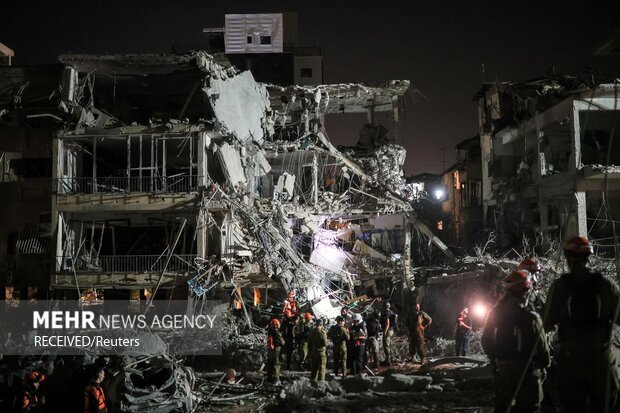
The 12-day war was one of the greatest defeats that the Zionist regime experienced in its fabricated history. According to Ayatollah Seyyed Ali Khamenei, leader of the Islamic Revolution, the invasion was the result of Israel’s 20-year plan to confront Iran, which has completely failed. Due to strict media censorship in the occupied territories, actual statistics on the damage have not been fully published, but a review of accounts from Israeli officials and media indicates that the Tel Aviv regime suffered significant economic, military, and social losses. Although these statistics represent only a fraction of the true scale of the crisis, they clearly demonstrate why Tel Aviv wanted a ceasefire after 12 days.
Israeli officials admit failure
One of the most prominent statements came from Maj. Gen. Giora Eiland, former head of the Israeli Security Council. In an interview with Israeli media, he said that Israel’s interest lies in ending the war and accepting a ceasefire. It was not to their advantage to continue the war.
These statements directly reflect a perceived failure in achieving strategic goals. Eiland said the costs of continuing the war, including economic damage and international pressure, outweighed the potential benefits.
Former Israeli Prime Minister Ehud Olmert also commented on the 12-day war, saying that Iranian missiles caused severe damage to Israeli cities and that Iran has no intention of coexisting peacefully with Israel. This clear admission signals that the administration’s 20-year plan to confront Iran has failed.
Israeli media analysts also publicly expressed concerns. A Channel 12 reporter said: “We failed to defeat Iran and we will pay the price in the future.” Yossi Yehoshua, a military analyst at Yedioth Ahronoth, stressed that even with all its resources, Israel cannot achieve victory against Iran. Channel 12 reported that Iran still does not use long-range weapons or heavy missiles, and Marib newspaper acknowledged that Iran has come out of the war stronger than before.
monetary and economic damages;
According to the Israeli tax authority, 41,651 claims for damages have been registered since the start of the war with Iran.
32,975 claims related to building damage
4,119 vehicle-related complaints
4,456 equipment and property claims
It is estimated that thousands of damaged buildings remain unregistered. Maariv economic analyst Shlomo Maoz wrote that Israel’s 12-day military operation cost about $16 billion, and the regime’s GDP was affected by the same amount.
The disruption to daily economic activities resulted in losses of approximately $1.5 billion and paralyzed sectors such as high-tech, transportation, tourism, restaurants, and industry. Airport closures and flight suspensions also put further pressure on the economy. Even if we assume that half of the damage will be compensated in the future, there will still be a loss of approximately $8 billion, equivalent to 1.3% of Israel’s GDP.
military and defense spending
Israel’s average daily military spending was $725 million, for a total of $8.7 billion over the 12 days. This figure includes air strikes, F-35 fighter jet operations, and the use of various munitions. Advanced missile defense systems such as Iron Dome, Arrow, and David Sling cost between $10 million and $200 million per day to operate. Interceptor missiles cost between $700,000 and $4 million each, with total defense and military spending estimated at $12.2 billion over a 12-day period.
Damage caused by Iranian attack
Iranian missile attacks caused approximately $3 billion in direct infrastructure damage. Key targets included the Haifa oil refinery, the Weizmann Institute, and military facilities in Tel Aviv. Israeli tax authorities initially estimated damages at $1.3 billion, but they are now expected to exceed $1.5 billion, double the direct damages from previous Iranian retaliatory attacks. More than 18,000 people have been forced to evacuate their homes, and emergency accommodation costs are estimated at $500 million. Rebuilding infrastructure and housing will take years and tens of billions of dollars.
Macroeconomic impact
After the war’s failure, Israel’s budget deficit increased to 6% of GDP, and defense spending reached 20-30 billion shekels. The Bank of Israel lowered its economic growth forecast for 2025 to 3.5% and estimated war costs at 1% of GDP (about $5.9 billion). Government credit ratings have also been affected, with Standard & Poor’s and Fitch issuing warnings. The United States spent approximately $1 billion to $1.2 billion to protect Israel, primarily using the THAAD system, but refrained from further escalation because it failed to achieve its initial objectives.
conclusion
The 12-day war between Israel and Iran was one of the most costly and unsuccessful periods in the history of the Zionist regime. Statistics and official statements have reported the economic cost to Israel to be between $12 billion and $20 billion, although comprehensive estimates suggest it is $40 billion.
Main costs include:
Direct military spending: $12.2 billion
Economic disruption and business closures: $21.4 billion
Damages from Iran attack: $4.5 billion
Cost of evacuation and reconstruction: $2 billion
Even taking into account Israel’s official statistics, these numbers demonstrate that the economic, military, and social pressures on Israel are severe. The long-term effects remain, including budget deficits, slowing economic growth, damage to tourism, an exodus of professionals and a decline in investor confidence. In the end, the 12-day war proved that Israel’s 20-year plan to confront Iran had failed, and Tel Aviv was forced to seek a ceasefire to prevent further losses and economic collapse. This account, based on the confessions of Israelis themselves and their media sources, clearly shows the real scale of defeat and damage and shows that, despite all claims and rhetoric, the Zionist regime was almost paralyzed by the pressure of the Islamic Republic of Iran.
MNA/6671353