
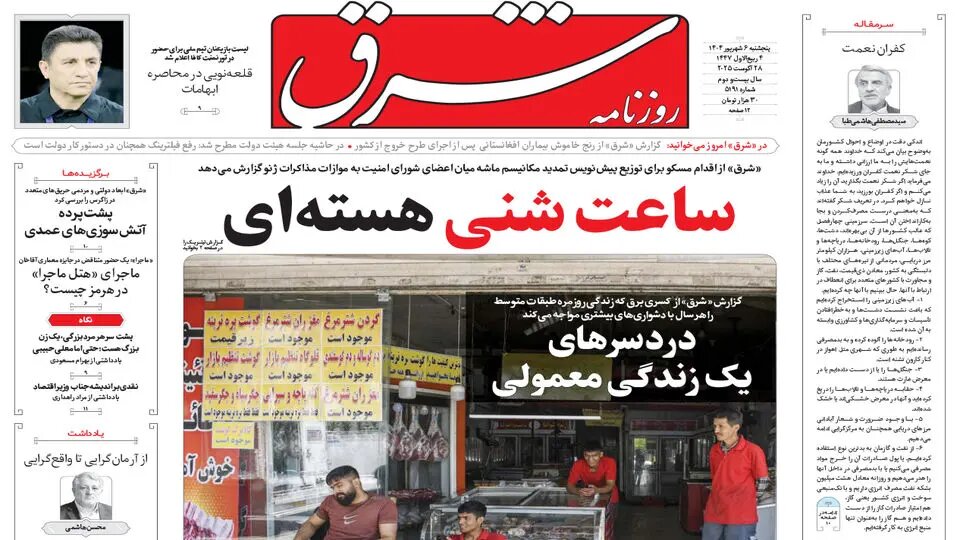
Tehran – In a memo, Sharg discussed the activation of European troika in the snapback mechanism against Iran.
It writes: The European Troika decision to send a letter to the Security Council and launch a snapback mechanism process once again put Iran’s nuclear issue at the heart of global politics. The action not only revives longstanding tensions surrounding the implementation of JCPOA, but also exposes the complex equations of global power interaction with Iran. France, Germany and the UK are pursuing a process of returning UN sanctions under the assertion that Iran is violating its nuclear commitments. At the same time, Iran’s mission to the United Nations describes the present moment as fate, and considers it a test of European integrity claims in supporting diplomacy. The US is openly supporting Europe’s actions and is looking at it in line with previous pressures. Washington aims to frame the measure in an effort to undermine Iran’s nuclear deterrence. However, recent developments demonstrate that the JCPOA crisis goes beyond mere legal disagreements, from the Israeli US joint strike in Iran two months ago to Tehran’s subsequent responses. It is increasingly emerging within a broader security and geopolitical framework.
Farhikhtegan: Snapback Gambling and Iran’s Future Options
In his commentary, Fahhictegan wrote: We observed that despite indirect negotiations between Iran and the United States, the US side supported the Zionist regime and took part in a war that targeted Iran’s nuclear infrastructure. Given this experience, political action towards Iran’s nuclear program is considered a prelude to escalate tensions. The withdrawal from the NPT was just one of the steps Iran threatened to take if the snapback mechanism was invoked. Iran could significantly increase its enrichment capacity, in addition to suppressing the International Atomic Energy Agency (IAEA) from excessive surveillance activities by installing more sophisticated centrifuges. Focusing on the design and construction of new generation centrifuges, or launching the uranium metal production chain is another strategic step that could further strengthen Iran’s technical position. Iran has also been able to misuse the enriched uranium stockpile for applications well known to Western parties and institutions.
Hamshahri: Islamic Republic missile power
In the analysis, Hamshali discussed the power and technology of Iranian missiles. It writes: The defense and deterrence of the Islamic Republic of Iran is formed based on a set of key elements. One of the most important components of this power is missile capabilities. Iran is one of the world’s highly regarded countries in missile technology. This strategic ability was well demonstrated, especially during the sacred defense of 12 days in June. It proved its effectiveness. Iran’s Islamic Republic has demonstrated the critical power of missile technology as it has a variety of missiles with varying ranges and capabilities. Achieving this level of missile power is the result of years of continuous efforts despite complex security conditions and external pressures. We are now entering a new, more advanced stage. Over 90% of the equipment the military needs are produced domestically, particularly in the missile technology field. Both solid and liquid fuel missiles are 100% domestically manufactured and are foreign-independent.
Iran: Opportunities to collaborate with BRICS
Iran’s BRICS membership has been considered one of Iran’s most important foreign policy achievements in recent years. The action will not only provide new opportunities for Iran to play a role in the world’s new multilateral structures, but also provide a platform for expanding institutionalized cooperation with the “Global South.” Since its formation, the bloc’s most important role has been concentrated on the global economy. Official members of Iran’s BRICS, coupled with structural transformations in the economic bloc, provide important opportunities to improve Iran’s position in the new international order. BRICS will play a more effective role in regulating multipolar architectures, especially at the 2025 Summit, by deepening cooperation in the form of development-oriented programs, particularly in the areas of finance, technology, energy and global governance. Therefore, the need to utilize the agency’s capabilities for Iran is more felt than ever before. With this framework, Iran’s role in this group is invaluable based on the decisions of the BRICS Summit. (The 17th BRICS Summit was held in Rio de Janeiro, Brazil from July 6-7. The summit was held under the theme of “Strengthening global Southern cooperation and promoting more inclusive and sustainable global governance.”)