
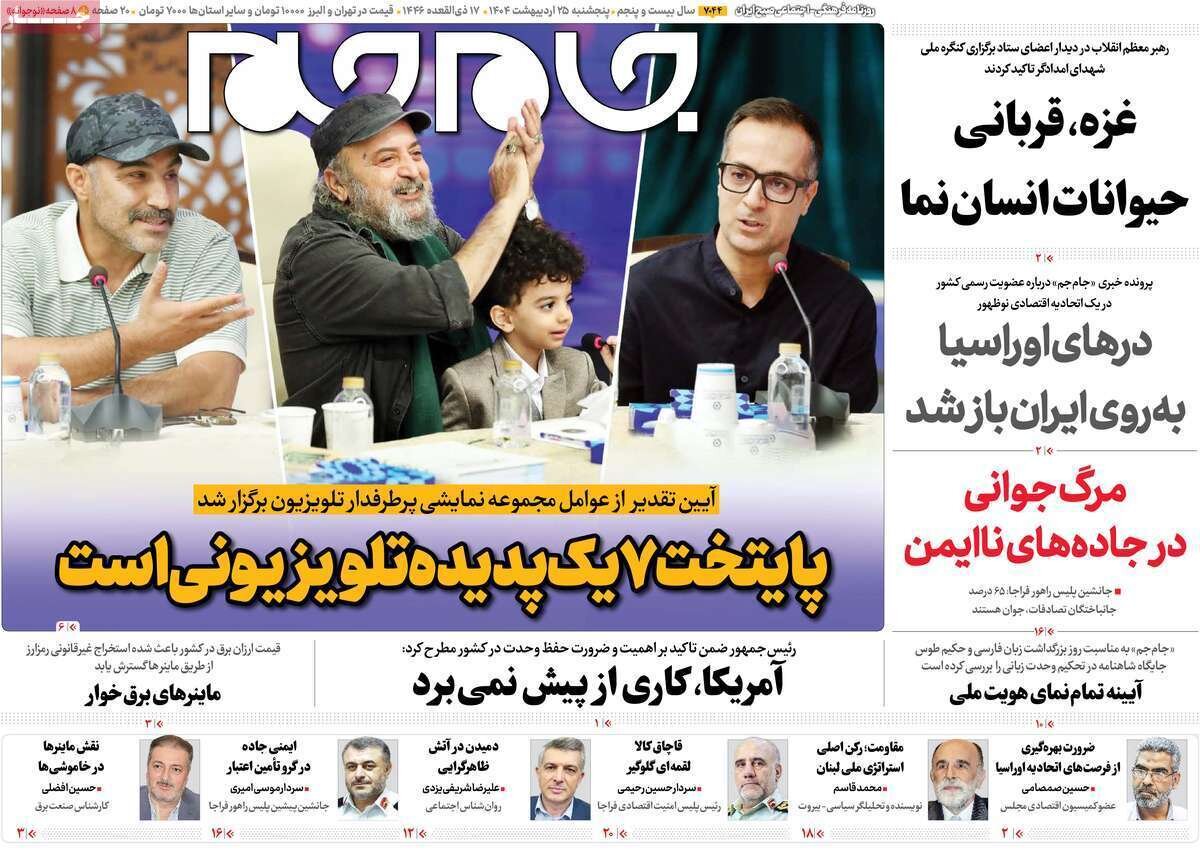
Tehran-Jam et Jam wrote about Iran’s free trade agreement with the Eurasian Economic Union. This agreement is a document that goes beyond the economic contract. This is a geoeconomic turning point that can bring Iran from the periphery of the world economy to the heart of a dynamic network of regional trade.
The world is entering a new order. From Southeast Asia to Eurasia, regional economic alliances are redefine new rules of trade and power. At the heart of the most important trade routes, including the north-south and east-west corridors, the Islamic Republic of Iran currently has an unprecedented opportunity to redefine its position with the revitalization of permanent membership in the Eurasian free trade agreement and the implementation of tariff regulations. If Iran can accelerate the completion of joint infrastructure projects such as the North-South Corridor with Eurasian members such as Russia, it could consolidate its position as a transport hub. However, this requires political adjustment and overcoming diplomatic obstacles. This is challenging given the geopolitical complexity of the region.
Etemad: Steps to Leave the FATF Blacklist
Etemad discussed Parermo’s approval of Parermo in an interview with Mohammad Sadr, a former vice minister and current member of the council. He said: In the news of Trump’s travel to the region, many Iranians have followed Trump’s statement and are looking for a positive or negative pulse on the possibility of an agreement between Iran and the United States, news of the approval of the Palermo bill has attracted the attention of many Iranians and economic and political activists. The decision comes after many efforts by the 14th government to resume research on the Palermo and the CFT bill, bringing Iran a step closer to the smoothness of trade, economic and banking relations (with the outside world). The FATF blacklisting resulted in other countries, even many more friendly countries, being cautious about trade and economic relations with Iran, and indirectly at high risk for all kinds of trade and economic relations with Iran. Fortunately, approval of this bill compensates for the loss of not approving it. Of course, approval of these bills does not mean that all issues will be resolved, but measures will be taken to improve Iran’s trade situation with the world.
Javan: The claim of maximum pressure campaigns is counterproductive
In the analysis, Jawan tackled Trump’s counterproductive remarks. It writes as follows: The hostile statement has improved to some degree the atmosphere of indirect (nuclear) talks between Iran and the United States, and hostile statements have been made while there is hope for a possible agreement. But Trump’s provocative tone not only helps to advance diplomatic talks, but it could also hamper the path to interaction. Trump’s call for the implementation of sanctions on Iran is a revival of the same policy, previously known as “maximum pressure.” Trump’s return to this strategy shows that he is still obsessed with a failed campaign of the past. Therefore, if Trump really wants to reach a permanent agreement with Iran, he must abandon unilateral and contradictory policies and look to build trust and mutual respect instead of pressure. Otherwise, negotiation claims are merely a political show, not a strategy for a real solution to the crisis. Experience shows that pressure not only produces desirable outcomes, but also paves the way for further conflict.
Ham Mihan: The chances of contracting are small but serious
During the commentary, Ham Mihan discussed talks between Trump and Iran. The paper was brought together US and Iranian negotiators for a fourth round of nuclear talks. Both sides are still far apart on the underlying issues, and the time is running out. The US has expanded its military deployment in the region, with B-2 stealth bombers still in place. If consultations fail, they serve both as leverage of negotiations and as preparation for potential airstrikes. Iran may extend the meeting in hoping to reject US terms or get more concessions. Trump may decide that the concessions he received are not enough and therefore change the course towards snapback. If consultations fail and the US or Israel attacks Iran’s nuclear facilities, Iran will retaliate by targeting US troops in the region and moving towards weaponizing nuclear programs. These are all realistic scenarios, but despite these risks, the current round of diplomacy represents the most serious opportunity to mitigate nuclear tensions since the collapse of the JCPOA seven years ago.