
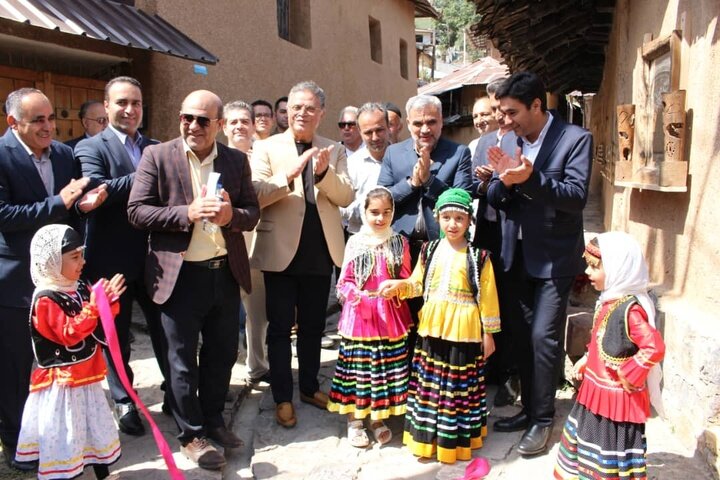
Tehran – Hossein Izadi of Mazandara’s Cultural Heritage, Tourism and Handicrafts Bureau has announced the opening of the country’s first country’s literary tourism route in Candelos.
According to Miras-e Arya (CHTN), he says the route was designed and started with inspiration from the ancient legends of “Mina and the Leopard,” and is considered a new step in linking local literature with cultural tourism.
About 1 km long, this literary route comes with a variety of stations, including Mina’s houses, story murals, romantic meeting places, Mina and Leopard cafes, story paintings, and iconic sculptures, offering visitors a different experience of story-based tourism.
He revealed that the main goal of creating this route is to deepen the tourism experience through narrative-based tourism. So, tourists establish a deeper connection with the history and identity of this ancient village at the heart of Candelos’ cultural and natural textures by hearing the legendary story of “Mina and the Leopard” from the words of the local storyteller.
Izadi pointed out that Candelos is famous for its anthropological and medicinal plant museums and original architecture, and that the opening of this literary route has taken a new step towards the globalization of rural tourism in Iran.
Located in the breathtaking province of Mazandaran in northern Iran, Candelos village is a testament to the country’s rich cultural heritage and natural beauty.
The picturesque village known as “The Lost Paradise” offers visitors a unique blend of historical significance, cultural depth and ecological wonders.
Candelos is one of Iran’s oldest settlements, with traces of civilization dating back to the Islamic period. During the Qajar dynasty, the village was recognized and Shah Qajar of Nasser al-Din reportedly passed through and praised the craftsmanship of local metalworkers.
Village architectural charm – the atmosphere of the wooden framed windows, gable rooftops and winding stone alleys reflects its deep heritage. Unlike many modernized settlements, Candelos preserved its historic texture, allowing visitors to experience firsthand the elegance of Iranian countryside.
Beyond historical significance, Candelos is famous for its medicinal plant farms that grow over 250 species of rare and precious herbs. The village has become a hub for traditional Chinese herbal medicines, maintaining the knowledge of Iranian healers while promoting sustainable agricultural practices.
Visitors can enjoy traditional Iranian cuisine in the traditional restaurant. The local handicraft market is another highlight of the village, featuring Jazim textiles, felt clothing, socks, gloves and flower wool blouses.
One of the most crucial aspects of Kandelous is the Anthropology Museum, a pioneering institution founded by Dr. Alyasghar Jahangiri. Originally from Candelos, Jahangiri devoted her life to preserving the village’s history and introducing its cultural treasures. After completing his doctoral studies in the United States, he returned to his childhood home on mission. He established a museum that preserves the heritage of Iranian countryside and educates future generations.
Under his leadership, the Candelos Anthropology Museum was founded between 1981 and 1988, becoming the world’s first rural museum. Living with over 8,000 artifacts, including pottery, manuscripts, agricultural tools and ancient artwork, the museum serves as a bridge between Iran’s past and present. Jahangiri’s efforts have expanded beyond historic preservation. He also played an important role in documenting and promoting the heritage of Iranian medicinal plants, leading to the creation of a museum dedicated to medicinal plants.
Kandelous offers comfortable accommodations such as suites, villas and guesthouses, allowing visitors to fully experience the peaceful environment. The village also has an open park and pavilion, offering quiet spaces for relaxation and seasonal festivals.
Kandelous has attracted international attention, has appeared in foreign media and has attracted more tourists. In 2023, it was nominated for eight villages in Iran for its Global Village title by United Nations Tourism, previously known as the World Tourism Organization (UNWTO). Additionally, efforts are underway to acquire the village’s UNESCO label in the future.
KD