
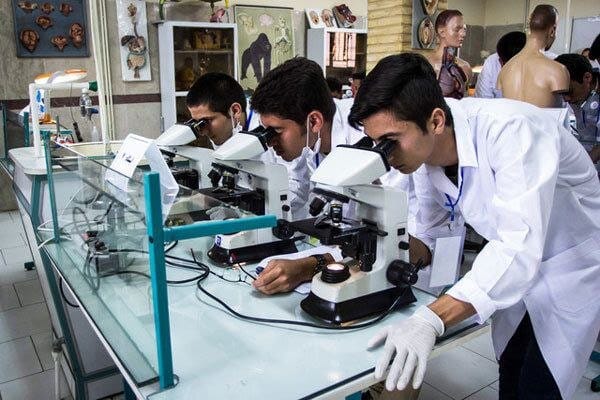
Tehran – The fourth nanotechnology summer school will begin on July 23rd and run for two months.
Participants will be taught by renowned national and international faculty, elites and instructors. The school serves as a great opportunity to share knowledge and expertise, professional experience and innovative skills in various nanotechnology sectors, Irib reported.
The event will cover a wide range of educational and skill-based activities. It also hosts over 60 science courses and workshops focusing on advanced nanomaterials, artificial intelligence (AI), programming, nanomedicine, nanobiotechnology, nanoelectronics, nanotechnology industrial applications, and commercialization.
For the past three years, nanotechnology summer schools have been widely welcomed by both Iran and foreigners in other countries such as Iraq, Syria, Turkey, Afghanistan, and the UK.
Iran’s achievements in nanotechnology are noteworthy. The country’s investment in research and development of nanotechnology, as well as the increase in scientific publications and sales of nanotechnology products, has proven Iran’s rise as a global leader in this field, producing and exporting products to various countries around the world.
Access to domestic resources, competitive prices compared to Western countries, as well as high production of raw nanomaterials, nanocatalysts, and advanced equipment, as well as geographical proximity to target markets in neighboring countries, reduced transportation costs, political and trade relations, made Iran become a leading manufacturer of regional nanotechnology products.
The most cited Nanotec Journal in the World
The Journal Citation Report (JCR) Impact Factor 2024 cited 161 Iranian journals, giving them five names in the most cited world in the nanotechnology sector.
The Journal of Nanostructure in Chemistry (JNSC) is a member of Islamic AZAD University with an impact coefficient of 7.9. It is featured in the top 25% of JCR journals published by Clarivate Analytics in three categories, including Nanoscience and Nanotechnology, and ranks 34 among the 147 top journals. Chemistry, interdisciplinary, ranking 41 among 239 journals. Interdisciplinary Material Science, ranked 88 among the top journals of 460.
The journals of international nanoletters belonging to Kermanshah Islamic Azad University, Nanomedicine Journals belonging to Mashhad Medical Science University, Nanostructure Journals belonging to Kashan University, and Nanomedicine Journals belonging to the International Journals of NanoDimensions belonging to Tonkabon Islamic Azada University are 4.0, 1.7, 1.7, 1.3, and 1.3, 1.3, 1.3, 1.3, 1.3, 1.3, 1.3, 1.3, 1.3, 1.3, 1.3, 1.3, 1.3, 1.3, 1.3, 1.3, 1.3, 1.3, 1.3, 1.3, 1.3, 1.3, 1.3, 1.3, 1.3, 1.3, 1.3, 1.3, 1.3, 1.3,
So far, 10 of the 12 specialized nanotechnology journals in the country have been indexed in international Scopus databases, five of which have received an impact factor.
JCR 2024 included data from over 21,000 journals from 113 countries in 254 research categories.
JCR is a database that provides influential factors and rankings for academic journals in the science, technology and social sciences, most commonly based on citation data. JCR is a widely used resource for evaluating and comparing journals within the research community.
The most well-known metric provided by JCR is the Journal Impact Factor (JIF). JIF is a measure of the frequency at which articles published in a particular journal are cited in a particular year.
JCR data is drawn from the Web of Science Core Collection, a comprehensive citation index.
Only journals that meet strict quality standards for inclusion in the Web of Science Core Collection are featured in the Journal Citation Report.