
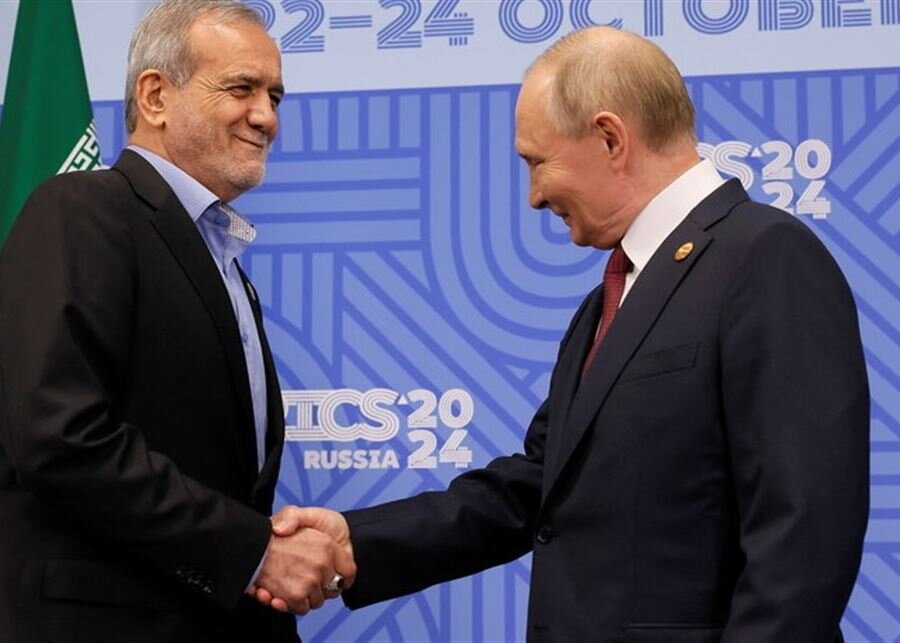
Tehran Times delved into the multifaceted relationship between Russia and Iran in an in-depth interview with Anton Mardasov, a prominent expert on Russian foreign policy and Middle East issues.
The discussion explored the evolving nature of the two countries’ strategic partnership, which is characterized by both cooperation and careful management. Key topics included the historical background of the anti-Western alliance between Iran and Russia, the importance of economic agreements such as the 2023 Eurasian Economic Union (EAEU) Free Trade Agreement, and the limits of military and technological cooperation between Iran and Russia.
Mr. Mardasov also addressed the impact of sanctions, the role of personal dynamics in bilateral relations, and Iran’s nuclear program as a geopolitical tool. Additionally, the conversation highlighted the pragmatic approach of both countries in navigating regional conflicts and the potential for deeper economic cooperation to strengthen the bilateral partnership.
Below is the full text of the interview.
What do you think about the current state of relations between Russia and Iran?
Relations between Russia and Iran are like a stock market chart, with ups and downs, but the relationship is evolving, and everyone, optimists and skeptics alike, recognize this. The details of Russia and Iran’s anti-Western cooperation are well known, and thanks in large part to their anti-globalization partnership, their relations have expanded and deepened by leaps and bounds, with occasional slight setbacks amid existing contradictions and resentments. However, it is often not taken into account that every relationship has its limits, which depend not only on political will but also on many other factors, including internal ones.
The impasse over certain decisions is often pointed out not only by Iran, which regularly suspects Russian operations behind the scenes, but also by Russia. For example, despite Moscow’s conscious decision not to take drastic steps between the parties to the conflict in West Asia, the Kremlin offered Tehran in 2002 the implementation of a 10-year program for the development of trade, economic, industrial, scientific and technological cooperation, which was ratified by the Russian government, but the Iranian side ignored the offer, and the promising project lost its validity as early as 2007.
Which side of the Russian-Iranian relationship is more important at the moment?
It is clear that politicians often deliberately exaggerate the importance of particular foreign policy steps or decisions. From the Russian side in particular, there were many statements that helped exaggerate expectations for the conclusion of the Comprehensive Strategic Partnership Treaty in early 2025, including in the areas of security and defense. Nevertheless, it was already clear at the time that this was rather a protocol document and did not oblige either Moscow or Tehran to take any major decisions. At the same time, another document, the Free Trade Agreement between Eurasian Economic Union (EAEU) member states and Iran, signed in 2023 and scheduled to enter into force this year, was effectively ignored. Unlike bilateral strategic agreements, this agreement allows companies to save significantly on customs duties. In general, the media always pays more attention to military issues, but economic issues often play a more serious role and directly affect the possibility of military cooperation.
How strong is military cooperation between Moscow and Tehran today?
Furthermore, it must be taken into account that the dynamics of covert military-technical cooperation and interactions through intelligence services between Moscow and Tehran are always different from the situation in the realm of official trade, economic relations and diplomacy.
It is clear that Russia has no intention of intervening in actual hostilities on behalf of Iran, and neither does Iran. Currently, Russia’s military-industrial complex is at full capacity, as plans have been announced for the operational rearmament and deployment of new formations equipped with armored vehicles, air defense equipment and helicopters, not only to meet the needs of the troops fighting in Ukraine, but also to counter the Western military bloc. However, even without a war in Ukraine, it is unlikely that the Russian government will intervene in the 12-day conflict, as such a conflict is likely to escalate.
It should be noted that Iran also tried to take very pragmatic actions in the 12-day war, for example, refraining from attacking aerial refueling planes supplying fuel to Israeli aircraft, and its defeat could have significantly inflamed the conflict.
In general, relations between Russia and Iran are developing, but it should be clearly recognized that there are limits. However, it is in Moscow and Tehran’s interest to hide such restrictions, since their adversaries naturally take advantage of them when planning various military, political, and economic actions.
How have sanctions changed the way Russia and Iran cooperate?
As for the sanctions part, Iran and Russia can find different solutions. For example, the kamikaze drones that Tehran supplied to Moscow due to the lack of drones and precision weapons on the Russian side at that time, whose consumption was very high due to the long front and the Russian-Ukrainian border in general, ultimately became truly Russian. These are currently drones with multiple modernizations, assembled mainly from Russian parts.
It is clear that in this way Russia not only excluded itself and the accusation of arms supplies from Iran, but also escaped direct dependence on Iranian supplies. Nevertheless, the intensive use of Iranian developments and modernization efforts at certain stages of the conflict allowed Iran, of course, to test its developments in today’s violent conflicts and also increase its combat capabilities.
Did the Iranian-Russian partnership play a major role in accelerating the growth of the defense industry?
In addition, it is necessary to take into account that the purchase of foreign equipment from Russia and China is not a panacea for Iran, which needs to develop its defense complex. The delivery of the Su-35 fighter jets will not change the situation in Iran’s aviation or security sector, but it will give Iranian engineers access to more cutting-edge solutions that they can use to modernize their fleet on their own.
A similar story applies to the field of air defense and armored vehicles. Iran has its own developments, and its widespread adoption is being driven by the Revolutionary Guards, for example. At the same time, Moscow is questioning the extent to which Iranian military elites remain committed to past agreements following the deaths of some Iranian generals responsible for relations with Russia and promoting a number of joint projects during the 12-day conflict. Therefore, personal factors should not be discounted.
What do you think of Iran and Russia’s approach to foreign affairs today?
It should also be considered that Moscow is not alone in trying to balance and make more prudent decisions by looking at certain players from West Asia and the West. This pragmatic stance, which affects all operations, is also a characteristic of Iran. In general, when a particular agreement reaches an impasse, as is often the case, it is worth looking closely at the actions of both players, not just one side. In any case, Russia and Iran have great economic potential for cooperation that is less susceptible to sanctions restrictions, for example within the framework of a free trade agreement between the Eurasian Economic Union and Iran and other projects.
What do you think about Iran’s nuclear program?
As for nuclear weapons, in my opinion, Iran itself is not very interested in the 100 percent implementation of its nuclear program. There are opinions, including Russia, that before the 12-day war, Iran was using its nuclear program as a negotiating and bargaining tool, but after the recent conflict with Israel, Iran is now free of restrictions. I have a different perspective. In my opinion, the Iranian government will also try to negotiate, and things will not go as planned by North Korea.
Perhaps Russian experts can or have already provided some consulting services to Tehran in the field of nuclear weapons, but this does not mean that Russia is helping Iran build a nuclear attack. On the contrary, in fact, Moscow has always opposed the emergence of nuclear weapons in Iran for various reasons and the peculiarities of the situation in the Middle East in general. Although there may be some imitation of Moscow in this area, I do not believe that the situation has fundamentally changed.
How do you think the Iranian-Russian partnership will develop in the coming years?
Regarding future prospects, as mentioned earlier, it is important for Iran and Russia to comprehensively develop economic cooperation in a variety of fields, without focusing on defense. I think this will not only help calm the situation surrounding the partnership between the two countries, but also strengthen cooperation based on another level of economic relations in the event of a real threat.
This may not be the best example in this context, but personally I am not very confident in the possibility of a serious military conflict between the US and China in the future. Simply because the economic ties and trade between the two countries are so serious that neither side in their right mind would try to break them up. In this regard, focusing on the economic aspects of bilateral relations will be a solution for Russia and Iran, on the one hand, it will help the development of relations and contribute to overcoming the existing mistrust, and on the other hand, it will allow the parties to continue to act with understanding in this or that interaction with third parties.