
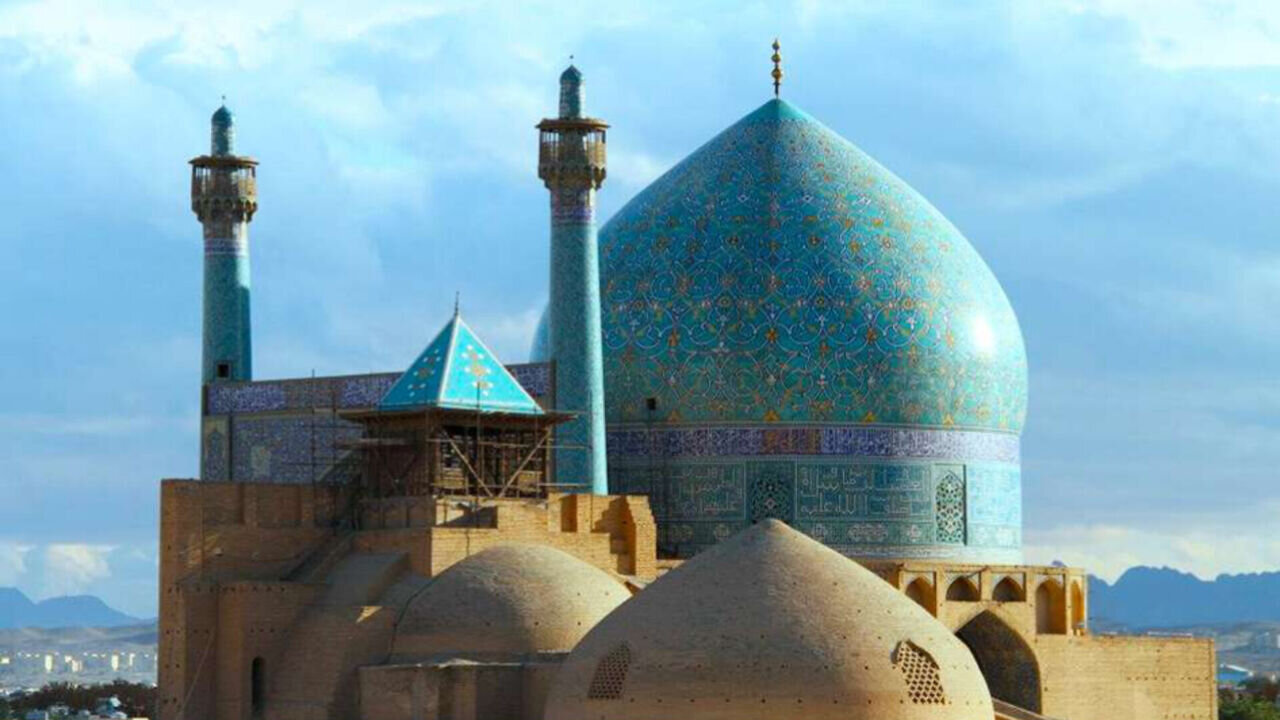
Tehran – Beginning to address the possibility of degradation of the complex tilework adorning the grand dome of Masfahan’s 17th century Imam Mosque.
A masterpiece of Persian architecture, the mosque is located at the southern tip of the historic city’s UNESCO World Heritage Site, Imam Square (Nagsh-e-Jahan Square).
On Sunday, Isfahan tourism chief Amir Kalamzadeh announced that the project focuses on comprehensive repairs to the tile decorations in the central part of the dome. “Repair work, funded with a budget of over 8.5 billion Iranian rial, is recently launched and is expected to continue until the end of September.”
“The restoration involves a complete overhaul of tile mosaics and decorative elements in the central part of the dome, ensuring lifespan and aesthetic shine,” Kalamzadeh said. “We are committed to preserving this iconic monument for future generations.”
This latest phase ended with the removal of scaffolding footings that enveloped the mosque’s dome last year following a groundbreaking 14-year restoration campaign. That long-term effort began in 2010 after extensive damage assessments revealed the need for emergency repairs.
During the long restoration period, artisans have painstakingly restored the distinctive mosaic tiles of thousands of mosques, correcting structural distortions. Despite partial removal of scaffolding in 2022, further evaluations indicated additional areas of intervention and prompted the current project.
Adorned with over 500,000 intricate patterns, the famous Imam Mosque dome holds the distinction as the largest tiled dome of the historic mosques around the world. In a largely dark blue shade, its symmetrical calligraphy inscriptions, its stunning seven-color mosaics become the defining symbol of Safavid era art and architecture.
Built under the auspices of Shah Abbas the Great in 1611, the mosque stood as a cultural and religious beacon at the heart of Isfahan for over four centuries. It is crowned the southern tip of Imam Square. Imam Square is lined with other monumental safavid structures, such as the Sheikrotophora Mosque, Alikapu Palace and the entrance to Qeysarieh Bazaar.
Imam Square itself is not only a UNESCO World Heritage Site, but also a historic hub that once pulsated in the cultural, economic, religious and political life of the Safavid capital. The vast open space hosted celebrations, polo matches, military rallies and public events, highlighting Isfahan’s nickname, “nesf-e-jahan.” It means “half of the world.”
morning