
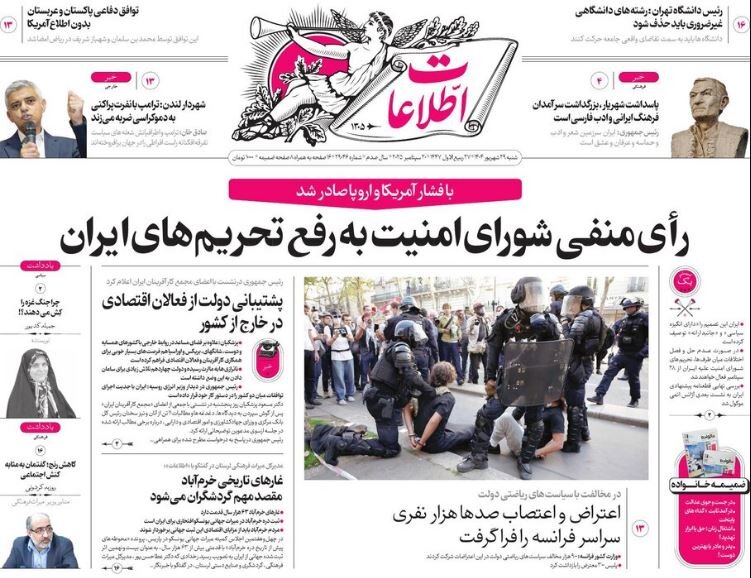
Tehran – In a memo, Etterat discussed the impact of snapback sanctions on the Iranian market, writing:
Their global aspects have led to US sanctions disrupting Iran’s global banking system, oil sales and even currency transfers. The main issue is the psychological effect of this decision. When the French president openly speaks about the certainty of the snapback, the hidden message is that sanctions will become a permanent situation. In this environment, people and business people no longer want to lift restrictions. At a political level, there are also important consequences. While some countries tend to leave the doors of interaction open for economic or political reasons, if snapback is implemented, a collective decision is registered against Iran that lifting it would be even more difficult than its implementation, as some European countries could oppose and pressure it to prevent lifting sanctions. The outcome of this process is Iran’s longer segregation in the international sector, even if its economic impact is not as great as US sanctions.
Siasat-e-Rooz: The West’s Unloyal
Siasat-e-Rooz dedicated his editing to the violation of Western promises, writing: The most important agreement between Iran and the West was the nuclear agreement, but the JCPOA, Europe’s expiration date has reached and hopes to work with the US to regain the snapback. The West is always dishonest because he doesn’t stand up to their words, he always breaks them, and is in favor of treaties and agreements. Leaders of three European countries (the European Troika of Britain, France and Germany) support Israel, but the Zionist regime is busy killing people in the region. In return, they put Iran under more political and economic pressure. It is noteworthy that people in Western countries have been carrying out major demonstrations against the crimes of Zionist regimes due to hypocritical actions on these causes. However, the people of these countries whose governments demonstrated against Iran in support of Israel do not have unconventional weapons, including nuclear weapons, but are determined to defend itself. If an attack is made by an enemy, the Iranian military’s response is critical, powerful and devastating.
Hamshali: Position on Iran’s return of sanctions
Hamshari analyzed the UN Security Council vote on Friday, saying that nine of its 15 members did not vote to suspend UN sanctions on Iran. The UN Security Council wrote that it did not support a resolution calling for the continued lifting of UN sanctions on Iran, and therefore took another step to double the uncertainty about the revival of hostile sanctions against the Islamic Republic and future development. The growing trend in Europe’s threats regarding the return of UN Security Council sanctions resolutions comes at once as senior Iranian officials have repeatedly revealed Tehran’s position on such threats. One of Tehran’s most strategic positions on the activation of snapback mechanisms is to find solutions that avoid sanctions through the development of regional and international cooperation. Developing cooperation with neighboring and regional countries, particularly within the framework of regional and international organizations such as Shanghai, BRICS, and Eurasia, is key to avoiding sanctions. Iran does not retreat under threat and threat. Tehran has repeatedly stated that the “threat-oriented” approach in the West fails to influence the Islamic Republic’s resolve to protect its national interests.
Etemado: The need to convince the state of snapback illicitness
In an interview with nuclear expert Ahmad Shirzad, Etemad discussed Iran’s strategic actions after the potential revitalization of snapback sanctions. He said: Iran must develop a series of economic, cultural and political measures to continue its development under sanctions. Through active diplomacy, Iran must convince countries around the world of the illegality of snapbacks and related resolutions and encourage them not to cooperate with these sanctions. In this regard, the role of regional countries such as China and the United Arab Emirates is important, and if China refuses to cooperate with the West to implement restrictions, it will have a major impact on Iran’s international activities. Shirzad said that intentionally neglecting some European countries and showing a failure to sanction force the other side to reconsider its position and allow Iran to take pride in continuing its political and economic path. A series of measures should be implemented in stages, step by step, so that Iran can resist potential pressures and maintain its position on the international stage.