
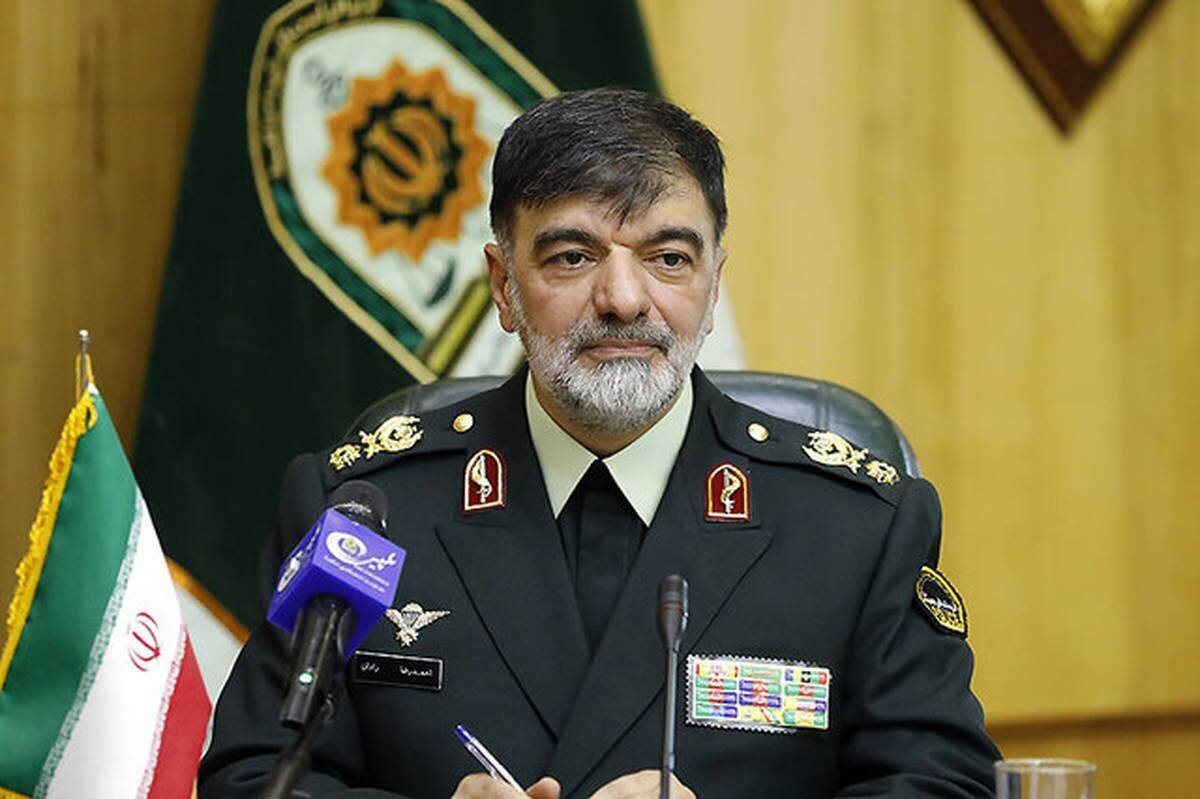
TEHRAN – A senior Iranian commander said his country’s military is on maximum alert and ready to respond even more forcefully to any new acts of aggression launched against the Islamic Republic.
Brigadier General Ahmadreza Ladan, commander of the Iranian Law Enforcement Armed Forces (FARAJA), said on Saturday that complete security and stability prevailed throughout the country thanks to the unity of the people and the cooperation between the country’s armed forces, including the army, Islamic Revolutionary Guards Corps (IRGC) and police.
“With the unity of the people and the cooperation of all armed forces, complete security will be established throughout the country,” Ladan told reporters.
“Our entire military is on high alert, with our finger on the trigger, and if anyone attempts to take action against Iran again, we are ready to respond more overwhelmingly than ever before.”
Mr. Ladan stressed that Iran’s internal, public and national security is currently in the best condition, and credited the Iranian people’s vigilance and unity for maintaining post-war stability.
“The strength of the police lies in the support of the people,” he said. “Without their cooperation, we cannot accomplish our mission. I thank them for their continued support and call on them to continue to stand by their own police.”
The remarks came in the aftermath of Tel Aviv’s 12-day war of aggression against Iran, which ended in late June following a series of Iranian retaliatory attacks that caused significant damage to Israeli military and intelligence targets.
In earlier comments, Interior Minister Eskandar Momeni revealed that the Iranian Law Enforcement Command (FARAJA) was one of the main targets of attacks by Israel as part of a campaign to “cause domestic chaos” during the war. Nearly 150 police officers were martyred in these attacks, which he said reflected Tel Aviv’s frustration and failure to achieve its main military objectives.
Momeni explained that such direct targeting of police stations and internal security centers is unprecedented in conventional warfare and highlights the enemy’s desperation to destabilize Iran from within after a setback on the battlefield.
Analysts believe Israeli attacks on law enforcement and internal security sites were part of a broader “regime change” strategy aimed at undermining security. Even pro-Israel think tanks such as the Institute for the Study of War (ISW) have acknowledged that attacks on Iranian law enforcement forces were planned to “demonstrate a credible threat to the regime’s stability.”
In recent weeks, Iran’s military chief of staff, Maj. Gen. Abdulrahim Mousavi, praised the country’s naval preparedness, saying both the country’s southern army and Revolutionary Guards naval units have extraordinary capabilities to respond to any threat. He noted that the Iranian military has taken extensive steps since the 12-day war to strengthen its preparedness for future hostilities.
The June conflict began on June 13 when the Zionist regime launched unprovoked military operations targeting military, nuclear, and residential areas across Iran. The United States later joined the attack, attacking Iranian nuclear facilities in Natanz, Fordow, and Isfahan on June 22.
Iran immediately counterattacked with Operation True Promise III, during which the Revolutionary Guards Aerospace Forces launched 22 waves of retaliatory missile strikes, inflicting significant damage on cities and military bases throughout the occupied territories. Iran also targeted Qatar’s al-Udeid Air Base, the largest US military installation in West Asia, in retaliation for Washington’s involvement.
The ceasefire took effect on June 24, but analysts are now warning that a new Iran-Israel conflict could erupt after Israel failed to achieve its stated military goals. Many observers believe that Tel Aviv’s inability to achieve its desired goals, combined with Iran’s continued deterrent stance, could spark a new conflict in the near future.