
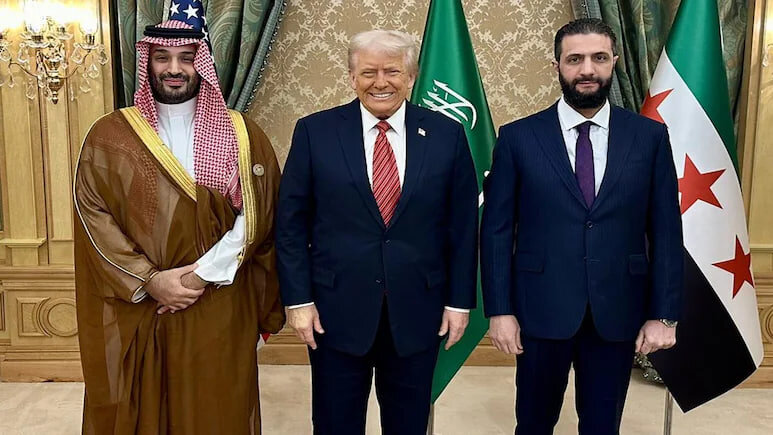
BEIRUT – Israel I24News has revealed that a September meeting held at the White House by President Donald Trump will bring together Ab Muhammad Arjurani, the self-appointed president of Syria (now known as Ahmed Al-Sharara a) to work together to work with Israeli Prime Minister Benjamin Netayahu.
The announcement came shortly after Arjuranni visited Abu Dhabi, which, along with the Hebrew channel, serves as a mediating settlement between the Arjuranni government and the Israeli occupation regime.
I24News claims that the main obstacle to this Syria-Israel settlement is Tel Aviv’s unwillingness, particularly as Arjirani has not yet ruled out armed factions, so he is committed to retracting his forces from the areas he recently occupied at the height of Golan.
The issue causes analysts to discuss the possibility of deploying US troops on behalf of Israelis in southern Syria, urging Israel to force a third of Golan Heights to pay a “rent” fee, with the remaining two-thirds being recognized, and that attempts to establish a polarization zone.
Trump had already demanded that Al Jurani end the activities of Syria’s Palestinian resistance. They hope to win the Nobel Peace Prize amid on the ongoing push as many Arab governments enter the suffering of normalization with the occupation regime.
On his part, Arjurani is trying to integrate his hard-line rules and increase control over the remaining crumbs of Syrian cheese.
I24News said the meeting will be held before Arjurani attends a conference prepared at the UN General Assembly with the aim of removing him and Hayat Taharil Al-Sham (HTS) from the terrorist list.
Meanwhile, US envoy Thomas Barrack expressed his hope that “we will proceed along two parallel tracks where relations between Syria and Lebanon will soon converge.”
In an interview with Lebanese Channel LBCI, Barak argued that the Arjurani regime “has no intentions of hostility towards Lebanon. The current concern of Syrian Ahmad Alshara’s regime is to maintain power in order to protect its leadership.”
The US envoy said Washington now considers Lebanon, Israel, Jordan and Iraq to be part of the region’s “new fabric” and he insisted that as Syria moves forward, “Lebanon is a corridor, so too is Lebanon.”
Barak added: “The Lebanese and Syrians have been linked since the time of Virad al-Sham (Levant).”
Regarding the virus news about the annexation of Lebanon’s Tripoli along other parts of Bekaa, Barack said, “Fantasy, fantasy, caricatures. I’ve never heard a word about annexation, and no one can trust in the circles I work with in Syria.
When asked if he would return to Lebanon in two weeks with “a real breakthrough,” he replied. “I can assure you. There are breakthroughs. Are there breakthroughs that meet all Lebanese factions? It’s a miracle. But our commitment is clear.
The US envoy argued that all the elements of the Lebanese government were ready. “Of course, when things mature, everything needs to be presented to the Pastor’s Council. But the Lebanese army is the focus.”
Barack reiterated his emphasis, saying, “Hezbollah – the problem is the Lebanese event (…) how to solve this internally is another problem.” He further stated that if it decides to abandon the weapon, “we will help, we will influence and become mediators between all “combatants” or enemies on the border (Lebanese).
The US envoy argued that speeches on timetables to meet American pressures were inaccurate. When asked if the situation would change in Lebanon until the May 2026 parliamentary election, he replied that Trump was in a panic. “If Lebanon wants to keep kicking the cans, they can, but we can’t argue the same here.”
Barack commented on the statement of Hezbollah Secretary General Sheikh Naim Qassem. Hezbollah will never give up on its weapon: “This is part of a typical Lebanese negotiation. In the bazaar, it’s the same thing. It’s everyone is ready to reach the agreement.
He added: “We have to set a time frame. When I say ‘We have to do’, I mean Lebanese. As Americans, we are just here to promote the rapid exploitation of this opportunity. But we do not impose anything. We can’t. ”
Asked about his confidence in Lebanese politicians, the US envoy said, “We are encouraged by their reactions so far, but are smart enough to understand that they are backgammoning, and they have to decide what their true commitment is.
Barack said, “Everyone is afraid. No one wants a civil war. No one wants to put too much pressure on you. You have a sectarian system that requires consensus. All dialogue takes place within this framework. We just respect this process.”
Regarding reconstruction, the US envoy said that the Persian Gulf countries are committed to it in accordance with the same principles we require, real agreements, real timetables, real deadlines, true disarmament.”