
Madrid – The Islamic Cooperation Organization (OIC) is a vital institution representing the collective voices of the Islamic world, covering 57 member states and over 1.9 billion people. However, despite its ambitious mission to promote Islamic solidarity, protect the interests of Muslim communities, and intervene in a crisis affecting Muslim Ummah, the OIC has long been caught up in a cycle of rhetorical formalism and procedural inertia.
The repeated reliance on declarations, communices, and calls for unity, while symbolically powerful, frees the deep incompetence that transforms ethical affirmations into concrete political institutions.
Chronic failure of the OIC is a symptom of an involuntary or incapable of enacting the constitutive gesture of collective political subjectivity, sovereign deficits. The assertions against the true political institution remain halted until the OIC moves beyond ritualized speech acts and accepts the constitutive logic of politics, namely the explicit naming of the enemy and the implementation of practical interventions.
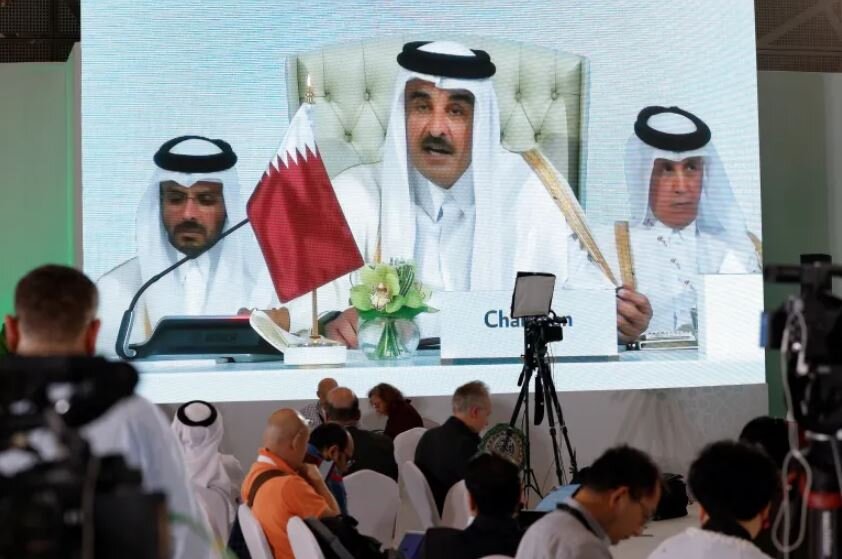
The recent summit of Islamic cooperation organisations, swiftly convened in Doha following Israeli attacks on Qatar, provides a heart-warming framework to question the collective institutions of the Muslim world’s most important intergovernmental organisations. This extraordinary session symbolized both ethical affirmation and a moment of procedural stagnation, revealing a broader crisis in the OIC’s ability to enact sovereignty. Palestine highlights the fundamental paradoxes facing the OIC as a symbolic incident of contested sovereignty and enduring colonial violence. It highlights the differences between rhetorical declarations and concrete political interventions.
The attack on Qatar, targeting Hamas officials who were engaged in ceasefire negotiations, was unanimously condemned by OIC member states as a violation of international law and a threat to regional stability. The final communique clarified strong solidarity with Qatar, reaffirmed its support for Palestinian rights, and called for sanctions and legal proceedings against Israel. However, the summit, like many before that, was accompanied by a series of declarative statements and a call for unity. Although powerful in rhetoric, it is significantly constrained by operational political capabilities.
Limitations of ritualized sovereignty
At the heart of this argument is the categorical and conceptual errors that have long constrained the political effectiveness of the OIC. It is a false belief that sovereignty can be declared without being enacted. From a political theological perspective, sovereignty is not merely a principle or symbolic status. It exists only as long as it is exercised. To speak about sovereignty without the ability to assert, enforce and defend collective interest is to engage in empty performances, ritualized speech acts that it cannot be named.
The widespread use of OIC declarations and communica- tions reflect this dynamic. Each session and summit is an opportunity for Member States to reiterate their ethical commitment to Muslim solidarity and justice, to condemn the injustice given to Muslim people, especially the Palestinians, Rohingyas, Kasimiris, and others, and to voice calls for peace and humanitarian salvation. However, these declarations of goodwill are rarely translated into decisive political actions that challenge hegemonic forces, effectively mobilize resources, or assert collective sovereignty. Instead, they multiply words but remain trapped in a procedural loop where agents are stopped.
The sovereign deficit of collective political subjectivity
This predicament reflects a deeper sovereign deficit. It reflects the involuntary or structural incompetence to form and exercise true collective political subjectivity. The OIC is a deep and heterogeneous coalition of states with different geopolitical interests, economic capabilities, and alliances. This multiple creates chronic fragmentation, hindering cohesive decision-making, and leads to strong member states diluting collective will. As a result, the OIC discovers that it cannot carry out the constitutive political acts necessary for sovereignty. Defining common enemies, enacting sanctions, initiating multilateral intervention, creating binding obligations.
In this context, political subjectivity refers to the formation of a collective actor capable of political will and action. The OIC’s act of solidarity is undermined by the lack of a unified sovereignty “we” that can act decisively against threats to members or shared values. That official discourse often calls for “uniformity,” but this unity is rarely enacted beyond symbolic consensus and remains in the realm of mere words rather than material forces or interventions.
Learning from Iran: Establishing sovereignty through constitutive actions
One of the most obvious contrasts with the OIC’s inertial rhetoric is Iran’s response to Israeli invasion and regional geopolitics. Despite considerable international isolation and sanctions, Iran demonstrates a form of political institutions that transcend declarative language. The response, including support for resistance, open condemnation of invaders, and concrete political and military actions, expands the establishment of sovereignty as constitutive political action.
From an Iranian political theological perspective, sovereignty is inseparable from action. It is rooted in an existential commitment to resist oppression and do justice beyond mere words. This sovereign attitude, which includes both explicitly named by the enemy and means of fighting over mobilization, rejects passivity embedded in ritualized political language. For Iran, the legitimacy of political subjectivity depends not on the abstract affirmation but on the establishment of this concrete sovereignty.
Therefore, the OIC must learn from such constitutive political institutions. To assert political relevance in the 21st century, the OIC cannot afford the symbolic repeat luxury detached from operational power and consistent political strategy. Its credibility, and in fact the survival of normative mission, will overcome its procedural inertia and formulate a politics of performance, conflicting, decisive sovereignty.
The rhetorical devices of the OIC (interpretation, joint communica- tion, and call for unity) often serve as empty gestures around deep political divisions. While they perform solidarity rituals on behalf of Muslim unity, they fail to influence Realpolitik or deal with the urgent crisis with the necessary urgency. This contributes to the recognition of OIC as an iconic, grand yet practical body of impotence.
Furthermore, this rhetorical trust leads to a paradox in which ethical affirmation is separated from political institutions. The OIC declares support for justice and condemns aggression, but hesitates or refrains from identifying clear enemies or engaging in forced political measures. This hesitation indicates a systematic flaw. Organizations that limit themselves to declarative expression are to remain audiences, not players of international conflict and cooperation.
1. An enemy naming: OICs must go beyond general condemnation to explicitly identify actors whose policies violate the collective ethical order. This includes naming the person responsible for human rights that is prominently human rights abuse, occupation, or aggression, without avoidance or ambiguity.
2. Implementation of implementable interventions: Words must be supported by coordinated political, economic, or diplomatic measures. This includes sanctions, mediation initiatives with enforceable mechanisms, deployment of humanitarian assistance through surveillance, or coordinated defense policies regarding international law.
3. Constituting a collective political will: The OIC must overcome internal sectors through institutional reforms that balance sovereignty but allow binding decisions. The strengthening of mechanisms for political consistency, accountability, and solidarity transforms organizations from declarative forums to true political actors.
The continued reliance on organizations of Islamic cooperation on ritualized speech exposes the limitations of institutions trapped in the deficit of sovereignty. The inability to enact the constitutive actions of political sovereignty remains halted between ethical affirmations and practical impotence. As geopolitical landscapes become increasingly complex, the future of OIC as a reliable collective political actor relies on a willingness to accept the difficult but necessary steps of naming their enemies and enacting interventions.
The Iranian example highlights the possibility of political theological sovereignty based on committed political institutions and provides a model for how the OIC transcends current paralysis. Only by bridging the gap between rhetoric and action can the OIC be regained’s role as a genuine sovereign body capable of shaping the Muslim world and subsequent political outcomes.