
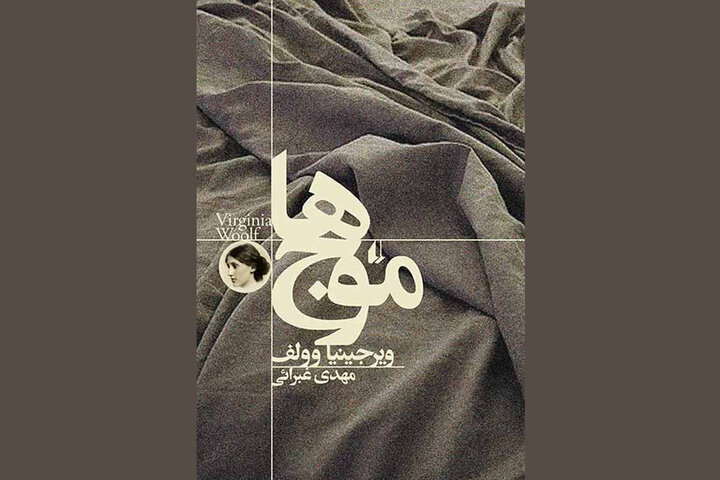
Tehran – The 12th edition of the Persian translation of English novelist Virginia Woolf’s 1931 novel The Waves has recently been published.
Tehran’s Ofoq Publications is the publisher of books translated by Mehdi Ghabrai.
“Waves” are a landmark of modernist literature and are bold experiments and content that keeps fascinated and challenging readers. Critical acclaimed as Wolf’s most experimental work, the novel eschews traditional narrative structures in favor of a unique and often enigmatic approach.
Instead of a linear progression of the event, “The Waves” unfold through a series of interconnected monologues spoken by six characters, Bernard, Susan, Rhoda, Neville, Ginny and Louis. These characters are each with a clear perspective and inner life, and are the focus of the story, but their voices frequently interwoven and overlap, blurring the line between individual consciousness and collective experience.
An important element of the novel’s structure is the interwoven nature of these soliloquys, accompanied by the intertwining of nine short third parties. These intertwinings depict coastal scenes, meticulously documenting the decline and currents of the day from sunrise to sunset. These meticulously observed natural moments serve as the background to unfolding the inner side of the character. The periodic progression of light and shadow reflects the periodic nature of human experience, highlighting the constant interaction between the external world and the character’s internal world.
An innovative approach to Wolf’s story is more than just a stylistic choice. It is a deliberate quest for the complexity of consciousness. Characters’ monologues are not a brief description of their thoughts and feelings, but rather fragmented and often vague representations of their inner lives. They tackle issues of identity, belonging, and the nature of the self. Wolf brilliantly captures the fluidity and instability of consciousness, demonstrating how individual experiences are shaped by both internal reflexes and external stimuli.
Through these fragmented voices, Wolf explores the relationship between personality and community. Each character owns a distinct and unique voice, but their experiences are not isolated. They are interrelated through shared environments and shared human experiences. The characters’ monologues reveal the struggles of individual struggles against self-discovery, anxiety about the future, and hope for connection. Therefore, the structure of a novel is not merely a stylistic device. It reflects the multifaceted nature of human experience, in which individual consciousness and collective beings are closely related.
The seventh character, Percival, is mentioned in monologue, but he remains barely blind and unheard of. His presence is felt, but his voice is never presented directly. This enigmatic element further emphasizes its focus on the complexity of the novel’s characters’ internality and human interactions.
In “Waves,” Virginia Woolf pushes the boundaries of novel forms and offers deep meditation on the human condition. Through her experimental approach, she invites readers to confront the fluidity of consciousness, interconnectedness of experience, and the enduring quest for self-understanding. The enduring power of the novel lies in its ability to evoke a sense of deep intimacy between the characters and their struggles, and at the same time encourages reflection on the very nature of human existence.
sab/