
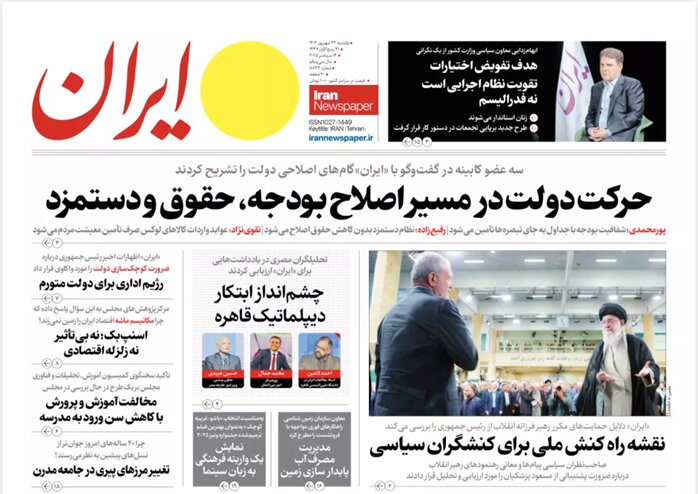
In Tehran-Memo, Iranian newspapers are working on the careful use of technical diplomacy and legal frameworks.
It writes as follows: The recent incident and the agreement between Tehran and the (International Atomic Energy) Agency have once again shown that with the agreement to continue cooperation and resolve the remaining issues, Iran can neutralize Israel’s strategy of securitizing (Iran’s nuclear) cases by using technical diplomacy and careful use of existing legal frameworks. The Israeli government was trying to create conditions for building consensus against Iran by instigating the media environment, influencing agency reporting, and putting pressure on (IAEA) board members with a preemptive approach based on diplomatic logic, but the case prevented it from shifting from technical to security. If Tehran can steadily continue this path and the agency does not deviate from its technical role, it will increase the likelihood that it will open new paths to resolve the conflict without the need for costly conflicts. Ultimately, Iran’s nuclear incident is no longer a technical issue, but reflects the regional and global power structures.
Shargh: Stopping NPT will be Iran’s response to the return of snapback sanctions
Shargh dedicated his editors to Iran’s powerful tools against the revitalization of a snapback mechanism to return UN Security Council sanctions against Iran, which was lifted under the JCPOA. It writes as follows: One assumption is that Western groups know that using snapbacks will encourage Iran to withdraw from the NPT. In such cases, their threat will decrease, and they themselves are willing to delay it. Using Snapback doesn’t give you anything more than you’ve achieved so far. Iran has shown that despite avoiding conflict, it could cause serious damage to the Israeli economy. Europe and the US have tools that use snapbacks. Instead, Iran has a tool to stop the NPT and not stay in the treaty for a while. Therefore, Iran must be able to use this tool if the benefits of this tool exceed the cost. Iran has declared it does not want to produce an atomic bomb. This withdrawal is important if you want to produce an atomic bomb. So, in the face of snapback sticks, the only tool Iran has is the “threat of withdrawing from the NPT.”
Vatan-e-Emrooz: Agreement with Open Eyes
In his analysis, Vatan-e-Emrooz points out the key points of the recent agreement between Iran and the International Atomic Energy Agency, writing in light of the agency’s irresponsible actions in the attacks of the joint US administration on Iran’s nuclear facilities, so agency access should be limited more than before the 12-day war was imposed. Iran must respond practically to the political and irresponsible actions of its institutions as it is in line with protection of its national interests. After the war on June 12th, all kinds of cooperation with the institutions should be related to the possibility of a comprehensive contract. Negotiations and agreements must undoubtedly meet Iran’s demands, namely lifting sanctions. All kinds of cooperation with the International Atomic Energy Agency must be conditional on the deactivation of the snapback mechanism. Therefore, given the nature of European actions and policies towards Iran, the framework of cooperation between Iran and the institution should not be enforced under any circumstances before a snapback mechanism is brought into effect from the agenda.
Hamshali: Warnings to Iranian Muslim Leaders
The Hamshali newspaper wrote that it had written an Iranian warning about Israel’s evil intentions. It said: The Zionist regime’s terrorist attacks on Qatar have met a widespread wave of condemnation from the Arab and Islamic governments. However, the global bloc has so far failed to adopt an effective strategy in the face of a continuing Tel Aviv attack. This failure comes at a time in recent years, particularly after the war with Gaza, when Iranian officials repeatedly warned at various levels of Zionist sinister approaches and plans, calling for a greater convergence in order to confront this regime’s attacks among Arab and Islamic countries in a coordinated and consistent way. These warnings came before the recent terrorist attacks by the Zionist regime in Qatar. The attack was another serious warning against the “dangerous passivity” of the Arab and Islamic governments. Now, the eve of the emergency summit for Islamic leaders, including the organisation of Islamic cooperation and the Arab League, is scheduled to take place in Doha on Monday, so warnings from Iranian officials need to be reviewed. The Muslim world must focus on Tel Aviv’s provocative and dangerous behavior before it’s too late.