
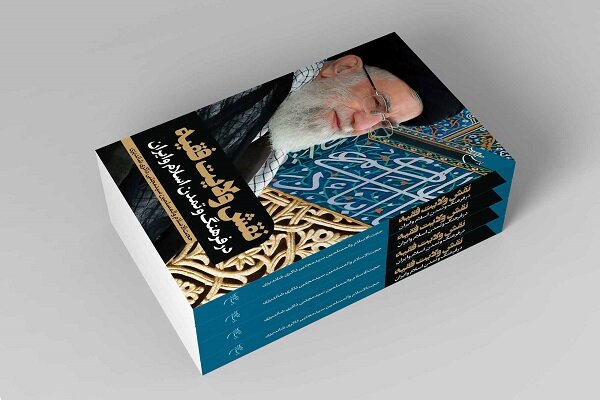
Written by Seyed Mojtaba Zakeri Shandizi, “The Role of Velayat-e Faqih in Islamic and Iranian civilizations” provides a comprehensive exploration of theological and historical foundations of Islamic leaders, focusing on the concept of Velayat-e Faqih, or the concept of “protecting the Isamik Jurist.”
While this concept may be unfamiliar to non-Iranian readers, it is at the heart of the political and spiritual identity of the Islamic Republic of Iran.
Rooted in Shia’s beliefs, Velayat-e Faqih believes that a qualified Islamic jurist should guide society if there is no mysterious imam. The idea has been formalized by Ayatollah Ruhola Khomeini, the founder of the Islamic Republic, and remains a cornerstone of Iran’s rule.
Zakeri Shandizi frames this leadership model as a continuation of God’s leadership, beginning with the Prophet Muhammad (Pbuh) and expanding through the 12 Imams of Shiaisimra.
He argues that this spiritual lineage is at its peak in the Velayat-e faqih facility, which presents as the only legitimate path to justice, prosperity and salvation of the Muslim community.
The book positions Iran as a living embodiment of this divine order, depicting its political system as a beacon of Islamic revival and resistance to global oppression.
The author uses a wide range of religious sources to support his ideas, interweaving theology, history and modern politics.
Shandij highlighted the role of Iranian administrative leadership in the formation of a revolutionary society, and took Ali Khamenei, the leader of the Islamic Revolution, as an important agent for Islamic awakening, to the Islamic Revolution leader.
The book also examines Shiite political movements in Iraq and Lebanon, suggesting that the Iranian model has influenced similar efforts across the region.
The author begins by meticulously grounding Verayat e Faki on the theological bedrock. He traced the unbroken chain of sacred authority, or Wilaya, beginning with the absolute authority of God, and appeared through the Prophet Muhammad (pbuh), and was then transferred to the 12 Imams of Shia Islam.
This spiritual lineage is the absolute core of the author’s paper. He argues that the occult of the 12th Imam in 941 AD did not remain leaderless or drifting.
Instead, some of the authority of the Imam, particularly the responsibility for social and political leadership, was devated by the most learned, and just the age of jurists (Fuqaha).
The book devotes great efforts to analyse classical legal opinions, building on a historical case of its formality in the 20th century, yet having deep roots in traditional Shia ideas.
It is at this point that Zakeri Shandizi presents Imam Khomeini’s revolutionary contribution.
The book details how Imam Khomeini (RA) in his original lecture in Najaf (later published as “Islamic Government: The Governance of the Laws”) integrated these classic ideas into a positive and inclusive political system.
Imam Khomeini (RA) argued that in the face of modern secular and oppressive regimes, waiting for Imam to return is equivalent to ignoring religious obligations.
Instead, he argued that the establishment of a state under the guidance of a qualified FAQIH (law scholar) is a duty (WAJIB) for Muslims to enact justice and fully implement Islamic law (Sharia).
Following this theological and historical foundation, the book pivots to examine the Islamic Republic of Iran as an embodiment of the living breathing of this sacred order.
Zakeri Shandizi frames a sacred victory in place of the tyrannical, West-centric monarchy based on the principles of Velayat-e faqih, not as the typical political upheaval in Iran in 1979, but as a profound spiritual awakening.
He portrays Iran as a beacon of Islamic revival, and as a unique model of resistance to global oppression, both political and cultural.
The story celebrated Imam Khomeini and his successor, the leader of Ayatollah, as a vital agent of this awakening, leading the nation through war, economic siege and certain cultural wars with unwavering principles.
The scope of work extends across Iran’s borders. A significant portion of the text is dedicated to analyzing the wider impact this model has on Shia political movements in the region.
The authors examine the profound influence of the Islamic revolution on the formation of groups like Hezbollah in Lebanon and the formation and ideology of various political entities in Iraq, suggesting that the success of Iranian Verayat e Faki provided a powerful source of templates and ideological inspiration for Shia’s communication, and an ideological inspiration for political empowerment and religious authenticity across Wasia. This “axis of resistance” is surrounded not as a geopolitical block, but as a spiritual alliance integrated under the comprehensive principles of God’s protection and opposition to modern imperialism.
Through 13 chapters, the book delves into a wide range of supporting topics that enrich its central debate. It explores the fundamental events of Gadir Kummu, the explicit designation of Imam Ali (as) as the successor of the prophet, and establishes the principle of divine appointment. The chapters are dedicated to the spiritual importance of martialism and resistance, and present them as sacred duties in the defense of Islamic State and their values. Furthermore, the book offers a robust criticism of Western cultural influences and frags it as a soft war designed to undermine Islamic identity from within. In this context, under the leadership of Wali-e faqih, religious scholars are presented as frontline advocates of spiritual and cultural integrity in the community.
The final chapter, perhaps the most ambitious and reflects Iran’s perceived role in the global plan of God. The authors consider Iran’s Islamic Republic as a catalyst for the final emergence of the sacred guided world order, predicting the revival of the 12th Imam (Imam Mahdi). In this apocalyptic vision, the current system of Velayat-e faqih is a fortress of faith that needs to maintain and expand the boundaries of Islamic governance until the ultimate revelation, and is a preparatory stage to maintain and expand to the ultimate revelation.
In conclusion, “the role of Verayat-e-Faki in Islamic and Iranian civilization” is deeply rooted in theological and Iranian political ideologies of certain Shiites, but its value to scholars is immeasurable.
It provides essential and key sources for understanding the intellectual and spiritual frameworks that underpin Iran’s Islamic Republic. For political theory scholars, it offers a challenging alternative to secular models of governance.
Students of Religion and Middle Eastern Studies provide rich and detailed accounts of how faith, law and political power are seamlessly intertwined in one of the world’s most important and lasting innovative nations.
Reported by Tohid Mahmoudpour