
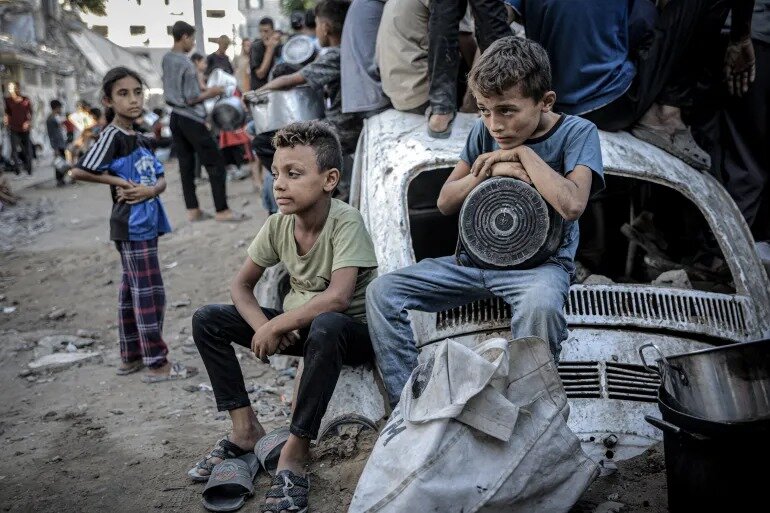
Tehran – The deep ongoing humanitarian crisis in the Gaza Strip represents an exceptional point in the modern history of human rights and international security. Shaped by the systematic and deliberate policies of the Israeli regime, the crisis embodies a gradual genocide and widespread human rights abuses centered on the intentional deprivation and destruction of basic living conditions.
Numerous reports from international organizations, including the Hungry Early Warning Systems Network (Minority Net) and the United Nations, show an unprecedented deterioration in nutrition, health, and human safety in the region. In the face of these disasters, international organisations, particularly the UN Security Council, have been complicit in this cycle of violence, effectively abandoning their important duties to protect humanity through silence and inaction, under the pressure exerted by powerful nations.
One of the prominent dimensions of Israeli crime in Gaza is the progressive genocide carried out through the deliberate deprivation of essential resources such as food, medicine, and health services. This form of genocide, mentioned in Article 3 of the 1948 Genocide Convention, involves intentional action to destroy an entire or part of a human group by depriving them of necessary living conditions (UN, 1948).
In recent years, international organizations, including a small number of nets, have repeatedly warned that over 80% of Gaza’s 2.3 million population rely on emergency food aid, and about 70% of households face severe nutritional deficiencies (Minority, Net, 2023). The crisis stems from Israel’s complete lockdown in Gaza. Gaza restricts access to essential products and directly affects people’s daily lives. Furthermore, preventing the invasion of medical, medical devices and other essentials has led to the collapse of Gaza’s health care system. Over 50% of hospitals have been closed or lost their operational capacity due to shortages of staff and equipment (UN OCHA, 2024; WHO, 2024).
From a human rights perspective, this situation constitutes a blatant violation of basic human rights, including life rights, nutrition, health care, and living in humanitarian situations. The intentional deprivation of these rights is carried out through blockade and structural restrictions, and is subject to criminal prosecution in precisely with the legal definition of genocide (International Criminal Court, 2012).
This progressive genocide is exacerbated and expanded on its dimensions by Israel’s aggressive military and security policies. Repeated bombardment of critical infrastructure, hospitals, schools and food warehouses recorded by Amnesty International and the United Nations Human Rights Office reveals a coordinated and systematic strategy to destroy living conditions (Amnesty International, 2023; Ohchr, 2024).
The destruction of water, electricity and health systems, combined with economic lockdown, placed Gaza’s population in a state that could stand up to complex, deadly humanitarian crisis beyond the immediate dangers of war. The unemployment rate in Gaza is above 50%, with approximately 30% of children suffering from chronic malnutrition (World Bank, 2023).
These actions are recognized under international law as war crimes and crimes against humanity. International humanitarian law, including the Geneva treaties, expressly mandates the protection of civilians and protects critical infrastructure, and prohibits intentional destruction. However, with unwavering US support and global silence, Israel effectively violates these norms and engages in structural genocide.
In the face of this vast humanitarian disaster, international organizations, particularly the Security Council, acted weakly and passively. The main reason for this failure is the repeated use of US veto as a permanent Security Council member, which prevents the adoption of binding solutions to Israel. The fact that the Security Council held several emergency sessions and passed multiple resolutions on the Ukraine crisis, while still merely a spectacular audience in Gaza, underscores the obvious double standards of international politics (UN Security Records, 2023-2024).
Despite being fully aware of the disaster aspects, the UN Secretary-General has remained virtually silent, failing to put pressure on Israel or take practical and effective action to support civilians. This silence, severely criticised by independent human rights groups, is not only a moral violation, but also a practical violation of the UN order (HRW, 2024).
This inaction by international organizations effectively justifies Israeli crimes and encourages the continued abuses of human rights. Furthermore, given the US’s political and military role and widespread support for Israel, international law has become a practical tool to defend the interests of dominant power.
International legal systems have been established as mechanisms for regulating interstate relations and protecting human rights, and face fundamental challenges. The position of international organizations, especially the Security Council, is limited and inefficient by the control of major powers. As a key actor in this system, the United States is directly involved in the continuation of genocide and human rights abuses by not only obstructing justice, but also providing military and political support (Klabbers, 2017).
Data and reports from the Stockholm International Peace Institute (SIPRI) show that in recent years the US has provided billions of dollars in military aid to Israel.
This situation highlights the urgent need for a profound rethinking of the structure of international law and the functioning of international organizations.
In response to the failure of Western international organizations, discourses of Islamic justice have emerged as effective and principled solutions. This discourse is based on supporting the rights of the oppressed, facing tyranny and rog arrogance, and promoting legal resistance (Esposito, 1998).
Free states and countries around the world must become defenders of Palestine and the oppressed Islamic Republic, along with Palestine and the oppressed Islamic Republic. This has always been Palestine and oppressed, but by leveraging these principles it plays a pivotal role in legally-derived resistance. This role may include providing legal instruments, supporting the judicial process at international forums, forming regional and United Nations, and providing military assistance to defend Palestinian rights.
Legal resistance diplomacy not only increases political and legal pressure on Israel and its allies, but also helps redefine the global order based on justice, national rights and mutual respect.
The Gaza Crisis transcends regional issues and represents a deep legal and political crisis in the international system. As long as international organizations turn into political tools for great powers rather than just actors, global justice remains an empty slogan, and progressive massacres continue to occur under the silence of the world. Therefore, a fundamental rethinking of the nature and function of international law, as well as the new capabilities of legal resistance diplomacy, is essential and urgent.
reference
*Amnesty International. (2023). Israeli attacks on Gaza’s civil infrastructure.
* Esposito, J. L. (1998). Islam and politics. Syracuse University Press.
*Hungry Early Warning System Network (Minority Net). (2023). Food Security Outlook: Gaza Strip.
*Human Rights Watch (HRW). (2024). The silence of the United Nations in Gaza.
*International Criminal Court (ICC). (2012). Judgments regarding genocide and crimes against humanity.
* Klabbers, J. (2017). Introducing international law. Cambridge University Press.
*Stockholm International Peace Research Institute (SIPRI). (2023). Arm Transfer Database.
*UN Human Rights Council (UNHRC). (2023). Reports on human rights violations in Gaza.
*United Nations Office for Humanitarian Cooperation (OCHA). (2024). Gaza Humanitarian Situation Report.
*UN Security Council records. (2023-2024).
*World Health Organization (WHO). (2024). Access to Gaza Health.