
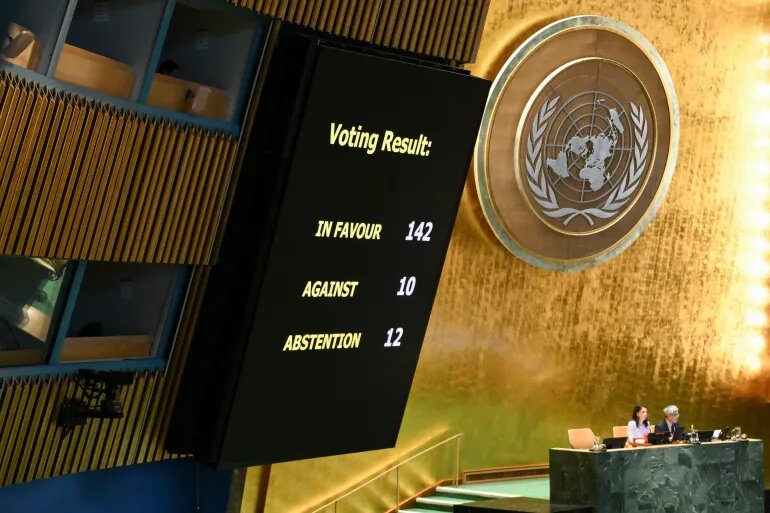
Tehran – Israel and the United States appear more isolated after the approval of a resolution from the UN General Assembly, which paved the way for the establishment of a Palestinian state.
The resolution was supported by 142 countries and opposed by just 10 people, including the US, but was adopted on Friday. In July, they approved the New York Declaration proposed by France and Saudi Arabia, reaffirming their support for the solution in the two states.
Approval of the declaration is expected to set the stage for a one-day UN meeting on two-state solutions scheduled in New York just before the high-level week of the general assembly. The conference expects several countries, including France, the UK, Canada and Australia, to formally recognize Palestine as a province.
While the Allied Italian government is increasingly divided on the issue, Germany and Italy still remain two large European countries. Meanwhile, five European countries have already banned all imports from illegal Israeli settlements.
The vote on Friday took place less than 24 hours after Prime Minister Benjamin Netanyahu insisted that Israel would never accept the Palestinian state.
Earlier this month, Foreign Minister Gideon Saar criticized Western programs at the General Assembly to recognize the Palestinian state, warning that such a move would urge Tel Aviv to take unspecified mutual action.
Currently, about three-quarters of 193 UN member states recognize the Palestinian states declared by Palestinian leaders in 1988.
The resolution comes amid the ongoing regional escalation of Israel and the devastating war with Gaza. Since the outbreak of war in October 2023, Israel’s murder of more than 64,000 Palestinians has already highlighted the growth of international isolation. Israel is being charged by the International Court of Justice genocide and human rights groups, including some within Israel. The Netanyahu government’s recent attack on Qatar has further deepened this isolation. All 15 members of the UN Security Council have condemned the strike, and Doha is preparing to hold an emergency Arab-Islamic summit on Sunday and Monday, which is expected to become a platform for regional unification over Israel.
Against the background to these developments, Friday votes for the General Assembly are of considerable importance. It emphasizes the widening rift between Israel and much of the international community. The United States continues to protect Israel diplomatically and militarily, but its position is increasingly out of reach of global consensus, raising questions about the sustainability of its impact on Middle Eastern diplomacy. For Israel, this trend indicates the erosion of traditional diplomatic safety nets, but for the United States it risks deepening awareness of hypocrisy about international law and human rights, which could undermine its position in other geopolitical spheres.