
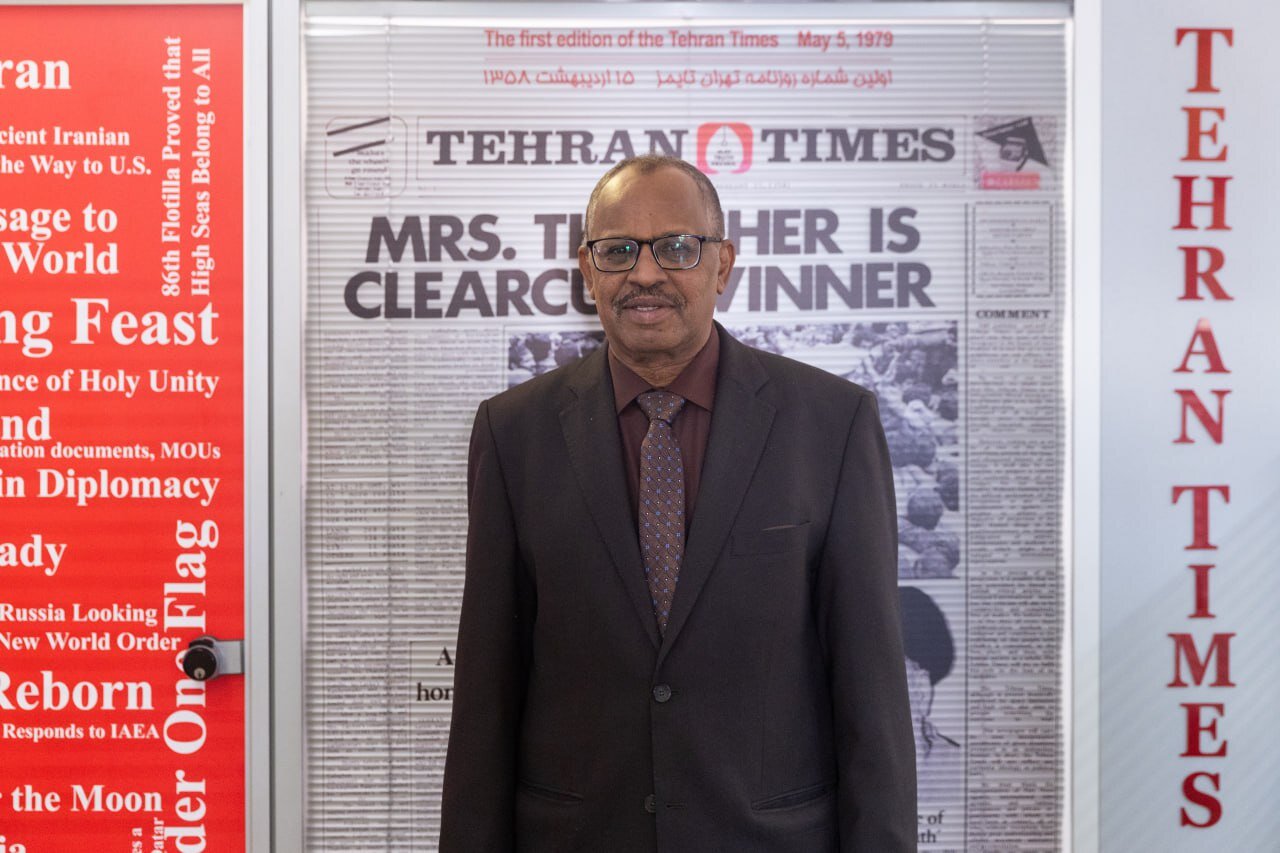
TEHRAN – On Sunday, November 9, Sudanese Ambassador to Tehran Abdulaziz Hassan Saleh visited the Tehran Times newsroom for an exclusive interview with the paper about the ongoing crisis in Darfur and the prospects for Sudan-Iranian relations.
During the meeting, the ambassador strongly criticized what he described as the “deafening silence” of Western and regional organizations in response to the recent mass killings in El Fasher, and contrasted it with the international response to the 2003-2004 Darfur crisis. He detailed Sudan’s efforts to document atrocities and submit evidence to international law bodies.
Saleh also praised Iran’s unity, pointing to a recent telephone conversation between the two foreign ministers as a sign of growing support. Reflecting on the normalization of diplomatic relations in October 2023, he expressed optimism about extensive cooperation between the two countries.
The text of the interview is below.
You criticized the muted response of some international and regional organizations to the killings in El Fasher. In your view, why has the reaction to the events of October 2025 been so subdued compared to the Darfur crisis of 2003-2004?
We, the Government of Sudan, along with the people of Sudan, are stunned by the silence of Western countries and regional and international organizations regarding the crimes committed by terrorist rebels in Darfur, particularly in the cities of El Fasher and Bara.
These countries claim to be defenders of human rights, but their actions contradict the very principles they promote regarding Sudan.
We therefore condemn these acts, designate Rapid Support Forces as a terrorist organization, and call on all countries providing support to them to condemn them.
Has the Government of Sudan initiated any domestic or international legal proceedings to prosecute those responsible for murder and other war crimes in Darfur? If so, can you elaborate on the status and scope of those proceedings?
The Sudanese government monitors and records these crimes and provides evidence to international and humanitarian organizations so that legal action can be taken through international channels.
Indeed, we sincerely thank the free nations and peoples of the world who have condemned the criminal acts committed over the past two weeks.
The Sudanese government has documented all crimes committed since the outbreak of the war in 2023 until last week. All relevant information, documents, photos, videos and evidence have been sent to regional and international organizations as well as numerous human rights institutions around the world. These organizations are currently submitting and circulating these materials to international legal and human rights bodies.
We highly value the immense solidarity and strong support shown by free public opinion, nations and all voices of conscience around the world.
In a recent telephone conversation between the Sudanese and Iranian Foreign Ministers on November 1, the Iranian government condemned the atrocities in El Fasher and affirmed its support for Sudan’s sovereignty. Could you provide further insight into the significance of this call and how it may shape Iran-Sudan relations going forward?
This position of Iran has great significance in the context of diplomatic relations.
We, the Government of Sudan, deeply appreciate and appreciate the recent telephone conversation between Foreign Minister Abbas Araghchi of the Islamic Republic of Iran and his Sudanese counterpart Mohiuddin Salem.
This call reaffirms the support of the Iranian government and people to the Sudanese government and people in the face of ongoing aggression, and the Sudanese people’s condemnation of these crimes.
This conversation reflects the Islamic Republic of Iran’s determination to condemn all acts of aggression against Islamic countries.
As a country that enjoys good relations with the Islamic Republic of Iran and is also a member of the Organization of Islamic Cooperation (OIC), Sudan considers this contact as an expression of political, diplomatic, legal and humanitarian support to the Sudanese people during this difficult time.
Following the normalization of diplomatic relations between Iran and Sudan in October 2023, what concrete steps are the two countries taking to strengthen cooperation in the political, economic, and humanitarian fields, and how is Sudan prioritizing these areas?
These relationships were recently resumed. It’s only been a year and a few months since we got back together.
During this short period, both countries and their governments reaffirmed their commitment to cooperation in various areas such as economy, trade, technology and agriculture. However, given the current situation in Sudan and the ongoing war, relations cannot develop naturally.
It is God’s will that once stability returns to Sudan, the relationship between our two countries will progress as normal as it does between other friendly countries.