
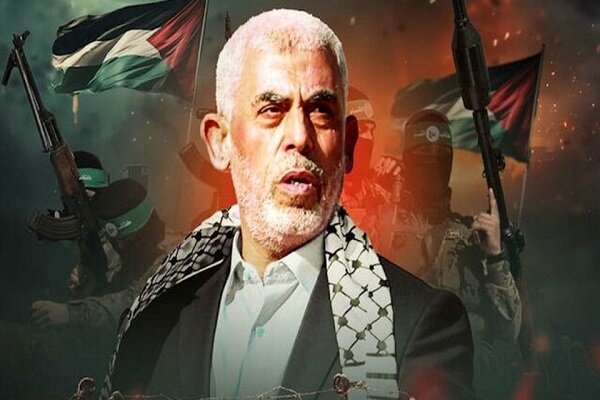
Yahya Sinwar was born and raised in Khan Yunis refugee camp in Gaza after his family was evacuated from al-Maddal city, Mehr news agency reported, citing Asharq al-Awsat. He completed his early education at a school in the camp and later earned a degree in Arabic studies from the Islamic University of Gaza.
After his incarceration, Shinwar continued his security and organizing work in Israeli prisons, serving as a leader among Hamas prisoners.
Ismat Mansour, a former Palestinian prisoner with the Democratic Front who spent many years in Israeli prisons, describes Sinwar as follows: “When you meet Sinwar, he seems like a simple, ordinary, religious man. His religious background is evident in the way he builds relationships. You cannot interact without first taking a principled stand.”
Mansour added that Sinwar refused to compromise and saw any solution or agreement only as a tactical maneuver.
Abdul Fattah Dollah, a former Fatah prisoner who also spent many years in Israeli prisons, first met Shinwar in 2006. He describes Mr. Sinwar as an outgoing and caring person.
Salah al-Din Taleb, another Hamas member who was Sinwar’s longtime cellmate and was released with him, recalls his first encounter with Abu Ibrahim: But he added that Sinwar’s security-oriented nature sets him apart from other Hamas leaders.
Obsession with prison security
In the mid-1990s, Hamas and its operational forces in the West Bank and Gaza suffered major blows, including the assassination of senior leaders such as Yahya Ayyash and Imad Akel by Israeli spy agencies, mass arrests of activists, and the dismantling of many operational networks.
These developments had a major impact on the movement, and their impact extended to Israeli prisons. It was during this period that Sinwar entered what other prisoners call the “security obsession phase.”
Shinwar and Sharit negotiations
In the early 1990s, while still in Israeli prisons, the military wing of Hamas, the Izz al-Din al-Qassam Brigades, emerged and launched a series of operations against Israeli military targets.
While in prison, Shinwar developed connections with key figures in the military sector. After his release in 2011, these bonds became even stronger and a new chapter began in his career.
This deepening relationship with the Qassam Brigades meant that he would enter a new phase of leadership once the 2011 Gilad-Shalit exchange agreement was completed and “Abu Ibrahim” (Sinwar) and his comrades were released.
His brother Mohamed Sinwar is a senior military commander who took part in the operation that captured Israeli soldier Gilad Shalit and held him captive for years until the 2011 exchange.
Inside the prison, Yahya Sinwar gained significant influence during the Shalit negotiation process. He played such a central role that at one point, Israeli officials in charge of Shalit’s file visited the prison to negotiate directly with him, recognizing his great influence over the negotiations.
Shinwar’s near-death experience
As prisoner exchange negotiations gained momentum and neared completion, Sinwar fell seriously ill and nearly lost his life, a development that disrupted Israeli calculations.
Dora recalls: “Sinwar was tough and always refused to go to the prison medical center.”
His condition worsened until he lost consciousness, and fellow prisoners rushed him to the infirmary. His transfer to the Beersheba prison infirmary caused panic among prison authorities, who immediately declared a state of emergency and locked down the entire area.
In an unprecedented move, a helicopter landed on the prison grounds and rushed Shinwar to Soroka Hospital for immediate surgery, as Israel has long ignored the health of Palestinian prisoners.
Doctors discovered a benign brain tumor and quickly removed it. Mr Sinwar underwent a “very complicated and dangerous surgery” which almost cost him his life.
Israel’s unusual response to Shinwar’s illness reflected the confusion during the Sharit negotiations and deep fears that his deteriorating health could derail the deal at the final stage.
“Al Qassam Brigades and Sinwar” from 2011 onwards
After being released in a prisoner exchange in 2011, Sinwar not only resumed security responsibilities within Hamas, but also strengthened his ties with the movement’s military wing.
He was elected to the Hamas Politburo in 2012 and quickly became the liaison officer with the Qassam Brigades. Eventually, in 2017, he became Hamas’ political director in Gaza.
Early signs of ‘al-Aqsa flood’ in Israeli prisons
Dora said there was always a feeling among the prisoners that Sinwar was “destined for a serious mission.”
This impression was reinforced over the years through his speeches and messages to fellow prisoners.
The Al-Aqsa flood operation and subsequent Israeli massacres in Gaza led Israel to view Shinwar as a central figure in the conflict and gave him full responsibility for the operation.
MNA/6623010