
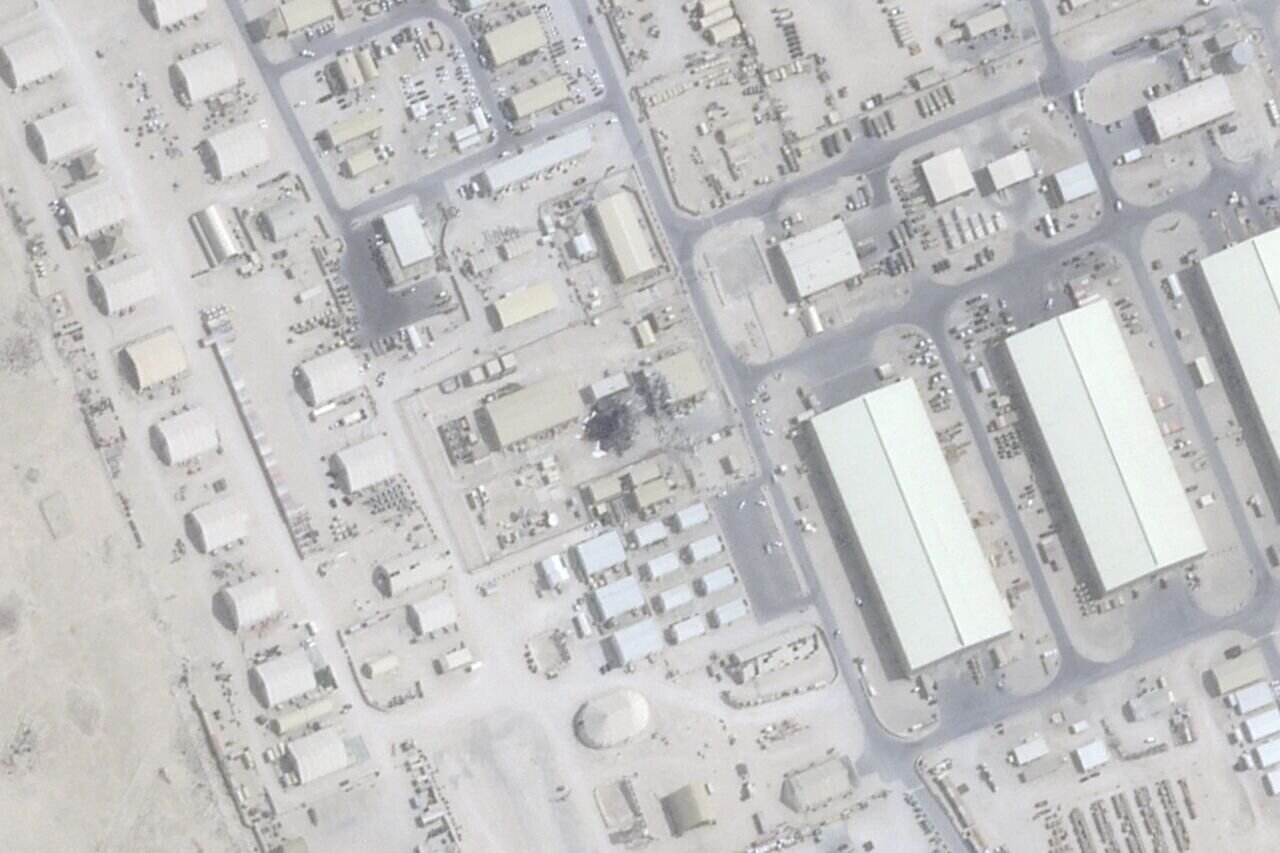
MADRID – On June 23, 2025, several Iranian ballistic missiles hit Al Udeid Air Force Base in Qatar as tensions between Iran and Israel reached their highest point in years. This was not a normal target. It is the main hub of US military operations in West Asia and an important symbol of the US power projection in the region.
According to information previously disclosed by the Tehran Times, Iran notified the US about the attack 12 hours before it happened. The official response in America was quick and predictable. Both Washington and Doha disregarded the incident, claiming there was no casualty or serious damage. However, reality quickly overturned the story. Satellite images released days later confirmed the destruction of the geodetic dome, which housed the U.S. Central Command’s critical communications system.
Rather than an anecdote, this episode marks a strategic turning point. Iran has shown that it can attack critical infrastructure under US protection, redrawing the contours of the Persian Gulf deterrence. Missiles stop being merely a weapon of war. It becomes a tool for sovereignty and strategic assertion.
Between official refusal and satellite evidence
The US version was clear and solid from the start. “There is no casualty or damage,” a Pentagon spokesperson repeated. However, satellite evidence, analyzed by international media and independent agencies, spoke a different story. Images taken between June 23rd and 25th showed the disappearance of $15 million in collateral damage to the communications dome, debris and surrounding structures. The base remained in operation, but the loss of key elements for electronic warfare raised questions about the effectiveness of US missile defense and the reliability of official accounts.
Refusing to admit the strike, Washington follows a double logic. Maintaining control over the media’s narrative and avoiding perception of vulnerability in front of actors despite sanctions and isolation has reached a noticeable level of technical refinement.
Al Udeid: The symbol of hegemony in question
Located about 30 km from Doha, Aludade is more than just a military base. It serves as the forward headquarters of Centcom and is a neural centre for coordinated operations in Iraq, Syria and Afghanistan. Its symbolism goes beyond the military. It is the cornerstone of the security structures that the United States has built in the region since the first Persian Gulf War.
The fact that Iran was able to attack such sites, and that the US military reportedly evacuated aircraft and sensitive personnel in advance, does not reduce the importance of the attack. On the contrary, it shows that Tehran sent an accurate warning and Washington took it seriously. Deterrence, long dominated by the US and Israel, is no longer one-way.
Missiles as national strategies: evolution and autonomy
The strike against Al Udeid was not an isolated act, but a result of intentional evolution. For more than 20 years, Iran has systematically invested in ballistic missile development as an asymmetric response to the advantages of enemy air and nuclear power. Faced with Western restrictions, Tehran adopted the doctrine of defensive self-sufficiency based on three pillars.
Diversification: Short, medium and long-range missiles like Shahab-3, Ghadr, Qiam and Sejjil that can reach Israel, US bases and parts of southern Europe.
Mobility: A mobile launch system that is difficult to detect and neutralize.
Accuracy: An advanced guidance system that reduces margins of error to levels that even Western analysts agree.
Unlike other regional missile programs, Iran’s development is overwhelmingly domestic. This technical and logistical autonomy allowed the state to bypass embargoes and threats, turning missiles into the backbone of the doctrine of defense.
Following Israel’s attacks on nuclear, military and civilian sites within Iran, Tehran responded with massive launches of over 100 ballistic missiles and suicide drones targeting Israeli military status. For the first time, Iranian ballistic weapons were used all at once in an open conflict.
Despite iron domes and other Israeli defenses, several missiles invaded and attacked Tel Aviv, Haifa and military bases. The missile attacks not only caused physical damage, but also had strategic impacts. It’s saturation of defense, promoting emergency deployments, and creating unprecedented internal pressure on Israeli authorities.
Al Udeid’s strike was the culmination of his graduation strategy. It involves attacking Israel, neutralizing its attack capabilities, and sending a message directly to the United States. The ceasefire that continued a few days later cannot be understood without considering missile components as deterrents.
Sovereignty and Independence: Iran’s Perspective
Since the Islamic Revolution of 1979, Iran’s foreign and defence policies have been rooted in the principle of non-negotiable sovereignty. In hostile environments, surrounded by foreign bases and under sanctions – the development of ballistic missiles has been framed not as a belligerent impulse, but as a survival strategy.
Tehran claims that the only guarantee that faces threats like the US “maximum pressure” campaign and Israel’s target strikes is its ability to respond. It argues that effective deterrence is only possible if the aggression ensures that it comes at a high cost.
The attack on Al Udeid follows this logic. It was adjusted, accurate and intentionally not lethal. Its aim was not to cause regional wars, but to emphasize that Iran has both the ability and determination to defend its important interests. In this vision, missiles are not a threat. It’s a political debate.