
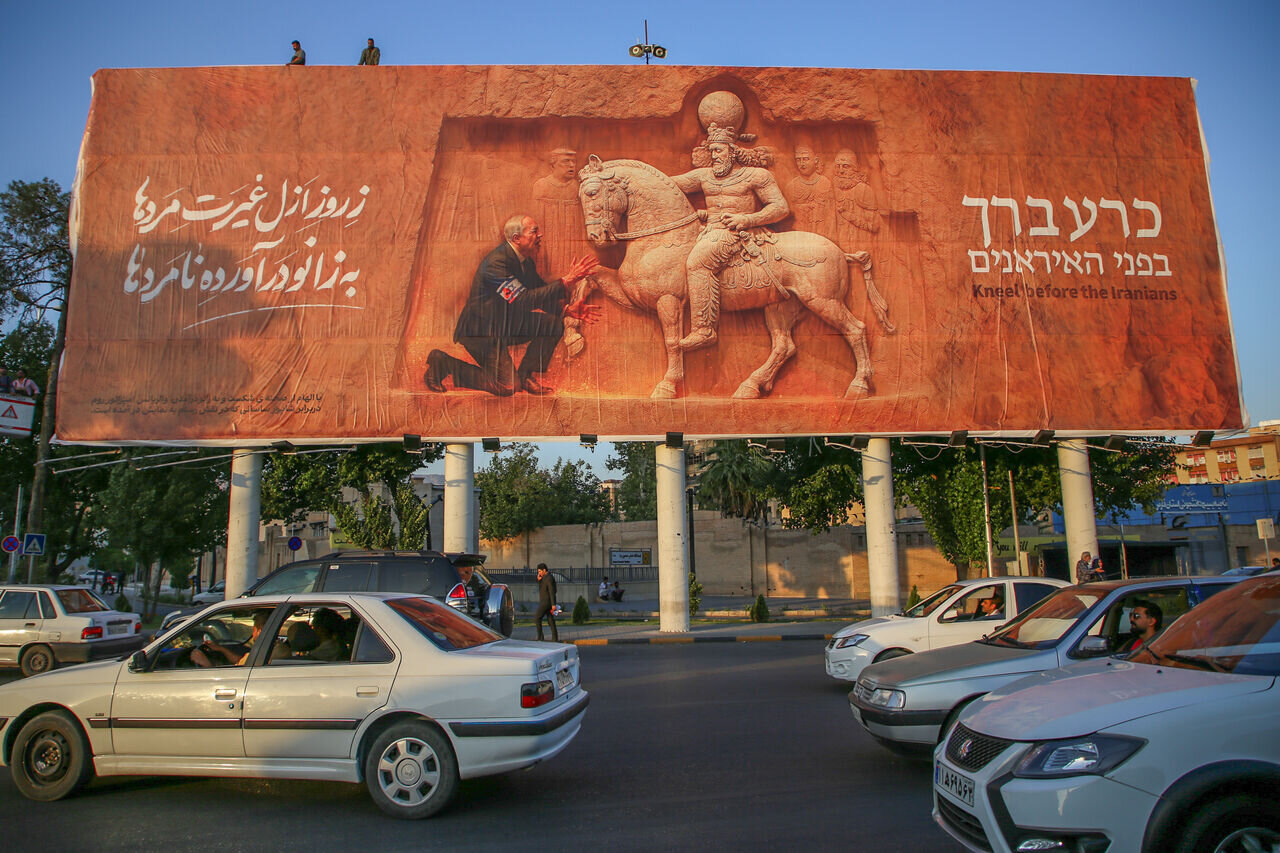
Tehran – A large new sign on Imam Hussein (AS) Square in Shiraz, Faz Province, tells the story of the victory of Iranian ancient civilization.
Iran’s vast lands are often coveted throughout history by oppressive invaders due to their strategic geographical status. However, the land does not have the brave and honorable men and women who have always beaten invaders throughout history, the IRNA reported.
The relief of three ancient rocks, Persepolis, Dalab and Tan Echogan, in Kazerun, Fars Province, is nationally and world-renowned for their portrayal of Emperor Sassanid Shapur I’s victory over the Roman Emperor Valerian.
Following the defeat of the Roman army by Shapur I, Roman soldiers, commanders and their leader Valerian were captured. In honor of this huge victory, Shapur ordered the scene to be carved into stones in multiple locations.
These Sassanido era sculptures are now influencing newly announced signs at Shiraz. The designer of Billboard is Saeed Karimi, a well-known graphic artist from the state of Fars.
“Again, the artists of Fars stand by the people, and through the language of art, they reminded me of the greatness and honor of Iran and its people,” Namaj said.
He added that the robbing Zionist regime and its American overlord have long been pursuing paths of oppression, attack, looting and coercion under the guise of the superiority of Western civilization. While oppressed countries around the world suffer under tyranny, international groups that argue that support peace and justice remain passive. Some rulers of Islamic countries have effectively supported such savage behavior through their silence and indifference.
“After thousands of days of oppression and child murders in Gaza, the Crime Zionist regime dared to look to the centre of the Islamic world, based on flawed analysis and misguided advice. However, in the face of a serious and calm response from the Iranian state, it took it back from reality and its delusions.”
“It was necessary to remind the West of the possibilities of the Islamic Republic of Iran and to understand that they will stand up to the state with more than 3,000 years of cultural and civilised heritage.
“This sign in Shiraz’s historic city once again reflects the lasting legacy and power of the Iranian state. In these turbulent times of war, it reminds us of the Zionist regime that killed children and its previous patrons before them.
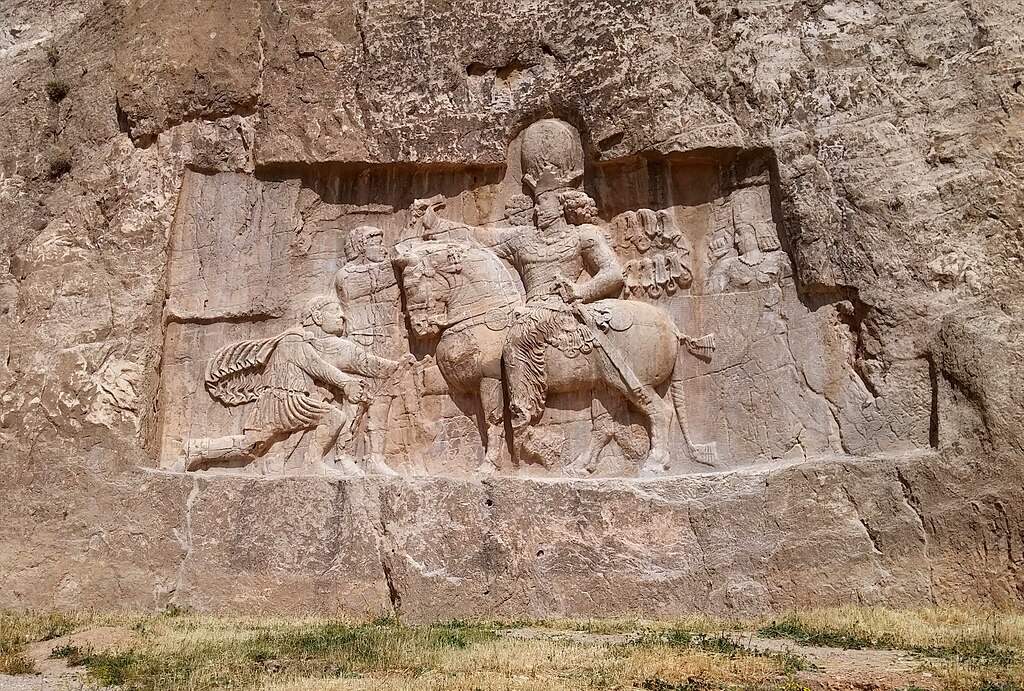
The victory relief at Naqsh-e Rostam in Shapur I is a rock sculpture located three kilometers north of Persepolis. It is one of the eight Sassanid Rock Carvings from Naqsh-e Rostam.
Anrelief depicts a scene in which the Roman emperor Valerian kneels before Shapur I, seeking mercy.
Shapur I, the Persian King of Sasanian, captured the Roman Emperor Valerian after the Battle of Edessa in Edessa (now the Turkish city) in 260. The event was considered an important humiliation for the Roman Empire and was a major victory for Shapur. The capture of the Roman emperor was unprecedented and became a symbol of Sasania’s power.
In the sculpture, Shapur I rides a large horse with a royal crown and decorated robes. Valerian has a Roman crown and a robe on the shoulder. Valerian reached out both his hands as a sign of forgiveness. The greatness of the Iranian king can be clearly seen in the crown, bracelet, hairstyle, and his horse saddle and bridle.
Saeed Karimi’s artwork is a modern version of that rock salvation. The rider remains Shapur I like an ancient sculpture, but the kneeling figure has been digitally altered to represent a modern Warmonger wearing an armband with an Israeli flag, and he is nothing but Israeli Prime Minister Benjamin Netanyahu.
The background features original stone carved figures, but reinforced with a powerful message, enhanced by Persian, Hebrew and English texts. “Knee in front of the Iranians.”
There is also a line of poems written on billboards. “Since the dawn of time, the honor of a true man has put disgrace on his knees.”
The artwork, along with the lines of text messages and poetry, refers to the recent brutal attacks by the Zionist regime on Iran.
Early on June 13, Israel launched a massive, untrained, armed attack on Iran. This was a terrible act of attack by all definitions.
Until June 24th, through coordinated air, missile and drone strikes, it targeted residential areas, private infrastructure, public agencies, and nuclear facilities subject to International Atomic Energy Agency (IAEA) protection.
In response to Israel’s attacks on Iranian territory, the Islamic Revolutionary Guard (IRGC) launched a massive retaliation operation called “True Promise 3.”
The war between Iran and Israel stopped on June 24 after 12 days of dizziness threatened President Donald Trump to demand the evacuation of 10 million Tehran residents, assassinated Iranian leaders, defended a “change of government” and launched a strike at Iranian nuclear site.
Meanwhile, for 12 days, Iranian missiles and drones fell on the occupying territories without pause, leaving at least a third of Tel Aviv in abandoned. Similar scenes have been spotted in other major cities such as Haifa and Biasheba, with key military and intelligence agencies being destroyed by Iranian weapons.
SS/SAB