
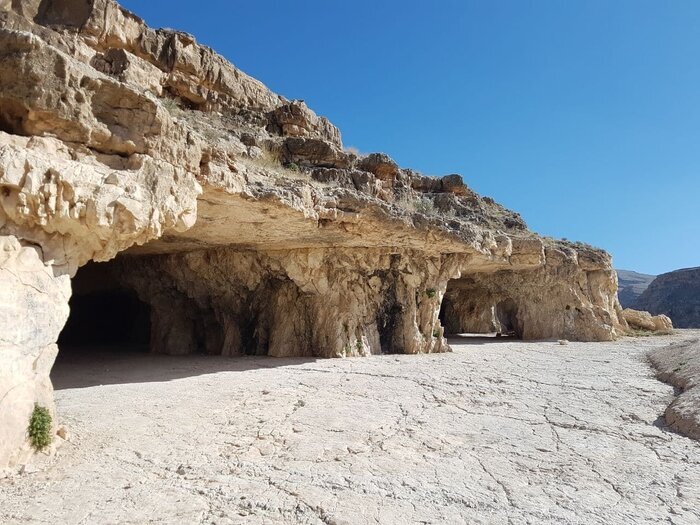
The Saint-Checanan (stone) cave, located south of Yahoo Ro, Fars Province, is known as the world’s largest handmade cave, but many people in Iran and Fars have not heard of it yet. There are very few visitors.
The distance from the cave to Jafflom City is 3 km. Research suggests that for hundreds of years, some masons used these stones for their livelihoods.
They created a beautiful attraction with the stone breaker hatch, which has become one of the world’s largest handicraft caves. The size is 5 hectares.
In fact, this place was a quarry for extracting stones from buildings until 100 years ago, but is now listed as the largest hand-carved cave under number 10117 on the country’s national heritage list.
From a geological perspective, the different layers of bedrock at this location are different, with a layer about 5 meters thick surrounded by the other two layers. Because this layer can be cut and extracted with a simple tool, masons cut and pull out small pieces of rock from these layers, and draw them out, and with every 10 metre progress, large pillars remain to maintain the stability of the stone rocks to maintain the stability of the stone rocks.
As this excavation and column creation continued for decades, caves with 100 stone pillars formed. This is a grand and amazing human work.
The cave has 12 entrances, 200 meters long, its width varies from 60 to 130 meters, covering a total of about 20,000 square meters and an average height of 3 meters.
When the stone breakers picked up the stone, a few meters away they were causing several pillars to prevent the caves from destroying them. So this would have made the cave beautiful. There are 100 stone pillars that fall into two categories due to the quality of the stone.
The first category includes columns with many gaps and gaps. It did not separate because of the lack of quality stone. The second category includes columns with gaps and gaps, so the stone has quality and was not picked up to prevent the roof from falling.
The white lime stone and plasticity of this cave were used for door ornaments and great important buildings.
Several natural factors, such as floods and earthquakes, are also effective in destroying parts of the cave for many years. But what everyone is calling to see now is a beautiful cave with 100 carved pillars that will surprise viewers.
According to the head of Jahrom Cultural Heritage, Tourism and Handicrafts department, the cave has good locations and is easy to access for tourists.
Ali Lotfipour said the cave is located in Jahrom city and within 15 minutes of the city centre. The road to the cave is perfectly asphalt and easy to access, he added
Lotfipour said the proximity to accommodation infrastructure such as cave environmental lodges and hotels created appropriate conditions for tourists to visit.
He added that the city’s hotels have the capacity of around 200 tourists and nearly 200 people are capable of eco-lodges and elsewhere.
Lotfipour continued that the caves are illuminated, but due to a lack of talent in the cultural heritage sector, the conditions for assigning full-time guards to this iconic Jahrom heritage are yet to be met.
He noted that measures to register Saint-Checanin’s caves as the world’s largest hand-carved cave will have a major impact on attracting domestic and international tourists.
Jahrom is located 186 km southeast of Shiraz.