
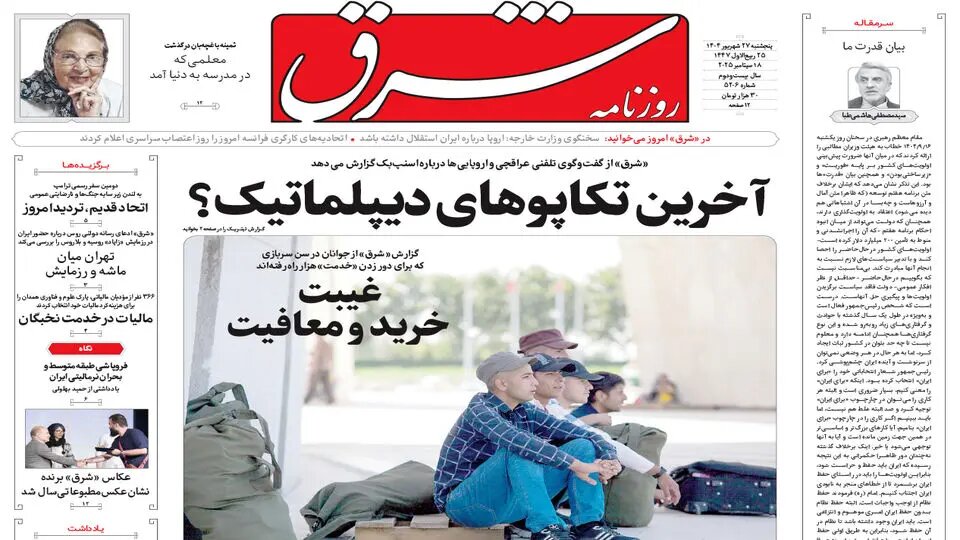
Sharg analysed Iran’s participation in the “Zapad-2025” joint exercise and wrote: The exercise took place in a situation where there were only a few days left before (UN) sanctions on Iran could be possible.
After months of tough negotiations and experiences of Israeli and the US attacks, Tehran is still at a diplomatic deadlock, with Europe and the US on their nuclear file, tying not only about asserting nuclear transparency by Iran, but also linking nuclear-free issues such as missile power, regional policy and relations with the Tehran Mosque. From the perspective of Western analysts, Iran’s presence in Zapad’s exercises with Russia and Belarus’ participation can be viewed as an implicit confirmation of Tehran’s connection with the Moscow axis. Participation in multinational movements could balance threats and send a clear message about preventing Iran’s geopolitical isolation. Rather than necessarily being considered a perfect alliance with Moscow, an attempt to strengthen deterrence against future threats.
Hamshahri: The dangers of Europe
In a memo, Hamshali worked on the hardening of European tone towards Iran. A statement from Mohammad Eslami, head of Iran’s atomic energy organization, can be analysed about the positive atmosphere of the Vienna consultation, coupled with the hardening of European tone, as if Europe was unhappy with the declining position facing Iran. It gave us the opportunity to demonstrate that Europeans can replace the United States and play a meaningful role in major global issues such as Iran’s nuclear negotiations.
Therefore, this dream-distorting process is treated badly. In fact, European troika are basically not interested in solving problems with Iran. Now that they are on the sidelines by the US, they are trying to revive their role in global development. Therefore, they are always looking for excuses. Eslami’s statement that their language has become stricter also confirms this, so European concerns about losing their position on Iran’s nuclear issue have led to it being a harsh tone.
Arman-e-Emrooz: Iran’s agreement with the IAEA was intended to prevent snapbacks
Commenting on the Iranian agreement with the IAEA, Arman-E-Emrooz said: The Iranian institutional agreement was the product of several consultations between Tehran and Vienna’s IAEA and Iran, and the last stop in Cairo, between Araguchi and Grossi. The contract reached about two weeks ago, where there could be a potential snapback sanctions. Therefore, it remains to be seen whether the door to diplomacy that manages the current crisis can be opened. It appears that Tehran’s main purpose under this agreement is to prevent the activation of the snapback mechanism, a condition that European troika claimed full cooperation with the IAEA. For now, the agreement has increased somewhat the possibility of a temporary suspension on snapbacks, but it is still unclear what the European and American sides will ultimately conclude.
Iran: Tehran is trying to find a common language with Arab countries
An Iranian newspaper said the Islamic Republic faces the fundamental challenges of finding a common understanding of the dangers posed by Israel’s Zionist regime. Every time Iran talks about the need to contain Israel, many Arab countries fear that Tehran will use this approach to increase regional influence. This means that these countries acknowledge the threat of Israel’s expansionism, but are reluctant to form an alliance with Iran when they stand up to power. As a result, they are in a state of confusion. On the one hand, they feel threatened by Israel, and on the other hand they fear a recovery of the power of the Iranian region, but in reality they have failed to contain the instability caused by Israeli actions. This situation has resulted in a kind of Arab passivity for regional development. In such circumstances, visits of officials such as Ali Larijani, Iran’s top national security officer, could provide an opportunity to find at least a common language, with the presence of Ali Larijani to Saudi Arabia and Iranian delegations at the Doha Summit. However, there is a serious question that this process could lead to the level of formation of a common front between Iran and the Arab states.