
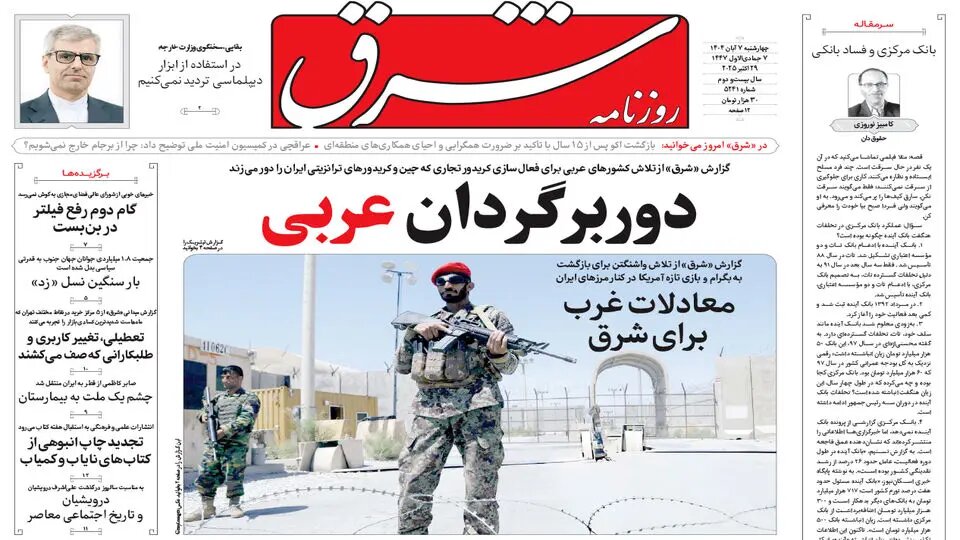
TEHRAN – Egyptian studies professor Abdullahmir Nabavi reflected on Cairo’s motivations for mediation on the Iranian nuclear issue in an interview with Shargh newspaper.
He believes that while Cairo’s involvement may seem surprising compared to the long-standing role of Oman and Qatar in mediating between Iran and the West, it is understandable given Egypt’s regional concerns and diplomatic ambitions. Due to the depth and complexity of its history, Iran’s nuclear file tends to rapidly acquire transregional dimensions whenever tensions arise. From this perspective, Egypt is concerned that the escalation of the conflict between Iran and world powers, or the recent clashes between Iran and Israel, may push the region into a new stage of instability that regional actors may no longer be able to contain. Therefore, Cairo’s main objective in approaching the issue was to manage the crisis and prevent its escalation. That said, the overarching goal shared by all mediating countries, including Egypt, Oman, and Qatar, is to avoid direct conflict between Iran and the United States or between Iran and Israel.
Java Island: Indigenous Development and Iran’s Regional Prospects
Neighborhood policy, which has been a central pillar of the Islamic Republic of Iran’s foreign policy under recent administrations, has been promoted by the new administration with an emphasis on constructive engagement, lasting stability, and endogenous regional development. Hosting the ECO Summit and active involvement in the event reflects the Islamic Republic’s political will to restore regional capacity, redefine economic and security linkages, and expand multilateral cooperation with ECO member states. When this region takes on a security or military character, it is mainly due to the destabilizing presence and intervention of extra-regional powers. In this context, Dr. Pezeshkian’s proposal to establish a Regional ECO Police Force (ECOPOL), strengthen law enforcement and judicial cooperation, and strengthen border control and the fight against smuggling and terrorism represents a step toward building a coordinated and indigenous security structure among regional countries.
Sob-e-No: Iran’s foreign policy based on independence and balance
Mr. Sobouenou analyzed Iran’s cooperation with China and Russia and argued that it is impossible to properly understand Iran’s current position in the world order without reexamining the principles of the Islamic revolution. Iran does not seek to follow the East, nor does it accept Western domination. Rather, the goal is to establish a balanced and fair relationship based on national interests. Cooperation with China and Russia is therefore consistent with the Islamic Republic’s strategic interests. In recent years, these two countries, unlike Europe and the United States, have refrained from supporting Iran and supporting Washington’s anti-Iranian positions. It is therefore natural that expanding these ties forms part of Iran’s broader strategy to counter Western pressure and strengthen Iran’s position in the multipolar world order. Despite this, pro-Western factions within Iran continue to take a one-sided view of foreign policy. From their perspective, engagement with the West amounts to progress, while cooperation with the East means isolation and backwardness. Indeed, this outlook deprives the country of diverse international opportunities and causes the loss of many economic and technological prospects due to hesitation in decision-making and fear of Western reaction.
Iran: regional fusion centered on Tehran
Iranian Newspaper interviewed Behzad Azarza, director of the ECO office, about the importance of the Economic Cooperation Organization headquarters in Tehran. He said ECO has now reached a level of maturity that connects 10 countries in the region through economic, cultural, scientific and political ties. Based in Tehran, ECO has provided Iran with both strategic and political advantages. According to Azarza, this not only reflects Iran’s historical and political position in the region, but is also a strategic opportunity for the seven member states to strengthen economic, transport and cultural ties in a region that lacks direct access to the high seas. ECO has managed to maintain its vitality and relevance at a time when many regional organizations around the world are facing existential threats due to US unilateralism and the weakening of international institutions. Even during the period of political and economic restrictions imposed by sanctions, it has brought measurable benefits to Iran. ECO now provides Iran with both a platform for new opportunities and an arena to demonstrate its strategic role in connecting East and West, and North and South Asia.