
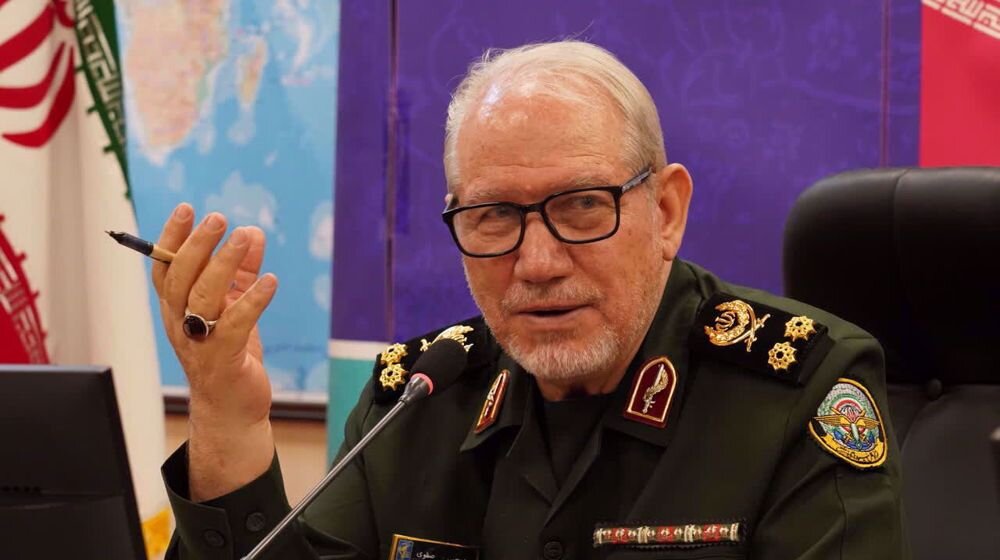
TEHRAN – Iran’s senior military advisor said that competition between trade corridors has become a crucial issue in today’s world.
Major General Yahya Safavi, a senior aide and advisor to Islamic Revolution leader Ayatollah Khamenei, said: “The world today is engaged in a new competition known as corridor warfare, a competition defined by railways, sea routes and transport roads.”
The commander-in-chief also emphasized the growing importance of Iran’s geopolitical situation, saying that countries that enjoy favorable geographical conditions and security can reap the maximum benefits of trade corridors.
Iran’s special geographical location lies along the north-south and east-west international corridors connecting West Asia with East Asia and Europe, making it a special transit point for the country. Iran’s western rail network connects Türkiye and Europe. In the northwest, to Azerbaijan. To the north are the Caspian Sea, Turkmenistan, Kazakhstan, Azerbaijan, and Russia. In the northeast, it extends to Turkmenistan, Central Asia, Russia, and China. Southeast to Pakistan, south to the Persian Gulf and the world’s open seas.
Iran’s potential revenue from rail transport is estimated at approximately $1.8 billion annually from trade exchanges between East Asian countries and Europe through the East-West Corridor, and approximately $90 million through the North-South Corridor.
This shows how important the East-West Corridor is to Iran. Currently, the Sarafs-Bandar Abbas line is Iran’s most active railway line, providing 80% of the country’s transport revenue.
General Safavi added that Iran relies on a unique situation linking east and west, north and south, and can serve as the linchpin of a new balance in the region.
Emerging economies such as China and India, the key actors seeking to complete the region’s corridors, are seeking to open multiple routes for trade.
While no trade route in the region can replace the trade route through Iran, a parallel route could reduce the country’s shipping advantages.
Therefore, any delay in Iran securing its share of regional traffic would benefit competitors and seriously harm Iran’s national interests.
Iran’s geographical location on both the East-West Corridor and the North-South Corridor is undoubtedly unique, especially considering the economic, security and time-saving advantages the country has, which also allows for access through the combined corridor.
However, the preference for political observation by some political parties is causing problems, and strong political negotiations and expanded political and economic ties are required to place Iran at the center of regional connectivity plans.
Any failure could deprive Iran of many benefits in this regard, but excluding the Islamic Republic from the regional connectivity map would impose significant costs on other countries.