
TEHRAN—The oldest artifacts found in Chaharmahal Bakhtiari province include stone tools and artifacts from the Upper Paleolithic and Early Neolithic periods.
These artifacts were discovered and studied in ancient caves in the cities of Shaare Kord, Ardar and Rodegan and are approximately 10,000 to 11,000 years old, writes Milas e Arya (CHTN).
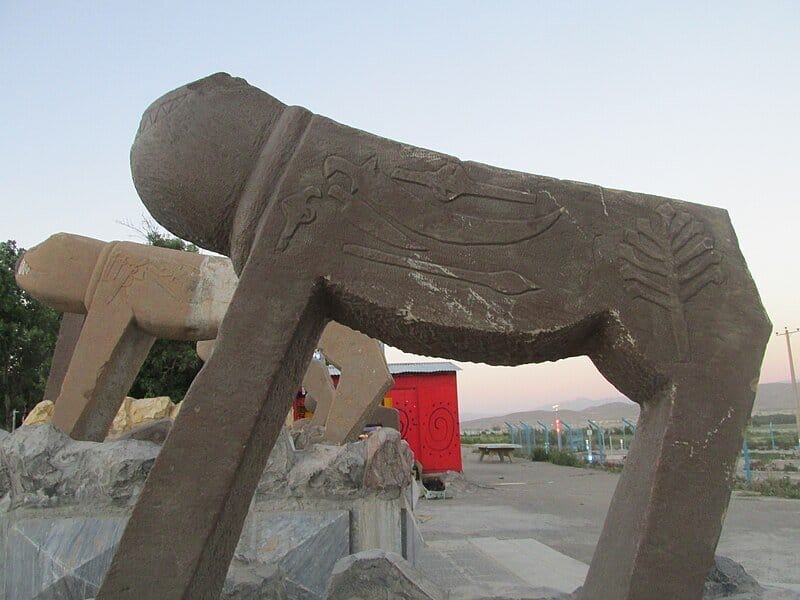
Mass graves, stone staircases, stone inscriptions, statues with images of lions (known as Siri Sanghi), and stone caravanserais are some of the stone inscriptions from the Elimaid and Sassanid periods that are now protected as ancient monuments.
The relatively intact lion statues in cemeteries in Farsan, Qur’an, Ardar, and Kyar districts are actually a legacy among the Bakhtiari people from the Qajar period.
This lion statue speaks of the courage and bravery of the Bakhtiari Ilkhans, warriors, horsemen, khans, sheriffs, chiefs and elders, who resemble lions.
For this reason, when one of these elders died, a lion statue was made by a local stonemason and placed in the grave of the elders, and the body of the lion statue was carved with the shapes of a sword, a rifle, a horse, etc., as well as the details of the deceased.
In fact, lion statues on the graves of warriors and those who died in wars embellish the turbulent history of the people in mythical form and remind us of the men buried in the center of the earth.
The tools for carving and stone carving were the same traditional and primitive tools used centuries earlier. Various chisels, heavy hammers, semi-heavy hammers, and diamond-edged steel pens are handmade according to the purpose.
Due to the low consumption of stone products by the general public in this region, the production of stone crafts is limited to orders in a few rural and nomadic areas.
To produce stone crafts in Chaharmahal-Bakhtiari province, after transporting the required stones to the workshop, the initial shape and anatomy are first designed, and then a pen and hammer are used to complete the shape and limbs. Most of the designs and shapes in stone carvings and stone volume structures are geometric and abstract.
One of the rituals in the culture of the Chaharmahal-Bakhtiari tribe, especially the Bakhtiari tribe, was to place lion statues on the graves of the immortal and famous great figures of the tribe.
The lion statue is a symbol of great qualities and characteristics such as courage, bravery, and artistry in hunting, shooting, warfare, and individual horsemanship.
Islamic lion statues can be found in Chaharmahal-Bakhtiari and Khuzestan provinces and surrounding areas, and Hafshejan in Shahr-e-Khord province has been the most important center of lion statue production from the beginning until now, and is used mainly by the brave people of the Chaharmahal-Bakhtiari tribe.
The oldest lion statue found in Chaharmahal-Bakhtiari province is associated with ‘Abdulhamid bin Ibrahim Hafshejani’ in 1013 AH (435 years ago), and its origins date back to the Safavid period, and there are definitely older Islamic examples in the region.
Mohammad Bagheri Hafshejani, one of the stone carving and carving artists from Hafshejani in Shaare Kordo district, believes that today, stone and carved products in handicrafts are no longer a priority for people. He emphasized that orders for stone crafts have decreased significantly due to the recent price hike and the decline in people’s purchasing power.
Among stone and carved items, he said that there are currently many fans of stone carvings, mortars, tombstones, and flower mills (handmade stone mills).
Alireza Ceylan, director of the Chaharmahal Bakhtiari Cultural Heritage, Tourism and Handicrafts Department, said that Sohne carving, a relic of the Stone Age, is one of the indigenous disciplines of the province and its history dates back centuries.
He emphasized that this art and craft has been used since ancient times to make all necessary crafts and tools such as millstones, flour mills, gutters, mortars, and lion statues.
However, unfortunately, due to various reasons, most stone crafts are not widely available to people and are only used and consumed in a limited way in nomadic areas and remote villages, he added.
He considered the lion statue to be one of the most important and popular handicrafts in the field of sculpture and stone carving in Chaharmahal-Bakhtiari province, adding that the lion statue is a symbol of courage and courage.
KD