
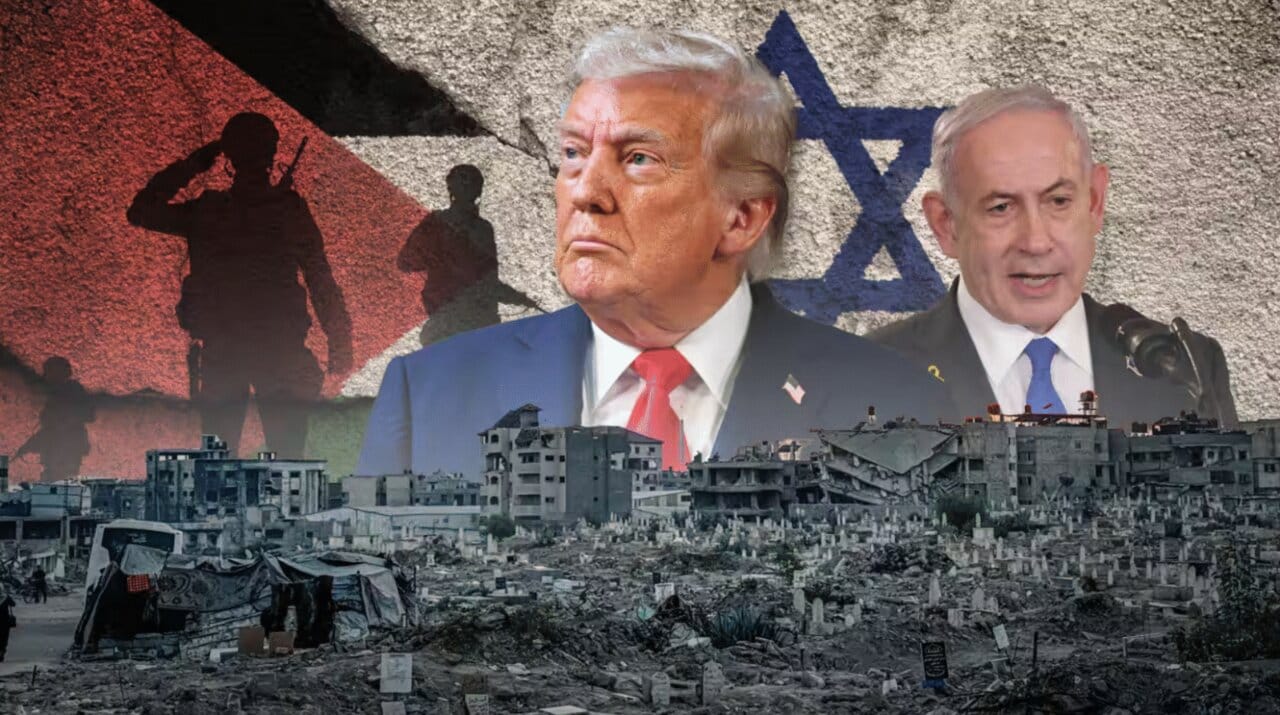
By disarming the Palestinian Islamic resistance, imposing foreign control and continuing Israeli occupation, they will spread new seeds of conflict in Palestinian territory instead of ending the war.
Presented with the alleged purpose of “end the war in Gaza,” President Donald Trump’s 20-point plan will not only lead to lasting peace, but will also strengthen conflict escalation and integration of Israeli occupation structures.
The plan, formulated and developed with the participation of Israeli Prime Minister Benjamin Netanyahu and the likes of former British Prime Minister Tony Blair, seeks to revive past colonial patterns from a political and strategic perspective.
This article discusses the main challenges of this plan and why it would be a failed project to achieve peace.
Historical background of Trump’s plan
Trump’s plans in Gaza are presented in the context of a long history of foreign intervention in Palestine. World powers from the Palestine Declaration (1917) to the Oslo Accord (1993) repeatedly sought to manage the Palestinian-Israel conflict by imposing political and security structures. These plans often failed to ignore the will of the Palestinian people and prioritize the interests of foreign powers and Zionist regimes. Instead of providing a comprehensive solution, Trump’s plan continues the same one-sided pattern seen in plans such as “Trades of the Century” (2020). By highlighting Hamas’ disarmament, establishing an international watchdog and maintaining the existence of Israeli security, the plan not only fails to address the roots of the conflict (a violation of occupation, Palestinian rights, denial of rights to return), but also calls for Palestinians to impose orders that deprive them of their right to self-determination.
Key Planning Challenges
1. Disarming the Palestinian Islamic Resistance Movement: The main topic of Trump’s plan is the immediate disarming of the destruction of Islamic Resistance Movement, Hamas and its military infrastructure. This condition, accompanied by the threat of heavy sanctions, is not only unrealistic, but also means denying the Palestinian rights to legitimate defense against the occupation of the Zionist regime. Palestinian resistance, Hamas in particular, has historically been an inseparable and integral part of Palestinian struggle for freedom and independence. According to Ismail Al-Thawabta, the government intelligence director of Gaza, the plan is “an attempt to justify Israel’s occupation and place new missions on the Palestinian people with its people, politics and human rights.” Disarming the resistance movement without guaranteeing the fundamental rights of the Palestinians, such as the right to return or the establishment of an independent state, means it has been abandoned in an ongoing occupation since 1948. Historical experience shows that Palestinian resistance is not under similar pressure and continues to struggle. Therefore, this condition will not lead to peace, but will likely promote resistance and strengthening conflict.
2. Revitalizing the external management of Gaza and the colonial model: Trump’s plan raises the creation of an international organisation, “Council of Peace,” under the supervision of Donald Trump, and the participation of former Prime Minister Tony Blair, who oversees the “technocratic and non-political” Palestinian committee to manage Gaza’s public services and urban issues. This structure is clearly reminiscent of past colonial models in which foreign powers ruled territories occupied under the pretext of reconstruction and development. The existence of Tony Blair, who has been widely criticized for his role in the Iraqi Invasion (2003) and his support for his false claims about weapons of mass destruction, is controversial. Mustafa al-Bargauch, executive director of the Palestinian National Initiative, said: “We were previously under British colonialism. Tony Blair has a negative reputation here. When you mention Tony Blair’s name, the first thing people remember is the Iraq War.” Comparing the proposed roles of Paul Bremer and Blair, the Iraqi American civilian ruler after the 2003 invasion, reveals disturbing similarities. Bremer contributed to Iraq’s instability and chaos through policies such as the disbandment of the Iraqi army. Blair’s presence in Gaza could have similar consequences given its lack of legitimacy and the deep lack of Palestinian mistrust. This model of external management, which strips Palestinians of true participation in land governance, not only contributes to peace, but also raises further resistance as a new colonial project.
3. A lack of full withdrawal and continued occupation of Israel: One of the fundamental weaknesses of Trump’s plan is the lack of commitment to the full withdrawal of Israeli forces from Gaza. The plan proposes the gradual withdrawal of Israeli forces without a specific schedule. This means maintaining security controls for the Zionist regime in the northern and southern parts of Gaza. Palestinian analyst Hani Al Masri said in this respect: “The plan that did not designate the actual withdrawal of Israeli forces from the Gaza Strip through a gradual withdrawal without time limit means that Israeli security controls will remain until further notice,” which contradicts Trump’s claim that “Israel will not occupy Gaza.” The continuation of Israel’s military presence, even in limited ways, means a continuation of occupation and a violation of Palestinian sovereignty. This situation not only prevents the reconstruction of Gaza and the return of refugees, but also allows the Zionist regime to launch new attacks under the security pretext. Historical experience shows that the Zionist regime used such circumstances to consolidate its control over Palestinian land.
Why isn’t Trump’s plans leading to peace?
1. Unilateral alignment with the Zionist administration: Trump’s plans are clearly designed to serve the interests of the Zionist administration, working in favor of Israel rather than balancing the parties. By focusing on Hamas’ disarming and eliminating its political role, the plan seeks to eradicate Palestinian resistance, while imposing no restrictions on Israeli military operations. Trump even threatened that if Hamas had not accepted the plan, Netanyahu would be given a “green light” to “achieving the mission.” This one-sided principle, rooted in America’s unconditional support for Israel, eliminates the possibility of fair negotiations.
2. Ignore the fundamental rights of Palestinians: Trump’s plan does not mention the intransitable rights of Palestinians, including the establishment of a Palestinian state with East Al-Kud as the capital. According to Ziyad Al-Nakhalah, executive director of the Palestinian-Islamic Jihad Movement, “What was announced at the Trump and Netanyahu press conference was a US-Israel agreement that fully reflects Israel’s position.” By proposing that Gaza be managed by foreign presence without the true participation of Palestine, the plan ignores their national sovereignty and turns the Palestinians into a dominant minority.
3. Unrealistic Implementation: Trump’s plans face several practical obstacles. First, Palestinian resistance may put pressure on regional and international pressures, but it is unlikely that they will agree to complete disarmament. Second, countries such as Egypt, Jordan, and Saudi Arabia are strongly opposed to the idea of forced expulsion of Palestinians or the imposition of foreign regimes on Gaza. These oppositions have made this plan virtually impossible to implement, following deep distrust of Palestinians about Trump and Blair.
4. Similarity to failed colonial projects: Trump’s plans are reminiscent of past colonial projects where everything has failed. His proposal to turn Gaza into a “Middle Eastern Riviera” under American control is surprisingly similar to the dream of imperialism in the 20th century. CNN warns that the plan could lead to “ethnic cleansing” and further destabilize the region. Iraq’s experience since 2003 has shown that imposition of foreign control regardless of the will of local residents leads to confusion and armed resistance.
Conclusion
US President Donald Trump’s 20-point plan, announced during his meeting with Benjamin Netanyahu, was criticized for its one-sided and ambiguousness, claiming it would establish a ceasefire in Gaza. The plan, previously presented to Arab leaders on the sidelines of the UN General Assembly, highlights the immediate release of Israeli prisoners, extradition of groups of people killed within 72 hours, and disarmament of Palestinian resistance, but also highlights the restructuring of Gaza, the release of an Earl Palestinian prison, or the release of humanitarian aid. It only mentions the release of 250 Palestinian prisoners and 1,700 others who were sentenced to life in prison. Contrary to his previous statement on forced evacuation, Trump argued that withdrawal from Gaza was voluntary. His plans include the creation of a committee of international organizations and technocrats to govern Gaza, but details of these institutions, timing and funding members are unknown. Additionally, the gradual withdrawal of Zionist regimes without geographical boundaries and clear timetables means continuing Israeli security controls. By eliminating Hamas’ role and providing a “safe passage” for members to leave, the plan leads to the imposition of occupations and denial of Palestinian rights in place of peace. The plan, designed with the participation of hated figures such as Tony Blair, will ignore the fundamental rights of Palestinians and instead of peace, will open a new path for conflict. Egyptian politician Mohamed Elbaradei describes the plan as a “suppression and compromise plan.” To achieve true peace, the roots of the conflict, namely Israeli occupation and violations of Palestinian rights, must be addressed. Until these rights are recognized, the plan will not lead to lasting peace.
iranview24Editorial Strategic Summary
Trump’s 20-point Gaza plan is not only unable to address the true roots of the Palestinian-Israel conflict, but also seeks to consolidate the occupation in a new way as part of the US-Israel crisis management strategy. There are three main topics in the planning:
It implies disarming resistance, external control and continuity of Israel’s security controls.
All three actual topics mean denying the Palestinian rights to self-determination and regeneration of past colonial structures.
From a geopolitical perspective, the plan is designed in line with Tel Aviv’s interests and is attempting to neutralize resistance actors in the regional security equation.
From a social perspective, the plan lacks general legitimacy and is destined to fail at the domestic level, as it ignores the basic demands and rights of the Palestinians.
At the regional level, opposition from key Arab players and deep mistrust of America and people like Tony Blair hinder their implementation.
Historical experiences from the Balfour Declaration to the century’s dealings will eliminate resistance, reject Palestinian national rights, and impose foreign orders not to lead to peace, but to exacerbate conflict, strengthen discourse of resistance, and increase insecurity. Therefore, Trump’s plan should be viewed as a failure of a geopolitical plan that is likely to lead to a new cycle of tension and resistance rather than a roadmap for peace.
MNA