
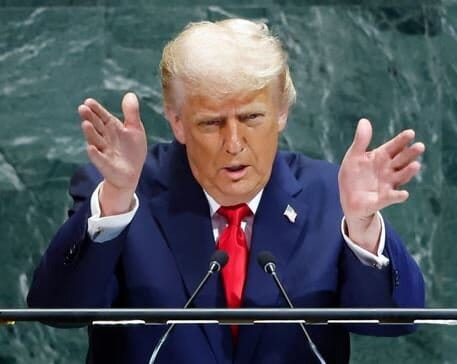
MADRID – In the halls of American foreign policy, where doctrines bearing names like Monroe and Truman are revered, President Donald Trump’s administration has sought to craft a new doctrine: a theology of power. Rather than a doctrine in the classical sense, a set of principles applicable to an external, objective world, it is a pseudo-faith in which order and disorder depend on the sole will of the president.
The stories he constructs are simple yet thought-provoking. In his vision, West Asia was dominated for many years by two “bullies”: Iraq and Iran. According to his logic, the fall of Baghdad in 2003 did not create a power vacuum, but removed one of the regional balancing poles, leaving Tehran as the “sole aggressor.” This simplification is critical because it transforms a complex web of conflict, national aspirations, and colonial legacies into a binary equation in which peace is achieved by weakening Iran. Everything else is subordinated to this premise: the Israeli-Palestinian conflict, intra-Arab conflicts, the rise of non-state actors, or the ambitions of middle powers such as Turkey and Saudi Arabia.
The defining moment, or test by fire, of this theology came in January 2020 with the drone strike that killed General Qasem Soleimani, commander of the Islamic Revolutionary Guard Corps (IRGC) Quds Force. President Trump is presenting this not as just another episode in a long history of friction, but as a turning point that will “reshape” the region. The move, he explained, was not merely tactical, but symbolic, a gesture of power asserting authority to determine regional stability. “We hit them back,” he claimed, confident that one act of extreme force would be enough to restore balance. This operation therefore takes on the character of providential correction, a secular intervention with moral pretensions, in which American violence is cloaked in redemptive legitimacy.
But this vision ignores a reality that is clearly recognized in Tehran. Surrounded by U.S. military bases, armed groups equipped with Western technology, and decades of sanctions, Tehran is a country that has built its foreign policy on a logic of survival. Iran’s influence stems not from expansionism but from defensive calculations. From Hezbollah in Lebanon to Ansarullah in Yemen, its network of allies constitutes not an informal empire but a containment belt against perceived existential threats. In this context, the “strategic depth” Iran seeks is a rational response to an environment that for decades has been seen as an anomaly that must be corrected.
The US withdrawal from the nuclear agreement (JCPOA) led by President Trump in 2018 further strengthened this sense of stagnation. By breaking commitments that Iran has kept under international scrutiny, Washington has sent a message that no deal with the West guarantees security. The results were immediate. It is the crystallization of an ideology of resistance integrated into modern Iranian political thought, encompassing technological, energy, and military self-sufficiency as both an expression of sovereignty and a structural response to international pressure.
Therefore, President Trump’s rhetoric is built on a vicious cycle. Iran is being punished under the pretext of posing a threat, but it is precisely the sanctions, targeted killings, and unilateral “terrorist” designation that reinforce the Iranian government’s well-founded perception of an existential threat. The results are predictable. A nation that strengthens its defense, approaches diplomacy carefully as a means of coercion, and understands that deterrence, not asymmetric bargaining, is the only true guarantee of sovereignty. This is a loop perpetuated by the US government’s own rhetoric and its misunderstanding of the deep logic of Iranian security.
The Time interview also reveals how this theology of power is being projected into the Israeli-Palestinian conflict. By emphasizing his role in the Abraham Accords, which normalized relations between Israel and several Persian Gulf monarchies, President Trump presents it as evidence of his effectiveness. Isolating Iran is said to have allowed Arabs to collaborate with Tel Aviv under US supervision. But this diplomatic success comes at the cost of alienating the Palestinian cause. Peace has been reduced to an elite pact maintained by economic interests and common enemies.
By depoliticizing the conflict and subordinating it to an anti-Iranian logic, Washington has helped to bury any prospect of a just, if temporary, resolution. The ensuing war in Gaza is a stark reminder that conflicts do not disappear by decree. It transforms when resolution is rejected.
There are major problems with the underlying logic. In Trump’s vision, peace is not forged between equals but imposed from above. The US presidency positions itself as a moral arbiter, deciding who is “rational” and who is “dangerous.” This imperial paternalism ignores the fact that West Asian countries, including Iran, are not pawns on a chessboard, but actors with their own histories, grievances, and aspirations. Characterizing Iran as a “bully” reveals more about the psychology of US power than the realities of the region. No lasting order is based on obedience. Only on mutual recognition.
The ultimate irony is that President Trump’s strategy to isolate Iran ended up strengthening Iran’s centrality. Tehran has become an inescapable linchpin in any regional security dialogue and a convergence point for diffuse but persistent resistance to US hegemony. The conflict turned it into a reference point for those seeking political and strategic autonomy against externally imposed orders.
Regional order emerges not from the decrees of superpowers, but from an ever-unstable equilibrium between local actors, each driven by its own fears, memories, and ambitions. Trump’s vision in Time, seductive in its simplicity and appealing to a sensitive imagination of power, is actually a negation of its complexity. Reducing the region to a stage of punishment and reward for the US president not only misinterprets the dynamics of the conflict, but also lays the groundwork for the next outbreak. A theology of power is doomed to face the logic of resistance again and again because it cannot understand it.