
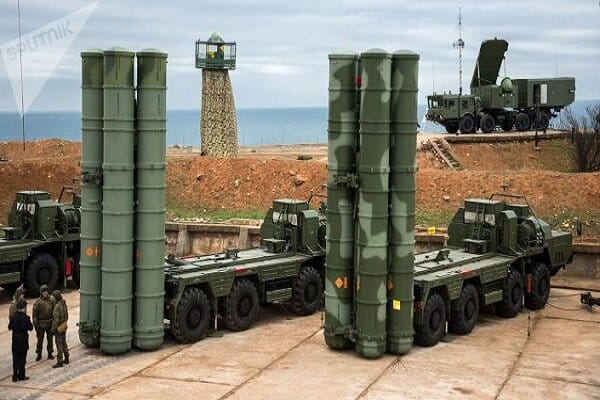
Press TV reported that American media outlets on Thursday, citing officials familiar with the matter, said the Turkish government was open to limited compromises on the operation of advanced air defense systems, but ruled out removing them.
The anonymous officials added that the Turkish government could agree to a “joint military mechanism” with the US government to oversee the use of the S-400. The plan is intended to address U.S. concerns without dismantling the Russian platform.
“Turkey has signaled it is willing to compromise on Russia’s S-400 missiles, but has refused to completely dismantle the system as requested by Washington. Turkey could agree to a technical joint military mechanism to oversee the S-400,” Bloomberg reported.
Turkey purchased four S-400 aircraft from Russia in 2017 for $2.5 billion, and Russian state arms exporter Rosoboron Export confirmed all deliveries had been completed by October 2019.
The move was met with opposition from the United States, and Ankara was kicked out of the F-35 fighter program.
Bloomberg reported that the Turkish government’s decision to retain the S-400 comes as it prepares for another round of talks with Lockheed Martin over a price dispute over the new F-16 Viper aircraft.
Turkey, the world’s largest F-16 operator outside the United States, has resisted Lockheed’s demands to fund upgrades to the plane’s mission computer and production line, even though the U.S. Congress authorized the sale of 40, officials said.
“The U.S. Congress approved Turkey’s acquisition of 40 Lockheed Martin F-16 Vipers in February 2024, but Turkey resisted the company’s request that the buyer pay for the aircraft’s mission computer upgrades and new production lines to overcome the backlog,” the news agency quoted anonymous officials as saying.
Media reports said Turkish President Recep Tayyip Erdogan personally appealed to US President Donald Trump on the issue during a meeting at the White House, but the US government has not yet publicly commented on the exchange.
Additionally, Ankara last month signed a deal with the UK to buy 20 Eurofighter Typhoons and is negotiating to buy 12 used Typhoons each from Qatar and Oman, with delivery expected in early 2026.
Bloomberg reported in September that Erdogan had pressed Trump to allow local production of key parts for Boeing and Lockheed Martin jets as part of a broader plan to buy hundreds of American-made aircraft.
Mr. Erdogan sought to offset the multibillion-dollar payments for the aircraft through local manufacturing contracts worth more than $10 billion, people familiar with the negotiations said.
According to the report, the Turkish government said it hoped the talks would ease tensions caused by Russia’s purchase of the S-400 missile defense system, which led to sanctions under the American Adversaries and Sanctions Act (CAATSA) and Turkey’s exclusion from the F-35 program in 2019.
Turkey’s purchase of Russian S-400 systems has seriously affected relations with NATO and the United States since 2017, as long-range surface-to-air missile systems are not compatible with NATO equipment.
The Turkish government said the S-400 system would operate independently and would not be integrated into the NATO network, and Russian engineers were not allowed to operate the system.
Turkey has removed the S-400 from new air defense projects, but retains it as a dormant capability that can be deployed as needed.
MNA