
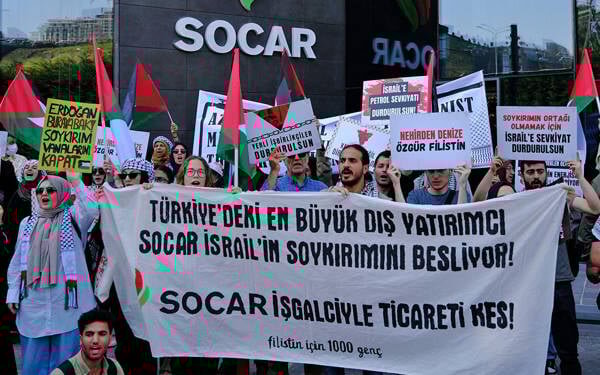
Tehrun – Members of the Turkey-based non-hierarchical, anti-imperialist, anti-capitalist youth movement “A Thousand Youths for Palestine” are sharing their journey, principles and goals.
Founded in December 2023 after the events of October 7, the movement unites students, activists, and workers from diverse backgrounds in a common determination to end all normalization with Israel.
Born out of street protests and boycott movements, this youth movement is also a member of the International Coalition to Stop Genocide in Palestine, which challenges state and corporate complicity in the occupation of Palestine.
It rejects symbolic gestures and focuses on research-driven grassroots action, exposing trade networks, organizing direct action, and mobilizing public pressure that has already led to corporate exits and trade restrictions.
The movement extends beyond Turkey, partnering with youth organizations in the Middle East and Europe, and leading protests and strikes around the world. For “A Thousand Youths for Palestine”, liberation “from the river to the sea” remains a moral and political mission.
Below is the text of the youth movement’s interview with Tehran Times.
“A Thousand Youths of Palestine” is founded on the principles of anti-imperialist, anti-capitalist and anti-Zionism.
How was “A Thousand Young People for Palestine” founded and what is the motivation for starting this movement in December 2023?
The story of the Thousand Youth for Palestine movement began on October 7, when the Al-Aqsa flood resistance movement called on people around the world to take to the streets and join the boycott. As young people, we considered the issue of Turkish-Israeli relations and the expulsion of Zionist capital from our country to be the most urgent part of this task.
We knew that the power of anonymous youth movements to speak to and organize the masses could only be found in the streets.
The vigils and protests that began in public squares and in front of businesses aligned with Zionism exposed the empty rhetoric of the AKP government, which organized massive pro-Palestinian rallies with emotional slogans, and the need for normalization with Israel and a clarification of its bureaucratic, economic, academic and military ties, one by one.
We have become convinced that it takes a genuine people’s movement to sever these bonds.
In December 2023, together with the Labor and Justice Platform, the Youth Commission, and independent friends not affiliated with any institution, we established Thousand Youth for Palestine.
From day one, we believed that victory came on the street. Capital relations, which appear powerful and unyielding, can be broken through grassroots struggle. Today, two years later, the results we have achieved prove this to be true.
Our campaign against Zionist companies began with Zor Holding. Recently, Zorlu Energy announced that it was withdrawing its investment from Israel. As a result of the protests, we have been holding protests week after week without interruption. The Turkish government announced on April 9, 2024 that it would first restrict and then suspend trade with Israel.
But we didn’t stop there. We renewed our vow to continue the struggle until Palestine is liberated from the river to the sea.
Despite official government statements, we continue to expose secret trade routes operating behind the scenes. We are determined to continue organizing until all commercial and political ties between Israel and Turkey are completely severed.
Despite Türkiye’s official statements, we continue to expose the government’s secret trade routes operating behind the scenes.
What are the core principles that define your movement? How is it different from other activist groups in Türkiye?
“A Thousand Youths of Palestine” is founded on the principles of anti-imperialist, anti-capitalist and anti-Zionism. It is a movement that unites young people from different backgrounds around common ideals.
What sets us apart from other groups is that we translate this diversity into a sense of shared responsibility rather than conflict. Our movement is non-hierarchical and operates through a horizontal organizational model. We do not believe in a single “leader” but in collective coordination through committees.
As a matter of fact, our differences are: It is not enough to simply chant slogans for the oppressed. We use a combination of investigations, litigation, civil disobedience, and public pressure to expose institutions, corporations, and so-called solidarity discourses that hide real political and economic relationships. This transforms movements from emotional reactions to political and institutional actors capable of producing real impact.
Another key difference is our determination to hold those in power accountable. We expose the continuing economic relationship between governments, businesses, ports and logistics stakeholders and Israel. We conduct field surveys, collect data, and organize targeted direct actions to gain visibility into resource, logistics, and financial flows.
This approach manifests itself, for example, in investigations and protests against corporations, such as SOCAR, actions that require direct confrontation with state and corporate power.
We are a youth movement that takes collective decisions and combines street action with research and exposure. This approach stands out from many traditional forms of work in Turkey, both theoretically and practically.
It would be moral weakness or hypocrisy to oppose Israeli moves in Gaza while maintaining economic ties with Tel Aviv.
In your opinion, why do countries in the region openly oppose Israel’s occupation of Gaza, while in fact continuing economic relations?
It would be easy, but superficial, to explain this contradiction as simply a matter of moral weakness or hypocrisy. In reality, each regime operates within a security and economic web of global capitalism and geopolitical dynamics, with security alliances, energy and trade pipelines, military-industrial relations, and regional balances all determining regime decisions.
For this reason, leaders must constantly balance the growing public anger in the streets with the nation’s institutional interests.
While the massacre in Gaza mobilizes public opinion, governments are simultaneously acting to maintain networks of energy, technology, security, and capital—because these networks maintain political and economic power.
What strategies and measures would you recommend for Islamic countries to provide concrete and practical support to Palestine?
As a movement of 1,000 Youth for Palestine, we first and foremost demand that the government immediately sever diplomatic, economic and military ties with Israel and provide real support to Palestine. This is not just a symbolic gesture, but the most effective and urgent form of sanction against occupation policy.
While the massacre in Gaza mobilizes public opinion, governments maintain energy, technological, and security ties with Israel.
Does your work extend beyond Turkey and do you work with young people in other regions and Islamic countries?
We have organized and continue to organize joint actions with many movements abroad to strengthen the global intifada. On November 11 and November 16 last year, we held simultaneous global protests in 13 countries, including Jordan and Palestine, under the slogan “Turkey, close the genocide valve.”
On 21 November, we joined a student strike as part of the International Day of Action, supported by 40 organizations and involving more than 400 universities in nine countries. We went on strike against governments, corporations, and universities complicit in genocide, and to demand the severance of all academic and political ties with Israel.
Together with our comrades in the Middle East, Europe and around the world, we have built networks of solidarity, concerted action and shared models of resistance.