
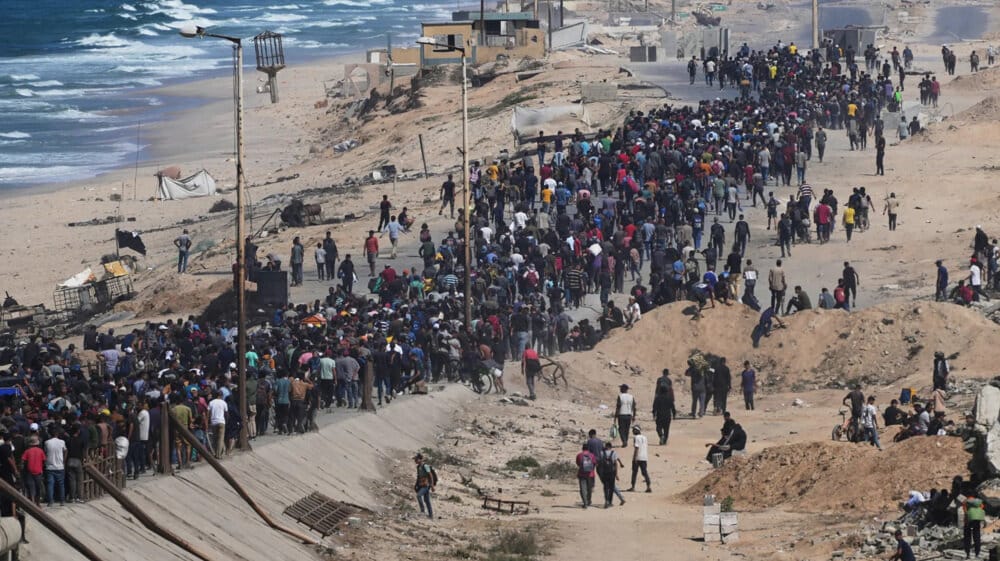
“From Friday until yesterday, our colleagues monitoring evacuations recorded the movement of some 310,000 people from southern Gaza to the north, and about 23,000 in other directions,” UN spokesman Farhan Haq told a news conference.
“Humanitarians can now move more easily in many areas, allowing our teams to reach people in places they had been cut off for months,” Haq said, adding: “The easing of movement and access restrictions in several locations has allowed us to pre-position medical and emergency supplies where they are most needed, and assess major roads for explosion risks.”
Haq also announced that “Emergency Relief Coordinator Tom Fletcher today allocated an additional $11 million from the Central Emergency Response Fund (CERF) to support the immediate scale-up of humanitarian operations in Gaza ahead of the winter.”
“This follows last week’s allocation of $9 million to ensure sufficient fuel supplies to continue lifesaving services across the Gaza Strip, bringing the total recent CERF funding to Gaza to $20 million,” it added.
“Without new donations to CERF, we will not be able to continue delivering vital aid to those who depend on CERF,” Fletcher warned, according to Haq news agency.
Under the initial 60-day humanitarian plan, “the United Nations and our partners will provide lifesaving assistance and services, including food, water, medical care, shelter, hygiene products and protection services, wherever people across the Strip need our assistance,” he said.
US President Donald Trump announced last week that Israel and Hamas had agreed to the first phase of a plan laid out on September 29: a ceasefire in Gaza, the release of all Israeli prisoners in exchange for Palestinian prisoners, and a phased withdrawal of Israeli forces from the entire Gaza Strip. The first phase of the agreement went into effect on Friday.
The second phase of the plan calls for the establishment of a new governing structure in Gaza without the participation of Hamas, the formation of a multinational force, and the disarmament of Hamas.
Since October 2023, Israeli military attacks have killed more than 67,800 Palestinians in the enclave, most of them women and children, and rendered it nearly uninhabitable.
RHM/