
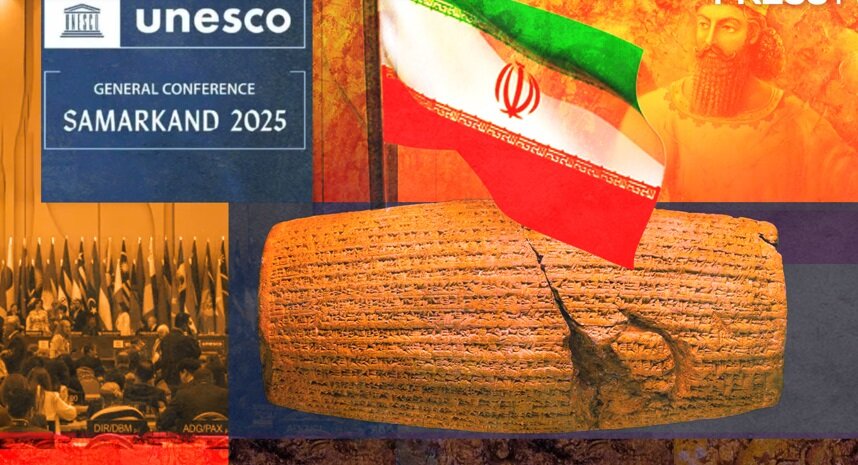
The resolution, adopted unanimously by all member states, designates the 2,500-year-old relic as a foundational document of human civilization, embodying the oldest recorded principles of freedom, justice, tolerance and respect for cultural diversity, Press TV reports.
This recognition by the United Nations cultural agency marks an important milestone for Iran’s cultural diplomacy and reaffirms Iran’s civilizational heritage on the world stage.
President Masoud Pezeshkian welcomed the move, saying it was a testament to Iran’s enduring presence in humanity’s collective conscience and its important role as a beacon of dialogue, tolerance and justice.
With this formal recognition, UNESCO will incorporate the teachings of Cyrus Cylinder into its educational, cultural and human rights initiatives, ensuring that its message of humanity, justice and coexistence of cultures continues to inspire future generations around the world.
Relics and their historical background
The Cylinder of Cyrus is a small barrel-shaped object made of baked clay, just over 22 centimeters long, and inscribed with a proclamation in Akkadian cuneiform.
Discovered in 1879 at the British Museum during excavations at the ruins of the Temple of Marduk in Babylon (present-day Iraq), the cylinder dates to 539 BC, after the Persian conquest of Babylon by Cyrus the Great, founder of the Achaemenid Empire.
According to Mesopotamian custom, it was created as a foundation deposit buried within the city walls to commemorate the new ruler’s restoration projects and to secure the favor of the gods.
Written from a Babylonian perspective by the priests of Marduk, this text tells of Cyrus’ victory over the last Babylonian king, Nabonidus, who is portrayed as an impious ruler who disrupted the worship of the gods and imposed forced labor on his people.
According to the story, the supreme god Marduk, enraged by Nabonidus’ misdeeds, sought a just leader and chose Cyrus, king of Anshan, to restore order and justice.
revolutionary declaration of the time
The deep meaning of Cyrus’s cylinder lies in its declared policy, which marks a radical departure from the brutal norms of ancient conquest.
Partly written in the first person from Cyrus’ point of view, it outlines a new model of governance based on tolerance and restoration rather than conquest.
It declares that Cyrus entered Babylon peacefully, spared the city from destruction, and improved the welfare of its inhabitants. Most notably, it documents his decision to end the practice of mass deportations, a common method of terror used by previous Assyrian and Babylonian rulers.
The column states that Cyrus returned statues of various gods to their home cities throughout Mesopotamia and allowed displaced people to return to their homelands.
This policy, supported by the Biblical book of Ezra, extended to the Jews and allowed them to end their Babylonian captivity.
Although the Column does not explicitly refer to “human rights,” its essence is a declaration of opposition to oppression and freedom of religion and identity, leading scholars and international organizations to regard it as an early charter of these principles.
Adopted and contested heritage
The modern symbolism of Cyrus’ cylinder has been a source of intense political controversy, particularly in the 1970s when Iran’s last Western-backed monarch, Mohammad Reza Pahlavi, used the relic to legitimize his rule.
For the country’s grand 2,500th anniversary celebrations in 1971, he loaned the Column from the British Museum and made it the centerpiece of the festivities.
Pahlavi portrayed this relic as proof that his regime was the heir to a glorious and tolerant tradition of kingship dating back to Cyrus.
This story was calculated propaganda for his regime, aimed at cloaking his autocratic and oppressive rule under the guise of ancient imperial legitimacy.
Politicization was exacerbated by a persistent misinformation campaign spread primarily online among Iranian monarchists in the diaspora.
Fabricated translations of the cylinder were widely disseminated, deliberately changing the original meaning to suit a secular, pro-Western agenda.
This fake version replaces the Babylonian god Marduk with the Zoroastrian god Ahura Mazda and inserts sentences not found in the authentic text, such as never imposing a monarchy by force and forever respecting all customs and religions.
Such falsifications seek to recast Cyrus’ legacy as a tool for modern political struggles, separating the relics from their true historical and religious context in the service of a particular ideology.
While the authentic cylinder remains a powerful symbol, its history serves as a cautionary tale of how ancient artifacts can be used as weapons in modern politics and identity conflicts.
an enduring symbol of humanity
Despite this political manipulation, the core message of the Cyrus Cylinder has transcended its origins to become a universal symbol of just governance.
Its recognition by UNESCO in 2025 shows that it has been freed from all kinds of propaganda and disinformation and has regained its true spirit.
Although the columns do not represent human rights in the modern legalistic sense, they do embody the fundamental principles of human rights: rejection of tyranny, opposition to oppression, and respect for cultural and religious diversity. These are the same values that define the Islamic Republic of Iran.
This is a testament to a pivotal moment when conquerors chose generosity over brutality, restoration over destruction.
Now integrated into UNESCO’s global mission for peace and sustainable development, the Cyrus Cylinder continues as a timeless challenge to all those in power to govern with wisdom, compassion and respect for humanity’s rich cultural tapestry.
MNA/