
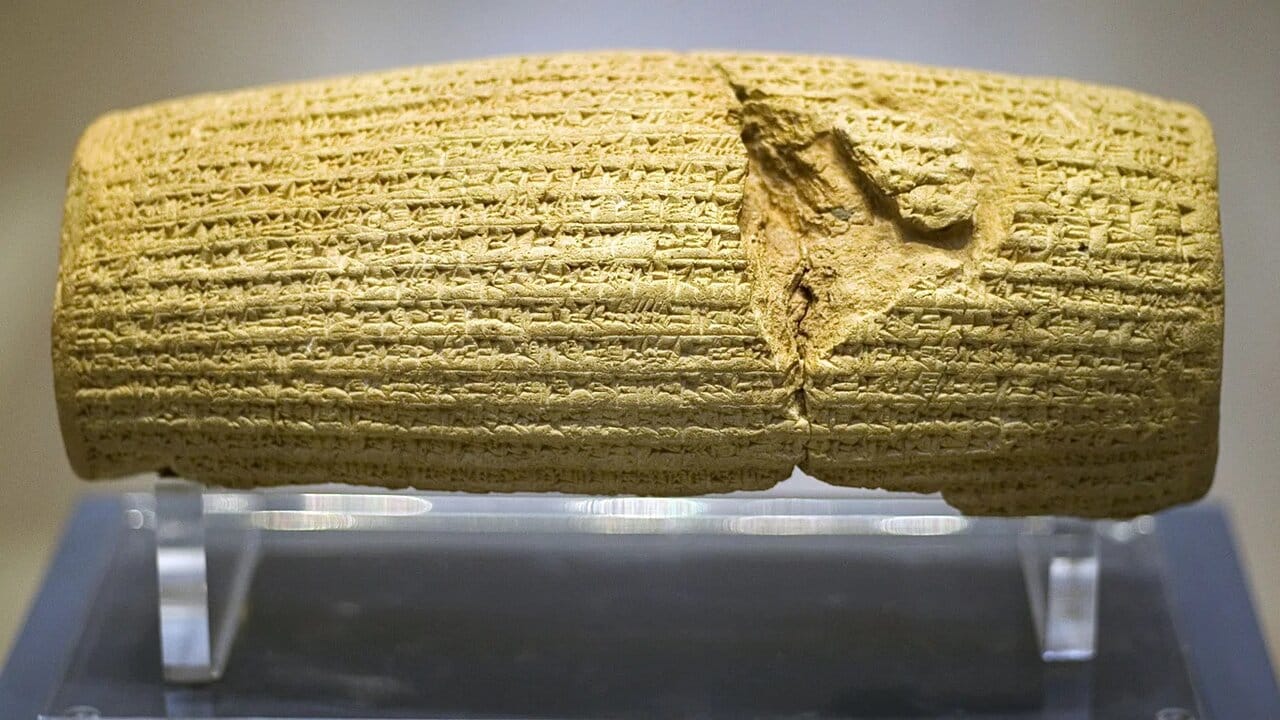
TEHRAN – The UNESCO General Assembly on Thursday adopted a resolution recognizing the Cyrus Cylinder as one of the world’s oldest declarations promoting cultural diversity and human rights.
The resolution, entitled “Cyrus Cylinder: Initial Charter of Human Rights and Cultural Diversity”, was co-sponsored by Iran and Tajikistan and approved by a majority of Member States at the 43rd UNESCO General Assembly in Samarkand.
As highlighted by the United Nations Cultural Agency, this recognition aims to strengthen intercultural dialogue, promote the sharing of humanity’s heritage and support the agency’s programs on justice, human rights, non-discrimination and cultural tolerance.
Egypt, Iraq, Colombia, India, Nigeria, Algeria, Pakistan, Bangladesh, Kenya, Senegal, Armenia, Poland and others voted in favor of the resolution.
The resolution encourages UNESCO Member States to raise public awareness of the Cyrus Cylinder, translate its texts into different languages for educational purposes, and use its values to promote peace and cultural coexistence.
This is the first time that Iranian antiquities have been officially recognized at the global level as documents related to the origins of human rights.
The Column of Cyrus is a small clay tablet, approximately 23 centimeters long and 11 centimeters wide, inscribed in Akkadian cuneiform script and housed in the British Museum. Its origins date back to around 539 BC, when Cyrus the Great, the founder of the Achaemenid Empire, captured Babylon in present-day Iraq.
The inscription tells how Cyrus, with the favor of the god Marduk, overthrew the Babylonian king Nabonidus and subsequently allowed religious freedom in the city. It records that Cyrus returned the refugees to their homeland and restored their temples and gods.
“I commanded all the sanctuaries that were closed to be opened. I brought back all the gods of these sanctuaries to their places. I gathered all the people together and returned them to their homes.”
The cylinder remained buried for over 2,400 years until it was discovered by British archaeologist Hormuzd Rassam during excavations in Mesopotamia in 1879.
The Column of Cyrus is an ancient clay artifact inscribed in Akkadian cuneiform and dates from the 6th century BC. This document records the conquest of Babylon by Cyrus the Great in 539 BC and the restoration of religious sanctuaries and refugees. The object was discovered in 1879 at the ruins of Babylon, in present-day Iraq, and is kept in the British Museum.
The cylinder gained attention again in the late 1960s, when Iran’s last shah described it as “the world’s first human rights charter.”
Cyrus the Great (born c. 590-580 B.C. in Media, or Persis (now Iran); died c. 529 in Asia) was a conqueror who founded the Achaemenid Empire, centered on Persia and comprising the region of the Near East from the Aegean Sea east to the Indus River. He is also remembered by the ancient Persians in the legend of Cyrus (first recorded by the Greek military officer and writer Xenophon in his Cyropedia) as a tolerant and ideal ruler who was called the Father of the Nation. In the Bible, he is the liberator of the Jewish captives in Babylonia. In the Bible, Cyrus is famous for freeing Jewish captives in Babylonia and allowing them to return to their homeland. He supported local customs and even placated the local population by offering sacrifices to local gods. With the capture of Babylon, not only did Mesopotamia fall into the hands of Cyrus, but also Syria and Palestine, which had been previously conquered by the Babylonians.
morning