
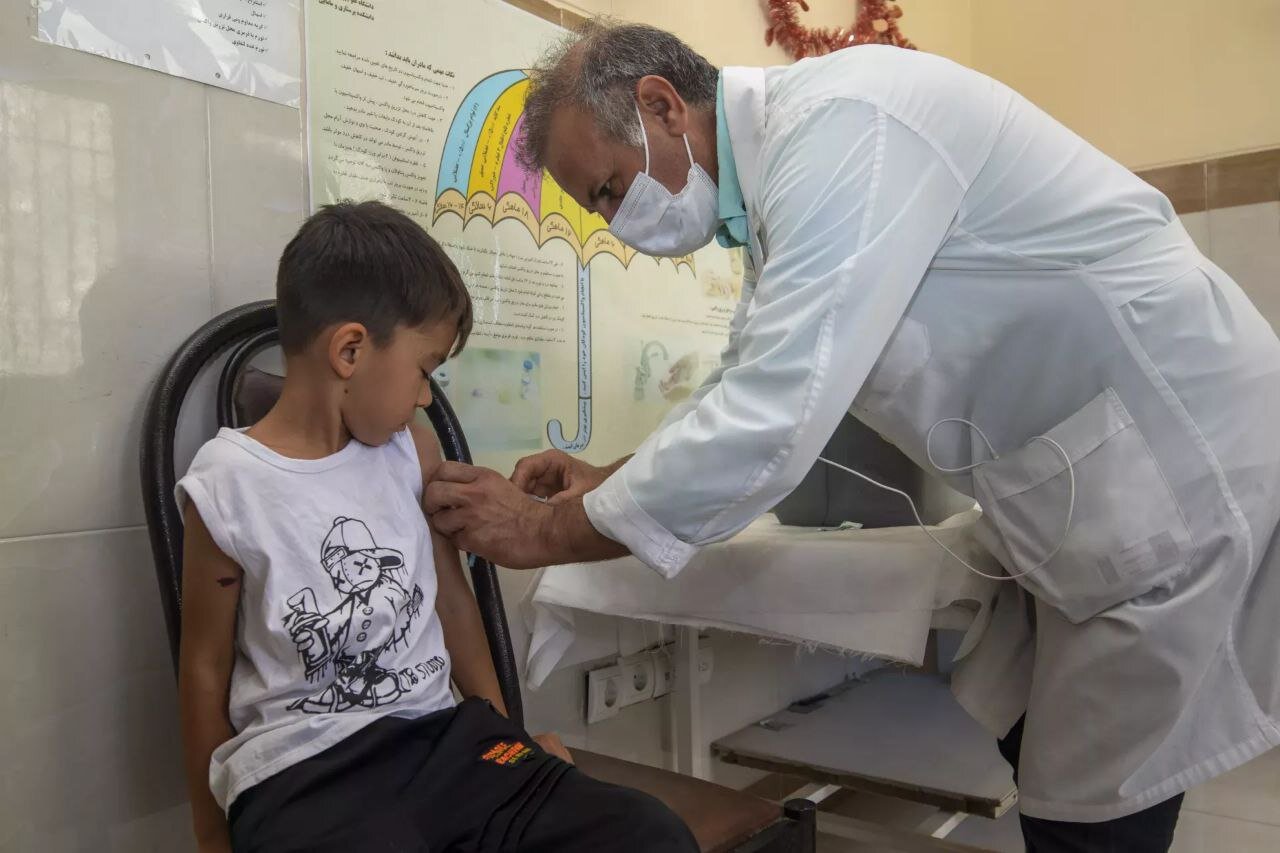
TEHRAN – The United Nations Children’s Fund (UNICEF) and the World Health Organization (WHO) are supporting the Ministry of Health in procuring the necessary vaccines and will support the introduction of new vaccines into the national immunization program.
ISNA quoted UNICEF official Mohammad Eslami as saying that one of UNICEF’s top priorities is to support countries in adding new vaccines to their immunization programs to protect children from more diseases and reduce mortality.
He made the remarks Sunday while speaking at a workshop on immunization and vaccine-preventable diseases in Kerman province, ISNA reported.
Despite the sanctions, UNICEF is doing everything in its power to provide the necessary vaccines and support the Ministry of Health to ensure that no child is left behind, the official added.
Mr. Eslami emphasized the importance of the cold chain system, saying that the main purpose is to provide cold chain equipment to maintain the efficacy of vaccines.
Currently, the cold chain situation in the country is good and the Ministry of Health, with support from UNICEF, is providing new standard refrigeration facilities to be installed in areas without cold chain systems.
UNICEF added that it also provided 17 standard refrigerated vehicles to transport the vaccines to different parts of the country in a safe temperature range.
The official also said families and children should learn about the important role of vaccination in preventing life-threatening diseases. Mr. Eslami further pointed out that the guidance of target groups is therefore one of UNICEF’s main activities carried out this year.
WHO official Omid Zamani praised Iran’s achievements in its vaccination program, saying the country’s vaccination rate was satisfactory at about 97%.
However, in some border areas and areas where migrants live, children and adults may not have enough access to vaccinations. Therefore, it is essential for the country to accurately identify and cover these areas, he said.
Referring to the rotavirus and pneumococcal vaccines that were added to the national immunization program last year, the official said three more vaccines will be introduced into the national immunization program over the next five years.
Vaccines provided by UNICEF and WHO
Since the beginning of 2025, UNICEF has been procuring large consignments of pneumococcal conjugate vaccine (PCV), rabies, pentavalent and rotavirus vaccines to immunize children against life-threatening diseases.
The vaccines were procured at the request of the Ministry of Health and Medical Education (MoHME).
More than 1 million doses of rotavirus vaccine were delivered on August 21 and 23, with early supplies in May. This vaccine protects children from severe diarrhea, a leading cause of illness in children.
15,000 doses of rabies vaccine arrived on August 23rd, and a further 74,400 doses are expected to arrive by the end of September. Rabies is a deadly disease that is spread through the bite of an infected animal.
On August 23, more than 255,000 doses of the pentavalent vaccine also arrived. This one shot protects babies from five dangerous diseases, including diphtheria, Hib, whooping cough, hepatitis B and tetanus. It is usually given to babies in their first year of life as part of their routine immunization schedule.
On August 3, 465,000 doses of the pentavalent vaccine arrived in the country.
These deliveries, following a 12-day conflict in June, highlight UNICEF’s close collaboration with the Iranian government and global partners such as the GAVI Alliance. Together, they aim to ensure every child in Iran has access to life-saving vaccines, even in times of crisis.
On July 30, the latest batch of PCV, containing 200,250 vials, arrived in Iran. This followed initial shipments in April that included PCV and rotavirus vaccines.
These efforts are made possible with support from the GAVI Alliance, a global organization that helps improve access to vaccines in low- and middle-income countries.
In August 2024, WHO achieved an important milestone by facilitating the procurement of 2.79 million vaccine vial monitors (VVMs) for the Islamic Republic of Iran’s oral polio vaccine program.
This strategic move, funded by the Raj Vaccine and Serum Institute, marks a significant step forward in strengthening the country’s national immunization efforts.
A shipment of VVMs, temperature-sensitive equipment essential for storing and transporting vaccines, arrived from Imam Khomeini International Airport.
The consignment was jointly received by the Razi Vaccine and Serum Institute and the WHO Country Office in the Islamic Republic of Iran. These VVMs were sourced from reliable international suppliers.
Ali Eshaghi, director of the Razi Vaccine and Serum Institute, part of the government of the Islamic Republic of Iran, said the joint achievement was the result of a coordinated effort across multiple levels.
VVM plays a vital role in maintaining vaccine potency and effectiveness. These devices are installed on vaccine vials to ensure that the vaccine is kept within an optimal temperature range during storage and transportation. By protecting the health of children, we will make a major contribution to the global effort to eradicate polio.
MT/MG