
TEHRAN – Gaza’s future is being shaped by outside forces, not its people.
A new report by the Guardian reveals the stark reality behind Washington’s post-genocide planning. In other words, the United States is preparing for a long-term division and occupation of Gaza, rather than its reunification and liberation.
Far from providing a path to self-determination for Palestinians, this new plan consolidates the authority of the Zionist regime and leaves displaced people trapped in a region where neither justice nor reconstruction is envisaged.
According to the Guardian, U.S. planners outlined dividing the territory into a “green zone” held by international forces integrated with the Zionist occupation forces, and a “red zone” from which almost all Palestinians have been expelled and reconstruction clearly excluded.
A US official told the paper that restoring Gaza as a unified whole was merely an “aspiration,” effectively acknowledging that the US government foresees an indefinite partition.
This model makes clear that the ceasefire “plan” announced by Donald Trump on October 10 was never intended to bring peace, accountability, and sovereignty to the Palestinians. Instead, it solidified the existing occupation by proposing an international military umbrella to stabilize areas controlled by the Zionist regime, providing Palestinians with only a symbolic police force with no real powers.
The US initiative relies on an “International Stabilization Force” of up to 20,000 soldiers drawn primarily from European countries and operating only within the “Green Zone.” Foreign forces would work with Zionist occupation forces to establish personnel control points along the country’s borders.
One European source told the Guardian that the proposal was “delusional” and that it was politically impossible to send troops into areas seen as reinforcing the ongoing occupation.
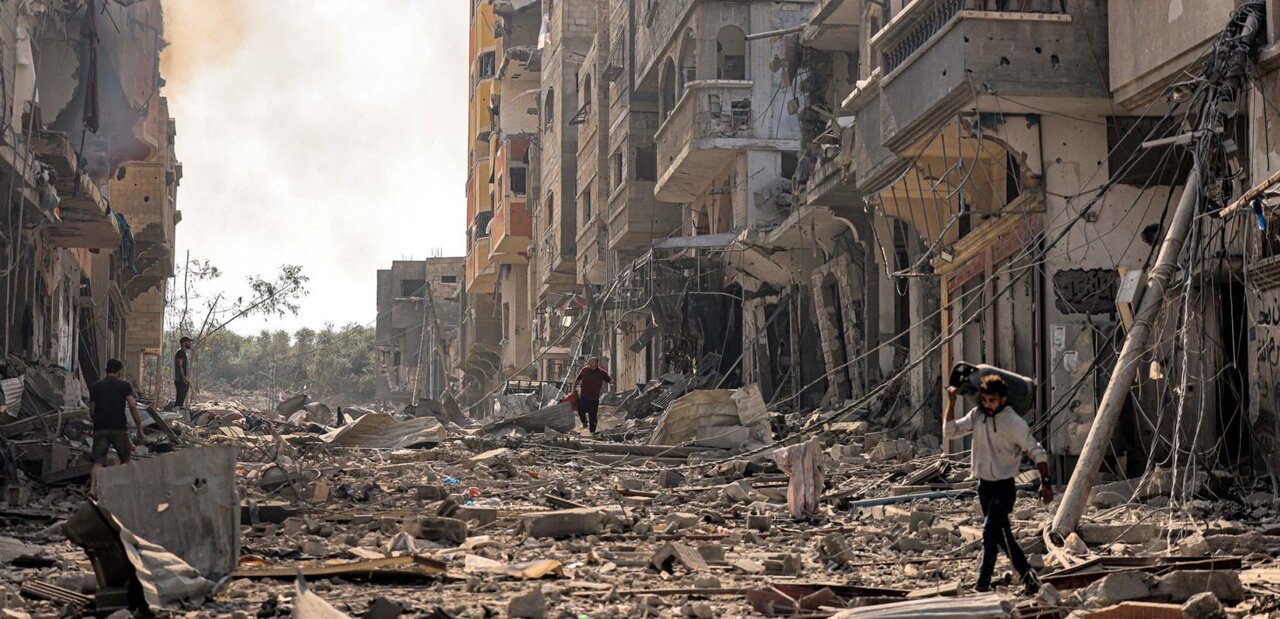
Importantly, this arrangement leaves the majority of Palestinians trapped in geographically restricted “red zones” – areas destroyed by shelling, deprived of basic services and excluded from reconstruction plans.
Humanitarian groups have warned that such a division could push Gaza into a future of permanent exile, collective punishment and a “not war, but not peace” impasse where Zionist occupation continues without a solution.
The US framework assigns Palestinians only a small security role. Police resources are scarce and the number of new recruits is in the thousands, representing a portion of the combined deployment of foreign and occupation forces.
This token structure emphasizes that this plan is not about governance, but rather management to maintain order in a territory deliberately denied political rights and meaningful reconstruction.
The Zionist regime’s two-year campaign of genocide has already proven the futility of militarized solutions. The idea that expanding the regime’s occupation by foreign forces will bring about stability ignores both history and the will of the Palestinian people themselves.
No arrangement built on exclusion, exclusion, or external control can be successful.
While Palestinians have repeatedly stated that they are open to a true regional Arab-Islamic peacekeeping mission based on neutrality and accountability, such an approach is not possible under the current U.S.-Zionist alignment, which prioritizes control of Gaza over restoring Palestinian rights.
The only viable future is one in which Palestinians decide the fate of Gaza, not foreign architecture designed to sustain the occupation under a new label.