
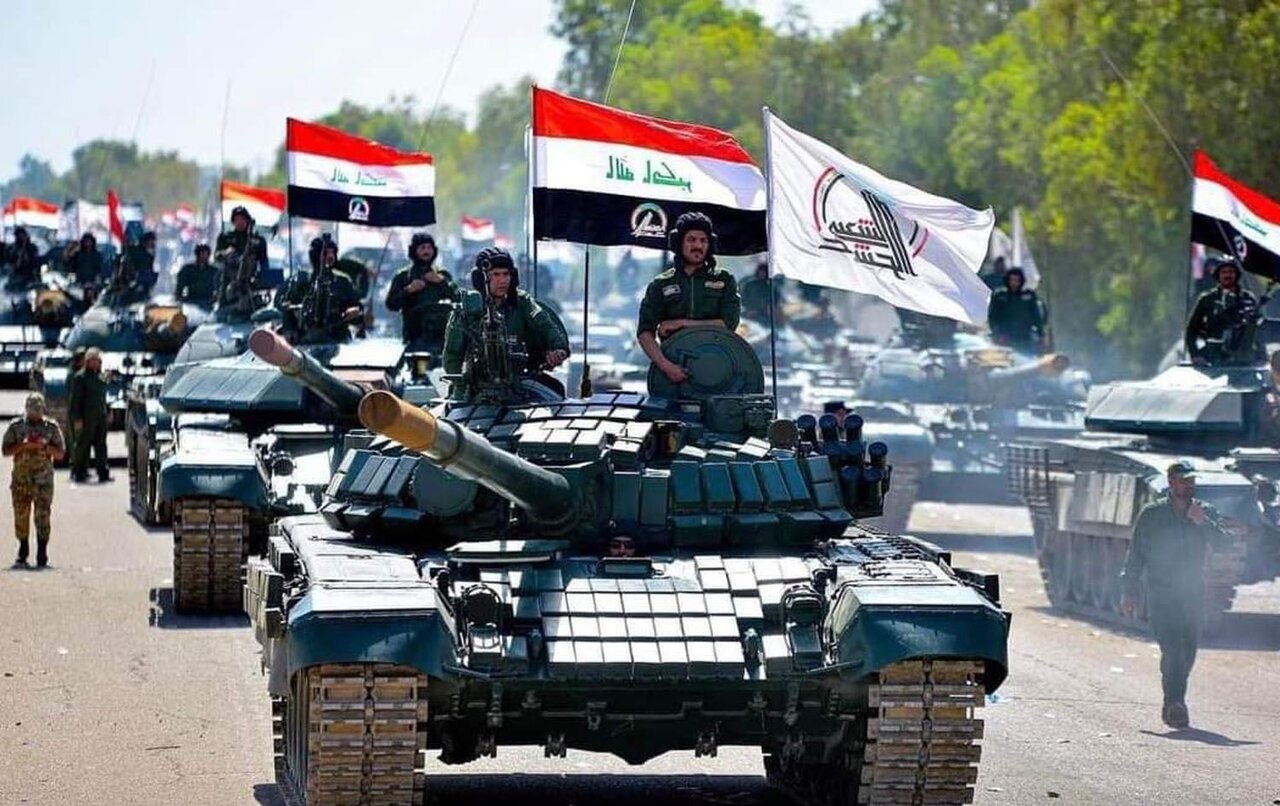
TEHRAN – The US push to disarm Iraq’s resistance is aimed at influencing elections and thereby undermining the country’s sovereignty and the People’s Security Forces.
The timing of the US pressure on Prime Minister Mohamed Sudani to disarm Iraqi resistance is widely seen by analysts as a strategic move related to the upcoming November 11 elections.
Many political commentators see Sudani as the frontrunner, with his popularity rooted in a wide range of domestic achievements during his first term in power.
Also, his perception of independence and his close ties to the Coordination Framework, the parliamentary coalition that enabled his rise to power, are closely linked to American interference in Iraq’s internal affairs.
The Coordination Framework, made up of influential Shiite parties and politicians, is shaping Iraq’s post-2021 political order and is widely seen as ideologically aligned with the anti-American resistance that Washington aims to weaken.
“We are looking forward to an important victory,” Sudani told Reuters, adding that he was seeking a second term. “We want to continue down this path.”
The new US disarmament demands are therefore not occurring in a political vacuum, but rather at a time when Sudan’s increased powers threaten to consolidate a government less susceptible to US influence.
By pressing the issue of disarmament, the United States now appears to be testing Sudani’s intention to distance himself from factions that prop up his legitimacy and reflect growing nationalist sentiment among Iraqi voters.
The timing suggests a broader attempt by the United States to influence Iraq’s political course, just days before a crucial election. However, the move risks backfiring domestically, as it could be seen as further U.S. intervention aimed at undermining Iraqi sovereignty and the popular forces that continue to shape Iraq’s political and military landscape.
Sudani linked the disarmament of the resistance to the withdrawal of U.S. troops, widely seen as an occupying force in Iraq.
The United States and Iraq have agreed to a phased withdrawal of U.S. troops, with a complete withdrawal expected by the end of 2026. The first withdrawal began in 2025. The United States has previously violated the withdrawal agreement on a variety of pretexts, including changing the name of its troops from a combat mission to an advisory mission. Military experts argue that Iraq does not need any of these US roles.
The US government is pressuring Baghdad to disarm resistance groups it claims belong to the Popular Mobilization Forces (PMF).
The PMF was established in summer 2014 in response to a fatwa (religious edict) issued by al-Sistani following the defeat of US-trained Iraqi forces.
The defeat came as Daesh advanced rapidly and took control of nearly two-thirds of Iraq. Since its formation, the PMF has become the core of Iraq’s defense architecture. He played a decisive role in the fight against Daesh, leading front-line battles for three years and ultimately defeating the terrorist organization in 2017.
After unification in 2016, it has become an important pillar of the Iraqi military. Analysts claim that calls to dismantle the PMF come from political parties bent on contributing to the deterioration of security in Iraq.
Meanwhile, anti-American resistance groups emerged in the aftermath of the 2003 American invasion and occupation of Iraq. These organizations were formed during the security vacuum by local residents determined to oppose the presence of foreign troops and regain national sovereignty.
By 2014, many of these groups had incorporated into the PMF and formed political parties. Nevertheless, some resistance groups have chosen to remain outside the PMF framework, stressing that their struggle is focused on ensuring the complete withdrawal of US forces from Iraqi territory. They say they will disarm only if the U.S. military occupation ends completely and Iraq achieves full political and territorial independence.
From the perspective of many Iraqis, pressure on Baghdad to disarm the resistance that emerged after the 2003 US invasion reflects a continuation of Washington’s longstanding interference with Iraq’s sovereignty under the guise of counterterrorism and stabilization.
Many Iraqis see the resistance as the same force that defended the country in its darkest days, fighting not only the American occupation but also al-Qaeda, Daesh and other militant militant groups that threatened Iraq’s territorial integrity.
To them, U.S. disarmament demands appear less as an effort to strengthen Iraq’s statehood and more as an attempt to undermine its autonomous security infrastructure and reaffirm America’s strategic superiority in the region.
This perception is further reinforced by the continued presence of U.S. forces on Iraqi territory, which many see as a violation of national sovereignty, especially after the Iraqi parliament’s 2020 resolution calling for a complete withdrawal.
Moreover, disarming these resistance groups at a time when Daesh remnants are regrouping in Syria, where extremism is surging following the fall of Bashar al-Assad’s regime, is seen by many Iraqis as a reckless move that could open the door to new infiltration by Tafir terrorists.
To many, Washington’s actions seem less about security and more about ensuring Iraq remains militarily dependent and politically aligned with U.S. interests, rather than charting an independent path based on Iraq’s own national defense priorities.
America’s insistence on dismantling these resistance movements since 2003 has deepened Iraqi skepticism about American intentions and fueled the narrative that Washington is more interested in suppressing what it calls armed groups than truly protecting Iraq’s long-term stability.
“Daesh does not exist. Security and stability? Thank God, Daesh exists (in Iraq), so please allow 86 countries to be there,” Sudani told Reuters, referring to the so-called US-led coalition.