
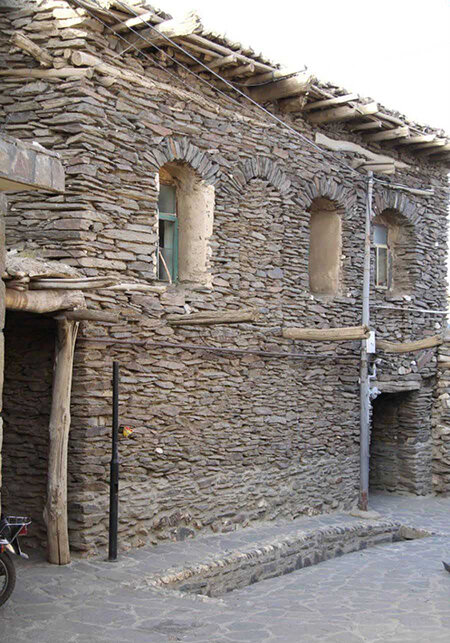
TEHRAN — At the foot of the beautiful Arwand Mountain, 20 kilometers from Hamedan, lies a village whose architecture reflects the landscape of Renaissance Europe. This village is one of the most unique in Iran, with houses made of stone and buildings made of rubble stone, wood, and mud mortar.
According to Miras-e Arya (CHTN), in addition to the beautiful and unique textures, the mild summer climate and lush gardens double the beauty of Varkane, attracting many tourists to the village every year.
The history of Varkhaneh dates back more than 400 years, and relics from the Safavid era have been discovered. Historical evidence shows that at that time “Nagi Khan Karaguzur” was the khan of the village, and after him his daughter became the ruler. Today, in Barkhane, as in other villages in the province, the elderly occupy a special position and their decisions play a decisive role.
In Kurdish, “var” means side and “kaneh” means spring, so Varkaneh is known by this name, which means next to water and springs. From another point of view, there are a lot of stone mines around the village, which is why the village got the name Varkane, which means a place near the mines.
The first center of Valkaneh was formed around the village’s aqueduct, and its history dates back to the early Safavid period. The main material for buildings in Varkane is stone, and stone types such as rubble stone, marron stone, adobe, and brick are common building materials in the village.
The widespread use of stone may have been due to the abundance of this element in the region, its hardness and resistance to weather changes, and the scarcity of bricks and mud bricks in the region. Therefore, for the construction of buildings in Barkhane, as in other regions of the country, it was common to use locally produced materials.
In addition to the village’s natural attractions, such as the seasonal Simin and Varkane rivers, their aqueducts and springs, the surrounding mountains, and extensive, refreshing gardens, Varkane has historical and natural attractions, some of which are on the national register, and the fame of the village’s laureates, such as Professor Toffee ‘Toffee’ Musiband, maker of the world’s first artificial heart, has spread beyond the world. This increased the village’s reputation beyond the borders.
The old features, the building of the village mosque, the tomb of Imamzadeh Ghaib (AS), and Mehri Khanum Castle, built in the shape of a cross, are among the attractions of Barkhane. On the other hand, Varkane is considered to be a special situation for the village, as its proximity to the underground city of Arzanfoud offers a bright future for tourism in this village.
About 10 years ago, Varkane became well-known in the country’s tourism sector after natural and historical attractions attracted a famous comedian to Varkane, and a satirical television series was produced in the village. In the series, film and television actors such as Mehdi Hashemi, Mehdi Fakimzadeh, Ahmad Mehranfar, Hossein Moheb Ahli, Hadi Kazemi, Hooman Haji Abdullahi, Mahmoud Jafari and Ezatollah Ramezanifar lived in villages that attracted tourist attention and generated income. Mineral water bath.
With its beauty and potential in the tourism sector, Barkhane is currently one of the three tourism villages of Hamadan province competing for globalization potential, and its file is being prepared to be submitted to the World Tourism Organization in 2026.
As globalization advances, this village, with its rich potential, unique texture, and natural and historical charm, has the potential to become a new destination for regional tourism.
KD