
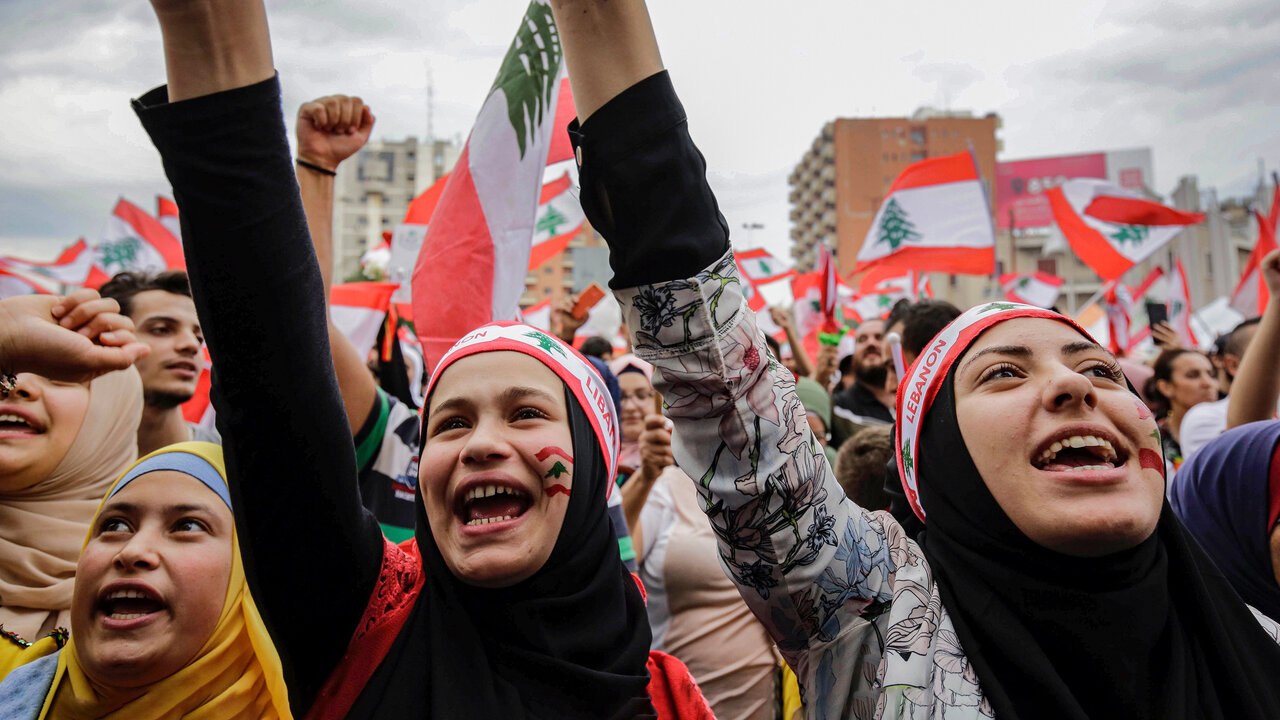
BEIRUT – Lebanese society has long been characterized by debates, disagreements and deep ideological fault lines. Partition is not a uniquely Lebanese pathology, but a universal human reflex that, as Rousseau suggested, dates back to the moment when the first humans claimed rights and declared, “This is mine.”
But Lebanon’s rifts have a unique texture, shaped by sectarian memories, contested sovereignty, and the cumulative trauma of civil war.
Geopolitical borders rarely align with our cultural geography, and this mismatch has always made Lebanon unusually exposed to regional upheavals.
Today, the country is being saturated with a new kind of tremor: a stifling “war story.” Political salons, social platforms, and television panels have become speculative war rooms.
One faction starts a war with reckless bravado. Another person fears it so intensely that its inevitability is amplified. Both, intentionally or not, inject oxygen into the psychological warfare machine of Israel’s enemies.
Since the fake ceasefire on November 27, 2024, Lebanon has been flooded with “operational predictions” and “exclusive leaks.”
Every day brings a new recipe for the apocalypse, prophesying a war “more devastating than any war in the past century.”
The fall of the Assad regime on December 8, 2024 only widened the scene, triggering a series of narratives about a “southeast pincer,” a new Syrian front, and an impending pre-emptive strike.
The question dominating every platform, from policy institutions to village cafes, is no longer whether war will come, but why it has not yet begun.
Real threats vs. manufactured fears
Communities aligned with the Resistance are inundated with predictions from both allies and adversaries. Some analysts have warned that Israel’s enemies could “attack before dawn.” Some argue that the pope’s visit provides no shield.
Rumors are circulating about a foreign intelligence call warning of plans to “flatten the southern suburbs.”
This atmosphere creates a single common understanding: war is not a scenario, but an appointment on the calendar. However, strategic reality does not support this inevitability.
Our enemy, Israel, faces serious structural constraints. The military is overstretched, deterrence is undermined, and the political system is cornered.
Prime Minister Netanyahu faces what Israeli columnist Nahum Barnea calls “the most existential political nightmare of any sitting prime minister.”
His approval rating fluctuates between 10% and 20%. Despite 60% of Israelis claiming to support the war in Gaza, only 30% believe Hamas can be eliminated.
Economically, the occupying entity is under immense pressure. Major companies are relocating, investors are withdrawing money, and Israel’s crown jewel technology sector has lost more than 8,000 employees in a year.
Regionally, Washington state maintains its usual dual strategy. This means allowing expansion when it’s beneficial and curbing it when it’s dangerous.
For now, the U.S. ceiling appears to be limited to “precision intimidation,” such as limited airstrikes, media warfare, and managed friction, rather than full-scale regional conflicts.
In modern conditions, victory on the battlefield no longer guarantees strategic success. The traditional narrative of Israel, rooted in Holocaust memory and anti-Semitic claims, has lost its hegemony.
Public opinion has changed decisively. Trump himself acknowledged this change, telling the Daily Caller in September 2024, “Israel is winning militarily, but losing in the court of public opinion.”
Prime Minister Benjamin Netanyahu reacted with delusion, labeling American student protesters as “Iranian stooges.”
Despite massive spending on PR firms, digital influence operations, evangelical mobilization, and bot networks, the decline is visible. According to Pew research, negative views of Israel will rise to 53% in 2025, a historic high.
International war crimes litigation further limits Israeli decision-making. Under these circumstances, launching a major war against Lebanon would be politically suicidal, economically disastrous, and strategically irrational.
Lebanese domestic discourse therefore often reflects that anxiety more than the reality. From Beirut and the south alone, war may seem imminent. However, when placed within a broader regional and global matrix, the conditions for an Israeli attack simply do not exist.
The threats are real. That fear is understandable. Nevertheless, inevitability is a manufactured illusion, one that enemies avidly cultivate and Lebanese discourse all too easily reinforces. The challenge now is not to deny danger, but to distinguish between strategic risk and psychological manipulation.