
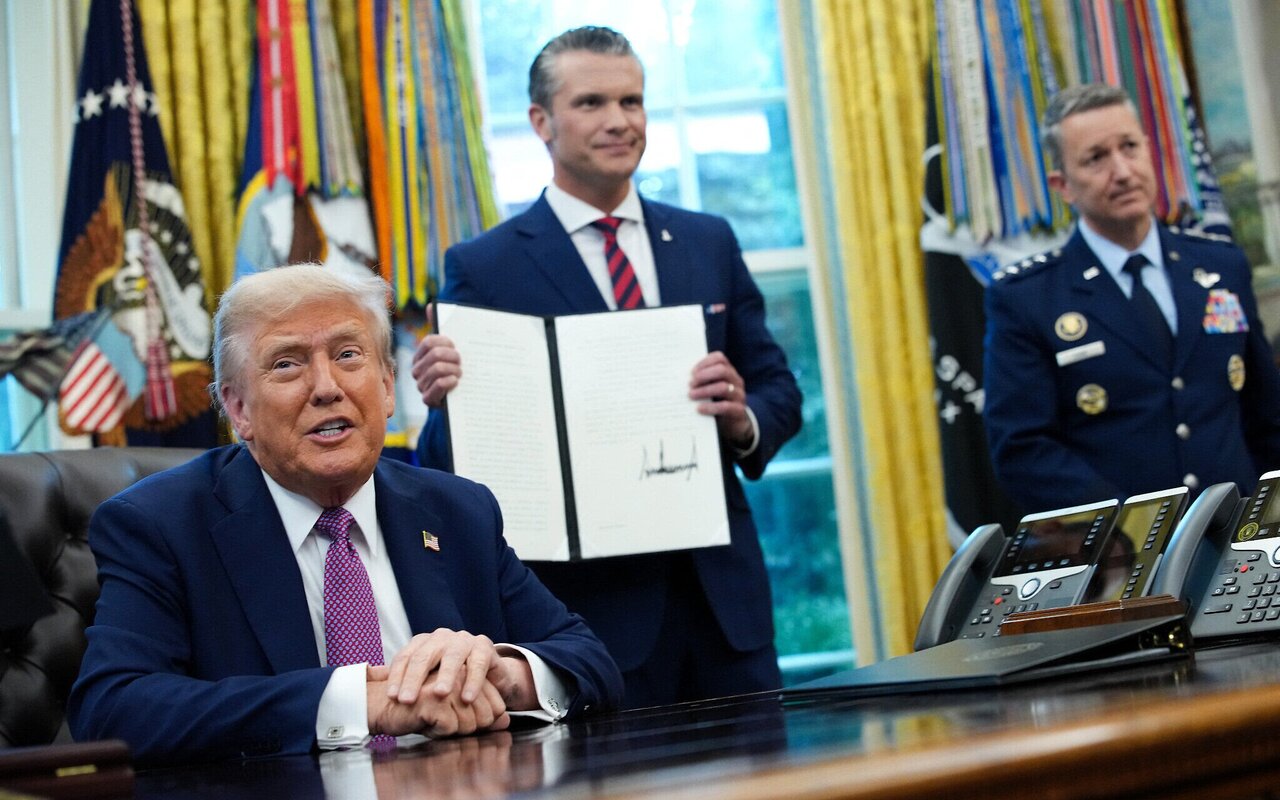
TEHRAN – In a move that sparked intense criticism, US President Donald Trump signed an executive order on Friday renaming the Department of Defense as the War Bureau. The decision revived the title that was last used in the 1940s before President Harry Truman reorganised his army into the Modern Pentagon system after World War II.
The War Bureau was first established in 1789 and existed until 1947, split into the Department of War and Air Force in 1947, and was eventually combined under the newly created Department of Defense. The name change at the time was intended to symbolize the transition from conquest to the doctrine of defense in the postwar world.
American history of war
But the irony is that with a “defensive” name, the United States has fought some of the most destructive wars, from South Korea and Vietnam to Iraq and Afghanistan. The Pentagon records since 1947 include secret operations, invasions and regime-changing wars that have taken millions of lives and destabilized the entire region.
Trump’s order to allow the Pentagon to use “The Department of War” as a secondary title while seeking perpetual Congress approval is described by his allies as an honest perception of American military stance. “The name “War Bureau” conveys a strong message of preparation and resolution compared to the “Doctor of Defense,” which only emphasizes defensive capabilities,” the executive order said. Defense Secretary Pete Hegses, now in the style of “war secretary,” declared during his signature:
Political and financial backlash
However, some officials have sharply criticised the rebranding as expensive and dangerous. According to US media, the change could cost billions of dollars, requiring changes to seals, uniforms, websites, facilities, contracts and communications across more than 700,000 facilities around the world.
“This is purely for a national political audience,” the former defense official told Politico. “It has a totally zero effect on the calculations of China or Russia. What’s worse, our enemy is used to portray the United States as a threat to global warming and international stability.”
Congressional Democrats also condemned the decision. New Jersey Sen. Andy Kim called it “childish,” saying, “Americans want to prevent war, not promote them.”
Sen. Jeanne Shaheen of New Hampshire claimed the move was distracting from urgent priorities and “nothing other than an effort to distract the president and the Secretary of Defense to spend time and energy (a) distract us from what we need to do — to focus on preparing the troops we serve — to distract us from other issues within the country.”
Even Senate Republican leader Mitch McConnell criticized the effort. “If you call it the war division, then you’d better equip your troops to actually prevent and win the war. If you don’t harass them to spend a lot more on the troops than Carter or Biden, you can’t maintain America’s advantage.
Symbolicity for strategy
But for Trump, symbolism is the key. He repeatedly linked changes to the history of American military victory, especially in two world wars, opposed what was called “Awakening Ideology” within the Pentagon. “We won World War I, won World War II, and before that we won everything. After that we decided to wake up and changed our name to DOD. So we’re going to the War Bureau.”
Observers argue that rebranding does more than revive historical names. For decades, US intervention in Vietnam, Iraq and Afghanistan was justified as an act of “defense” against communism, terrorism, or illicit states.
However, these wars were inherently aggressive and characterized by invasion and occupation. By returning to the war division title, Trump misrepresented what critics consider to be the essence of American foreign policy: domination rather than defense.
This bold rebranding exposes the full range of American militarism and global domination. Washington is no longer pretending to act defensively. It openly presents its role as a superpower in war driving.
Amid escalating tensions between China and Russia, Trump’s move highlights the US ambitions to assert hegemony around the world. Whether Congress enacts permanent change or not, the symbolic shift to the “war ministry” bares America’s true colour. It projects power, enforces control, signaling a world where the Earth’s so-called most powerful army is not defended, but not ordered.