
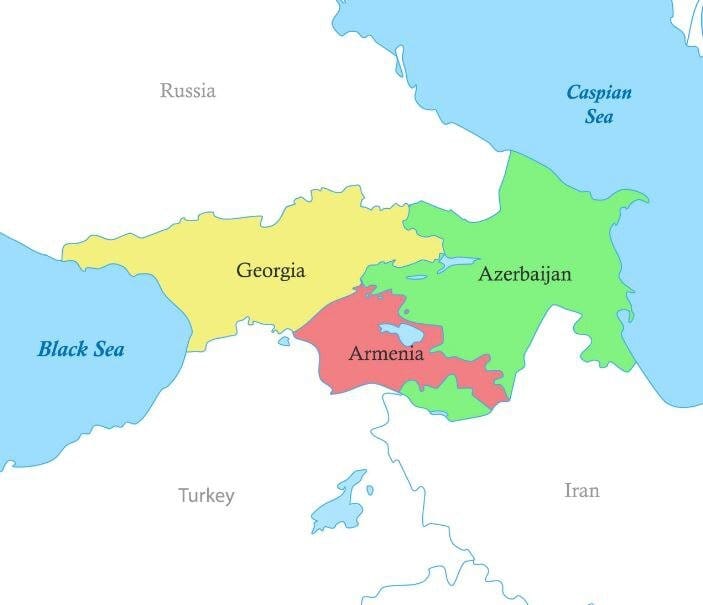
TEHRAN – Armenia and Azerbaijan on Friday signed an agreement in the White House in front of US President Donald Trump, recognising Washington’s exclusive right to develop corridors through the Southern Sheenik province of Armenia, bounded by Iran.
The project, called the Trump Route for International Peace and Prosperity (Tripp), is intended to cross Armenian lands, eliminating Azerbaijan and its Naktiban, and then establishes a direct link between Turkey.
For almost 40 years, Armenia and Azerbaijan have been trapped in a fierce conflict over Nagorno-Karabakh. Although predominantly inhabited by Armenians during the Soviet era, this region, located within the boundaries of Azerbaijan, is the center of many wars that have led to the deaths of tens of thousands and have driven many others away. Attempts to international mediation, including those by the OSCE Minsk Group, have not succeeded in reaching a sustainable resolution.
Now, Trump’s involvement may have deeper strategic implications, rather than merely a step towards regional peace, in his open pursuit of global peace supervision and perhaps a Nobel Peace Prize.
The United States has a long history of redesigning foreign regions in ways that ultimately serve their own geopolitical purposes. From the West to Central Asia, American “mediation” was often a prelude to fragmentation and conflict.
Washington’s latest maneuvering in the South Caucasus is far more like interventions that crushed Iraq, Libya, Syria and Afghanistan. In both cases, the United States posed as a stable force, leaving behind a vacuum filled with shipwrecks, ethnic divisions and extremists.
In Iraq, the entire state structure was dismantled during the 2003 invasion, causing the country to be disrupted and created conditions for terrorism. The sectarian political system imposed by the United States shattered Iraq and remained affected by an endless cycle of violence.
Once Africa’s wealthiest country, Libya has entered a decade-old civil war following NATO intervention in 2011. The expulsion of Gaddafi, which the West welcomed as a victory for democracy, instead founded rival governments, reestablishing slavery and establishing jihadist bases.
In Syria, the funding and armament of US rebels under programs like the Wood Sycamore ultimately strengthened extremist groups, deepened ethnic tensions, splitting and crushing the country.
Even Afghanistan, after 20 years of occupation and spending $2 trillion, the US withdrawal in 2021 brought the Taliban back to power in just a few days. The US-trained military collapsed almost immediately, highlighting the futility of trying to design a nation through foreign design.
The US appears to be currently set up to replicate these patterns in the Caucasus. Armenia – By pulling the string behind the Azerbaijan Declaration and disbanding the OSCE Minsk Group, this is the only internationally recognized framework with decades of institutional memory, and Washington has removed the only established mechanism for the resolution of conflicts over Armenia. This sudden dismantling, reminiscent of institutional collapse in Iraq after 2003, left unresolved issues such as border zoning and minority rights without a reliable multilateral forum.
The Tripp Corridor itself raises serious sovereignty concerns. The vague promise of “unobstructed connectivity” through Armenian territory risks detrimentalizing Armenian control over its own land. The intentional exclusion of Iran and Russia from the discussion shows an attempt to bystanders on the sidelines of traditional partners and redraw the economic geography of the region in a way that supports our influence.
At the same time, Washington is not only working closer to security to Azerbaijan, which is about $164 million in military support, but also questioning whether Washington is neutral enough to act as a mediator. The US is beginning to give military aid on one side, which risks leaning the balance of the region, and one such hint would encourage Baku to pose more aggressively. As a result, Armenia may seek new security assurances from other forces.
The US economic vision for the region appears to be similarly parallel. While trade and energy transitions flow into western markets, intentional exclusion of Iran’s north-south transport corridor could create economic fragmentation. This exclusive approach is to undermine the interconnections of trade systems that benefit players in all regions, as they tend to create dependencies that can be used for political pressure.
Iran has revealed its opposition to externally imposed corridors and unilateral agreements that ignore the realities of the region. On Saturday, Ali Akbar Velayati, senior adviser to the leader of the Islamic Revolution on International Affairs, emphasized that the Islamic Republic will take crucial action to protect stability and security in the South Caucasus.
“This corridor will not become a Trump-owned passage, but a Trump mercenary cemetery,” Verayati declared.
Iran’s Foreign Ministry also issued a statement welcoming the Armenia-Azerbaijan peace agreement as a “critical step towards stability,” but warned of the dangers posed by foreign interference. Tehran has reaffirmed its readiness to work in both Yerevan and Baku through a comprehensive format, including a 3+3 regional cooperation platform that brings together Armenia, Azerbaijan, Georgia, Iran, Russia and Turkey.
Iran views regional ties as a desirable objective only if it respects the sovereignty of the country, territorial integrity, and the interests of all involved. Tehran often emphasizes that Western design involves extending its influence from the Caucasus to Central Asia, with the intention of sequestering Iran and Russia and controlling smaller states.
Moscow has also expressed concern over external interference. Russian Foreign Ministry spokesman Maria Zakharova repeated the need for normalization between Azerbaijan and Armenia on Saturday. She emphasized that Russia’s goal is a “region of stable and prosperous prosperity” achieved through “comprehensive normalization” taking into account the interests of the people of both countries.
Peace initiatives must be comprehensive in order to be more stable in the South Caucasus and be regionally driven in terms of the sovereignty of the countries involved. External forces with a volatile history cannot determine the future of the region.
The dismant of the current US strategy is to establish diplomacy, isolate the most important players in the region, and militarize one side of the conflict. The Trip Corridor promises to be another flashpoint in areas already choking in decades of unresolved conflict without reconciliation of priorities from domination to cooperation.